



Question: Weighted Average Method, Journal Entries Muskoge Company uses a process - costing system. The company manufactures a product that is processed in two departments: Molding
Weighted Average Method, Journal Entries
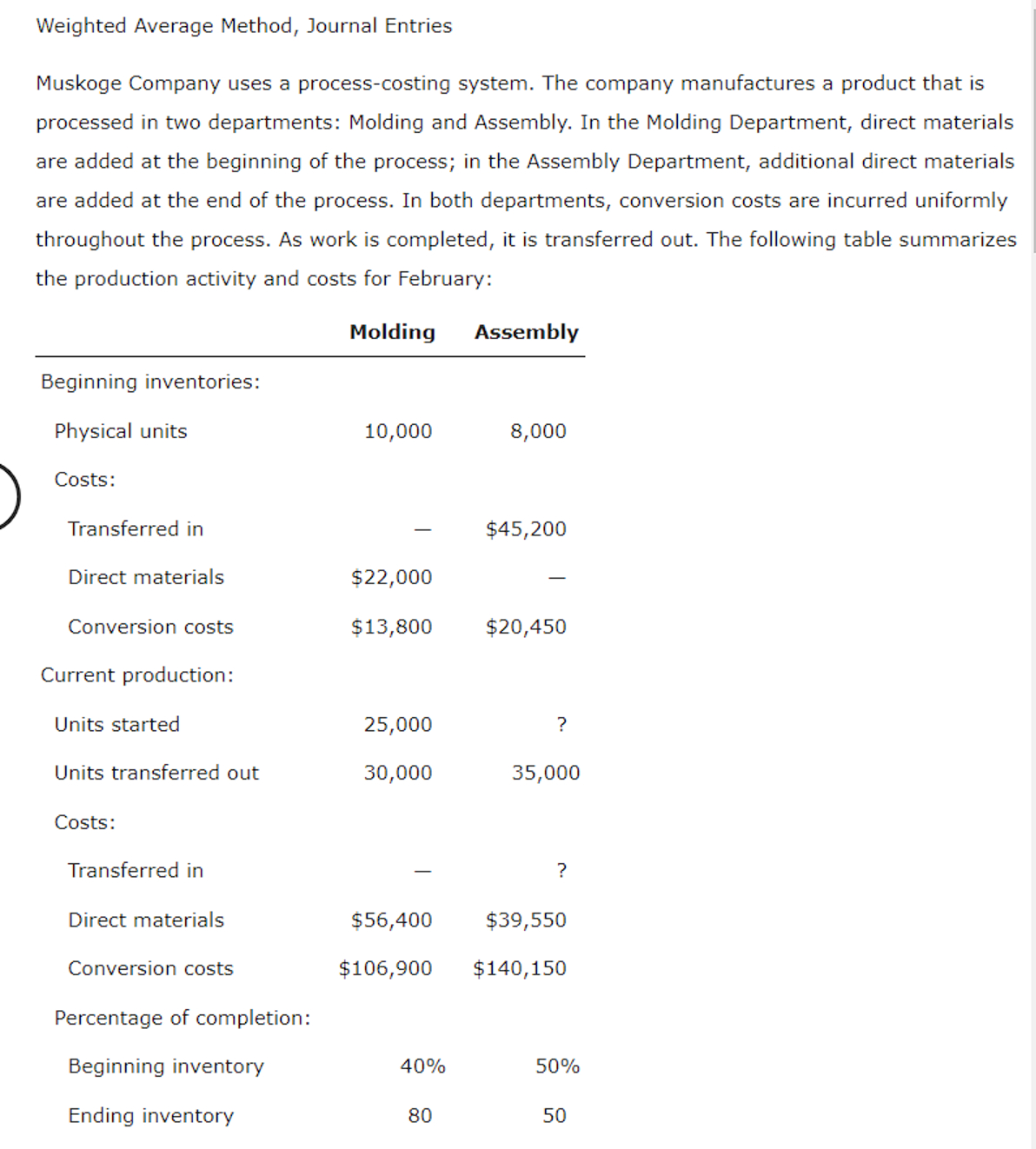
Muskoge Company uses a processcosting system. The company manufactures a product that is
processed in two departments: Molding and Assembly. In the Molding Department, direct materials
are added at the beginning of the process; in the Assembly Department, additional direct materials
are added at the end of the process. In both departments, conversion costs are incurred uniformly
throughout the process. As work is completed, it is transferred out. The following table summarizes
the production activity and costs for February:
Current production:
Costs:
Percentage of completion: Feedback
b An equivalent units calculation
c Calculation of unit costs. Round your intermediate computations and final answer to four
decimal places.
$
per unit d Calculate the cost of ending work in process and cost of goods transferred out. Round your
answers to the nearest dollar.
Cost of ending work in process: $
Cost of goods transferred out: $
e A cost reconciliation. When required, round your answers to the nearest dollar.
Costs to account for:
Check My Work
b To calculate equivalent units, weighted average counts priorperiod output in BWIP as
belonging to the current period. All units are output in the current period.
c Unit cost Unit direct materials cost Unit conversion costs
d Costing out ending work in process is done by computing the cost of each input and
then adding to obtain the total. The valuation of cost of goods transferred out is simplified
as it is the total unit cost multiplied by the units completed.
e Reconciliation is making sure that the costs assigned to goods or services completed
and EWIP are equal to the costs to account for. Prepare journal entries that show the flow of manufacturing costs for the Molding Department.
a Materials are added at the beginning of the process, b conversion costs are recorded, and c
units are transferred to the Assembly Department. When required, round your answers to the
nearest dollar.
a
Work ProcessMolding not
Materials Inventory
b
Work ProcessMolding
Conversion CostsControl
c
Feedback
Check My Work
An example of journal entries showing the flow of costs is illustrated above Exhibit
Repeat Requirements and for the Assembly Department.
a A physical flow schedule:
Assembly Department, Physical flow schedule:
Units to account for:
Units, beginning work in process
Units started in February transferred in
Total units to account for
Units accounted for:
Units completed and transferred out:
Started and completed
From beginning work in process
Units, ending work in process
Total units accounted forb. An equivalent units calculation
Total Equivalent Units
Direct Materials
Conversion Costs
Transferred In
c Calculate the total unit costs. Round your intermediate computations and final answer to
four decimal places.
$ per unit
d Calculate the cost of ending work in process and cost of goods transferred out. Round your
answers to the nearest dollar.
Cost of ending work in process: $
Cost of goods transferred out: $
e A cost reconciliation. If required, round your answers to the nearest dollar.
Costs to account for:
Costs accounted for:
Transferred out
Note: Cost reconciliation totals differ due to rounding error.
Feedback
Check My Work
Read the problem carefully. There are some differences in how the material additions
are accounted for.
Step by Step Solution
There are 3 Steps involved in it
1 Expert Approved Answer
Step: 1 Unlock

Question Has Been Solved by an Expert!
Get step-by-step solutions from verified subject matter experts
Step: 2 Unlock
Step: 3 Unlock