







Question: Welcome to the Lab for Module 5. In this lab we'll be getting a lot of experience in calculating probabilities for Normal distributed random
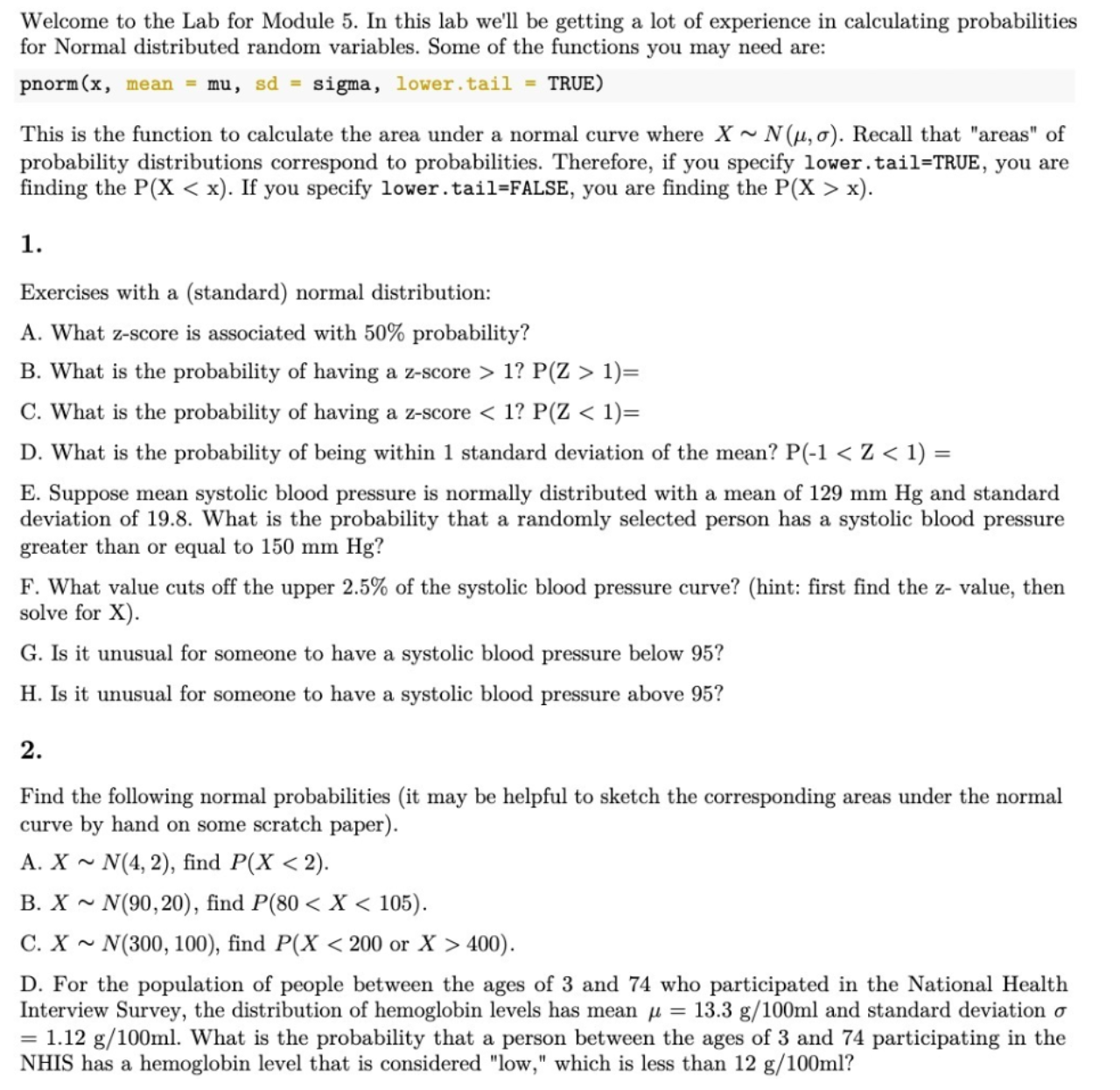
Welcome to the Lab for Module 5. In this lab we'll be getting a lot of experience in calculating probabilities for Normal distributed random variables. Some of the functions you may need are: pnorm(x, mean = mu, sd = sigma, lower.tail = TRUE) This is the function to calculate the area under a normal curve where X~N(,). Recall that "areas" of probability distributions correspond to probabilities. Therefore, if you specify lower.tail=TRUE, you are finding the P(X < x). If you specify lower.tail=FALSE, you are finding the P(X > x). 1. Exercises with a (standard) normal distribution: A. What z-score is associated with 50% probability? B. What is the probability of having a z-score > 1? P(Z > 1)= C. What is the probability of having a z-score < 1? P(Z < 1)= D. What is the probability of being within 1 standard deviation of the mean? P(-1 < Z < 1) = E. Suppose mean systolic blood pressure is normally distributed with a mean of 129 mm Hg and standard deviation of 19.8. What is the probability that a randomly selected person has a systolic blood pressure greater than or equal to 150 mm Hg? F. What value cuts off the upper 2.5% of the systolic blood pressure curve? (hint: first find the z- value, then solve for X). G. Is it unusual for someone to have a systolic blood pressure below 95? H. Is it unusual for someone to have a systolic blood pressure above 95? 2. Find the following normal probabilities (it may be helpful to sketch the corresponding areas under the normal curve by hand on some scratch paper). A. XN(4, 2), find P(X 400). D. For the population of people between the ages of 3 and 74 who participated in the National Health Interview Survey, the distribution of hemoglobin levels has mean = 13.3 g/100ml and standard deviation = 1.12 g/100ml. What is the probability that a person between the ages of 3 and 74 participating in the NHIS has a hemoglobin level that is considered "low," which is less than 12 g/100ml?
Step by Step Solution
There are 3 Steps involved in it

Get step-by-step solutions from verified subject matter experts
 Study Help