Question: Were all the elements required in a negligence suit present? How would you argue for the plaintiff(s)? What evidence would you consider presenting? If you
Were all the elements required in a negligence suit present?
How would you argue for the plaintiff(s)?
What evidence would you consider presenting?
If you were on the jury, what would your findings be based on the facts as presented in the textbook and classroom discussion?
If you found the defendant negligent in a malpractice case, what damages would you award, and for what reasons?
You should use at least two references to support your views.
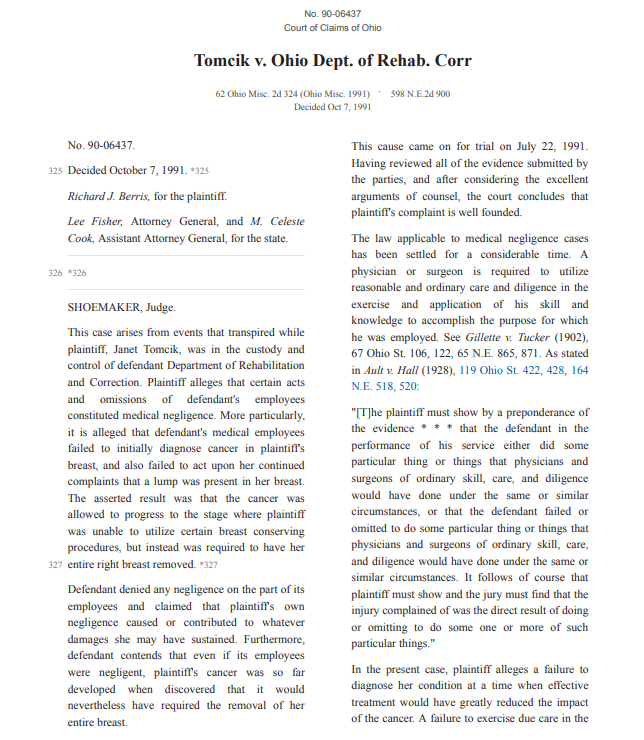
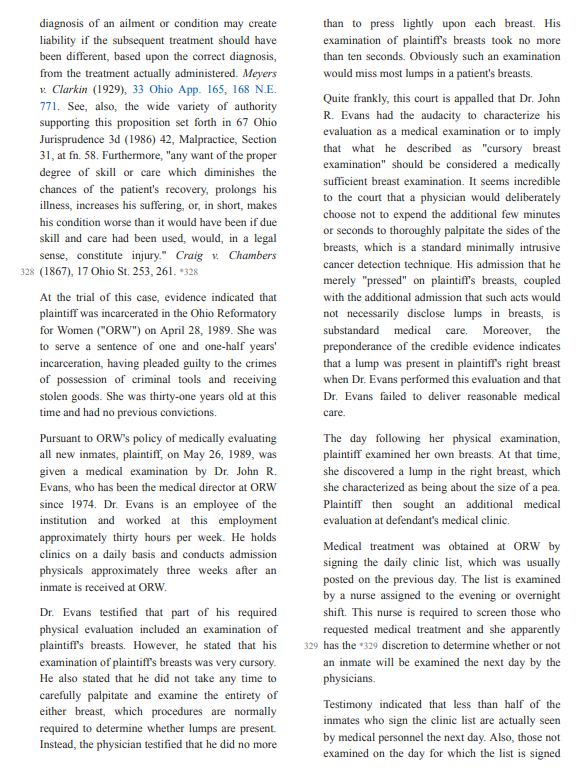
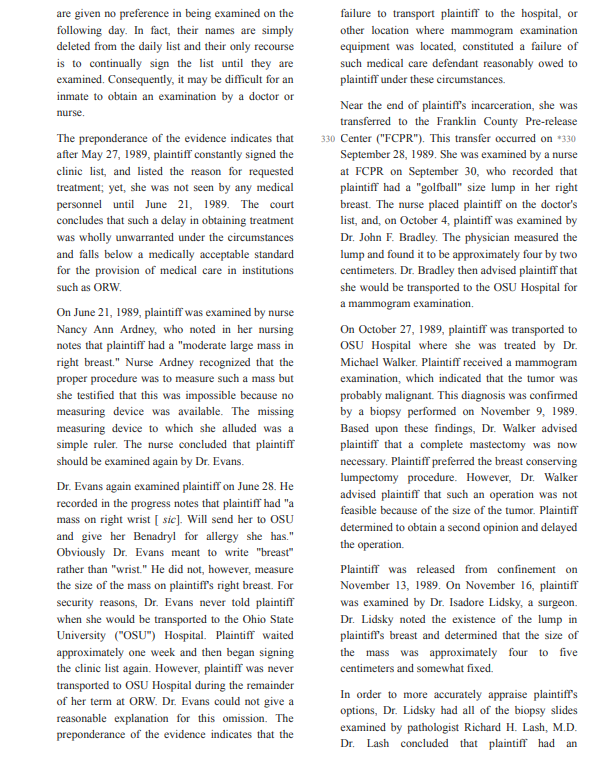
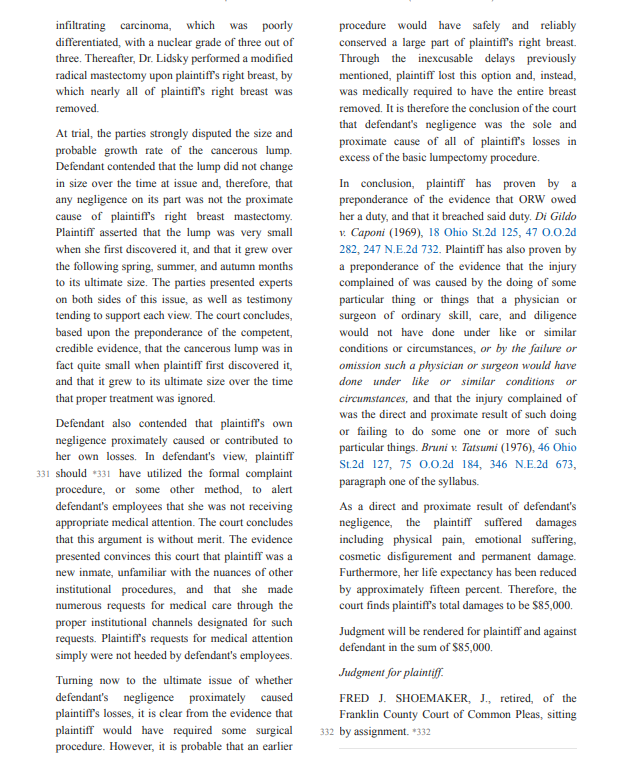
No. 90-06437 Court of Claims of Ohio Tomcik v. Ohio Dept. of Rehab. Corr 62 Ohio Mise. 2d 324 (Ohio Mise. 1991) . 598 N.E.2d 900 Decided Oct 7, 1991 No. 90-06437. This cause came on for trial on July 22, 1991. 325 Decided October 7, 1991. *325 Having reviewed all of the evidence submitted by the parties, and after considering the excellent Richard J. Berris, for the plaintiff. arguments of counsel, the court concludes that Lee Fisher, Attorney General, and M. Celeste plaintiff's complaint is well founded. Cook, Assistant Attorney General, for the state. The law applicable to medical negligence cases has been settled for a considerable time. A 326 *326 physician or surgeon is required to utilize reasonable and ordinary care and diligence in the SHOEMAKER, Judge. exercise and application of his skill and knowledge to accomplish the purpose for which This case arises from events that transpired while he was employed. See Gillette v. Tucker (1902), plaintiff, Janet Tomcik, was in the custody and 67 Ohio St. 106, 122, 65 N.E. 865, 871. As stated control of defendant Department of Rehabilitation in Ault v. Hall (1928), 119 Ohio St. 422, 428, 164 and Correction. Plaintiff alleges that certain acts N.E. 518, 520: and omissions of defendant's employees constituted medical negligence. More particularly, "[The plaintiff must show by a preponderance of it is alleged that defendant's medical employees the evidence * * * that the defendant in the failed to initially diagnose cancer in plaintiff's performance of his service either did some breast, and also failed to act upon her continued particular thing or things that physicians and complaints that a lump was present in her breast. surgeons of ordinary skill, care, and diligence The asserted result was that the cancer was would have done under the same or similar allowed to progress to the stage where plaintiff circumstances, or that the defendant failed or was unable to utilize certain breast conserving omitted to do some particular thing or things that procedures, but instead was required to have her physicians and surgeons of ordinary skill, care, 327 entire right breast removed. *327 and diligence would have done under the same or similar circumstances. It follows of course that Defendant denied any negligence on the part of its plaintiff must show and the jury must find that the employees and claimed that plaintiff's own injury complained of was the direct result of doing negligence caused or contributed to whatever or omitting to do some one or more of such damages she may have sustained. Furthermore, particular things." defendant contends that even if its employees were negligent, plaintiff's cancer was so far In the present case, plaintiff alleges a failure to developed when discovered that it would diagnose her condition at a time when effective nevertheless have required the removal of her treatment would have greatly reduced the impact entire breast of the cancer. A failure to exercise due care in thediagnosis of an ailment or condition may create liability if the subsequent treatment should have been different, based upon the correct diagnosis, from the treatment actually administered. Mevers v Clarkin (1929), 33 Ohio App. 165, 168 N.E. 771, See, also, the wide variety of authority supporting this proposition set forth in 67 Ohio Jurisprudence 3d (1986) 42, Malpractice, Section 31, at fn. 58. Furthermore, "any want of the proper degree of skill or care which dimimshes the chances of the patient's recovery, prolongs his illness, increases his suffering, or, in short, makes his condition worse than it would have been if due skill and care had been used, would, in a legal sense, constitute injury.\" Craig v Chombers (1867), 17 Ohio St. 253, 261. =328 At the trial of this cage, evidence indicated that plaintiff was ncarcerated in the Ohio Reformatory for Women ("ORW") on April 28, 1989, She was to serve a senfence of one and one-half years' incarceration, having pleaded guilty to the crimes of possession of criminal tools and receiving stolen goods. She was thirty-one years old at this time and had no previous convictions. Pursuant to ORW's policy of medically evaluating all new inmates, plaintiff, on May 26, 1989, was given a medical examination by Dr. John R. Evans, who has been the medical director at ORW simce 1974, Dr. Evans is an employee of the institution and worked at this employment approximately thirty hours per week. He holds clinics on a daily basis and conducts admission physicals approximately three weeks after an inmate is received at ORW. Dr. Evans testified that part of his required physical evaluation included an examination of plaintiff's breasts. However, he stated that his examination of plaintiff's breasts was very cursory. He also stated that he did not take any lime to carefully palpitate and examine the entirety of either breast, which procedures are normally required to determine whether lumps are present Instead, the physician testified that he did no more 39 than to press lightly wpon each breast His examination of plaintiff's breasts ook no more than ten seconds. Obviously such an examination would miss most lumps in a patient's breasts, Quite frankly, this court is appalled that Dr. John R. Evans had the audacity to characterize his evaluation as a medical examination or o imply that what he described as \"cursory breast examination\" should be considered a medically sufficient breast examination. It seems incredible to the court that a physician would deliberately choose not to expend the additional few minuates or seconds to thoroughly palpitate the sides of the breasts, which is a standard minimally intrusive cancer detection technique. His admission that he merely "pressed\" on plaintiffs breasts, coupled with the additional admission that such acts would ol necessanly disclose lumps in breasts, is substandard medical care. Moreover, the preponderance of the credible evidence indicates that a lump was present in plaintiffs right breast when D, Evans performed this evaluation and that Dr. Evans failed to deliver reasonable medical care. The day following her physical examination, plaintiff examined her own breasts. At that time, she discovered a lump in the right breast, which she characterized as being about the size of a pea. Plaintiff then sought an additional medical evaluation at defendant's medical clinic. Medical treatment was oblained at ORW by sigrang the daily clinic list, which was usually posted on the previous day. The list is examined by a nurse assigned to the evening or overnight shift. This nurse is required to screen those who requested medical treatment and she apparently has the *129 discretion to determine whether or not an mmate will be examined the next day by the physicians. Testimony indicated that less than half of the inmates who sign the clinic list are actually seen by medical personnel the next day. Also, those not examined on the day for which the list is signed are given no preference in being examined on the failure to transport plaintiff to the hospital, or following day. In fact, their names are simply other location where mammogram examination deleted from the daily list and their only recourse equipment was located, constituted a failure of is to continually sign the list until they are such medical care defendant reasonably owed to examined. Consequently, it may be difficult for an plaintiff under these circumstances. inmate to obtain an examination by a doctor or nurse. Near the end of plaintiff's incarceration, she was transferred to the Franklin County Pre-release The preponderante of the evidence indicates that 330 Center ("FCPR"). This transfer occurred on *330 after May 27, 1989, plaintiff constantly signed the September 28, 1989. She was examined by a nurse clinic list, and listed the reason for requested at FCPR on September 30, who recorded that treatment; yet, she was not seen by any medical plaintiff had a "golfball" size lump in her right personnel until June 21, 1989. The court breast. The nurse placed plaintiff on the doctor's concludes that such a delay in obtaining treatment list, and, on October 4, plaintiff was examined by was wholly unwarranted under the circumstances Dr. John F. Bradley. The physician measured the and falls below a medically acceptable standard lump and found it to be approximately four by two for the provision of medical care in institutions centimeters. Dr. Bradley then advised plaintiff that such as ORW. she would be transported to the OSU Hospital for a mammogram examination. On June 21, 1989, plaintiff was examined by nurse Nancy Ann Ardney, who noted in her nursing On October 27, 1989, plaintiff was transported to notes that plaintiff had a "moderate large mass in OSU Hospital where she was treated by Dr. right breast." Nurse Ardney recognized that the Michael Walker. Plaintiff received a mammogram proper procedure was to measure such a mass but examination, which indicated that the tumor was she testified that this was impossible because no probably malignant. This diagnosis was confirmed measuring device was available. The missing by a biopsy performed on November 9, 1989 measuring device to which she alluded was a Based upon these findings, Dr. Walker advised simple ruler. The nurse concluded that plaintiff plaintiff that a complete mastectomy was now should be examined again by Dr. Evans. necessary. Plaintiff preferred the breast conserving Dr. Evans again examined plaintiff on June 28. He lumpectomy procedure. However, Dr. Walker advised plaintiff that such an operation was not recorded in the progress notes that plaintiff had "a feasible because of the size of the tumor. Plaintiff mass on right wrist [ sic]. Will send her to OSU and give her Benadryl for allergy she has." determined to obtain a second opinion and delayed Obviously Dr. Evans meant to write "breast" the operation. rather than "wrist." He did not, however, measure Plaintiff was released from confinement on the size of the mass on plaintiff's right breast. For November 13, 1989. On November 16, plaintiff security reasons, Dr. Evans never told plaintiff was examined by Dr. Isadore Lidsky, a surgeon. when she would be transported to the Ohio State Dr. Lidsky noted the existence of the lump in University ("OSU") Hospital. Plaintiff waited plaintiff's breast and determined that the size of approximately one week and then began signing the mass was approximately four to five the clinic list again. However, plaintiff was never centimeters and somewhat fixed. transported to OSU Hospital during the remainder of her term at ORW. Dr. Evans could not give a In order to more accurately appraise plaintiff's reasonable explanation for this omission. The options, Dr. Lidsky had all of the biopsy slides preponderance of the evidence indicates that the examined by pathologist Richard H. Lash, M.D. Dr. Lash concluded that plaintiff had aninfiltrating carcinoma, which was poorly procedure would have safely and reliably differentiated, with a nuclear grade of three out of conserved a large part of plaintiff's right breast. three. Thereafter, Dr. Lidsky performed a modified Through the inexcusable delays previously radical mastectomy upon plaintiff's right breast, by mentioned, plaintiff lost this option and, instead, which nearly all of plaintiff's right breast was was medically required to have the entire breast removed. removed. It is therefore the conclusion of the court that defendant's negligence was the sole and At trial, the parties strongly disputed the size and proximate cause of all of plaintiff's losses in probable growth rate of the cancerous lump. excess of the basic lumpectomy procedure. Defendant contended that the lump did not change in size over the time at issue and, therefore, that In conclusion, plaintiff has proven by a any negligence on its part was not the proximate preponderance of the evidence that ORW owed cause of plaintiff's right breast mastectomy. her a duty, and that it breached said duty. Di Gildo Plaintiff asserted that the lump was very small v. Caponi (1969), 18 Ohio St.2d 125, 47 0.0.2d when she first discovered it, and that it grew over 282, 247 N.E.2d 732. Plaintiff has also proven by the following spring summer, and autumn months a preponderance of the evidence that the injury to its ultimate size. The parties presented experts complained of was caused by the doing of some on both sides of this issue, as well as testimony particular thing or things that a physician or tending to support each view. The court concludes, surgeon of ordinary skill, care, and diligence based upon the preponderante of the competent, would not have done under like or similar credible evidence, that the cancerous lump was in conditions or circumstances, or by the failure or fact quite small when plaintiff first discovered it, omission such a physician or surgeon would have and that it grew to its ultimate size over the time done under like or similar conditions or that proper treatment was ignored circumstances, and that the injury complained of was the direct and proximate result of such doing Defendant also contended that plaintiff's own or failing to do some one or more of such negligence proximately caused or contributed to her own losses. In defendant's view, plaintiff particular things. Bruni v Tatsumi (1976), 46 Ohio St.2d 127, 75 0.0.2d 184, 346 N.E.2d 673, 331 should *331 have utilized the formal complaint procedure, or some other method, to alert paragraph one of the syllabus. defendant's employees that she was not receiving As a direct and proximate result of defendant's appropriate medical attention. The court concludes negligence, the plaintiff suffered damages that this argument is without merit. The evidence including physical pain, emotional suffering, presented convinces this court that plaintiff was a cosmetic disfigurement and permanent damage. new inmate, unfamiliar with the nuances of other Furthermore, her life expectancy has been reduced institutional procedures, and that she made by approximately fifteen percent. Therefore, the numerous requests for medical care through the court finds plaintiff's total damages to be $85,000. proper institutional channels designated for such requests. Plaintiff's requests for medical attention Judgment will be rendered for plaintiff and against simply were not heeded by defendant's employees. defendant in the sum of $85,000. Turning now to the ultimate issue of whether Judgment for plaintiff. defendant's negligence proximately caused FRED J. SHOEMAKER, J., retired, of the plaintiff's losses, it is clear from the evidence that Franklin County Court of Common Pleas, sitting plaintiff would have required some surgical 332 by assignment. *332 procedure. However, it is probable that an earlier
Step by Step Solution
There are 3 Steps involved in it
1 Expert Approved Answer
Step: 1 Unlock
Question Has Been Solved by an Expert!
Get step-by-step solutions from verified subject matter experts
Step: 2 Unlock
Step: 3 Unlock
Students Have Also Explored These Related Law Questions!