



Question: We've noted in class that non-reactive (aka refractory) compounds in wastewater can accumulate in the wasted sludge. Heavy metals, for example, can affect final sludge
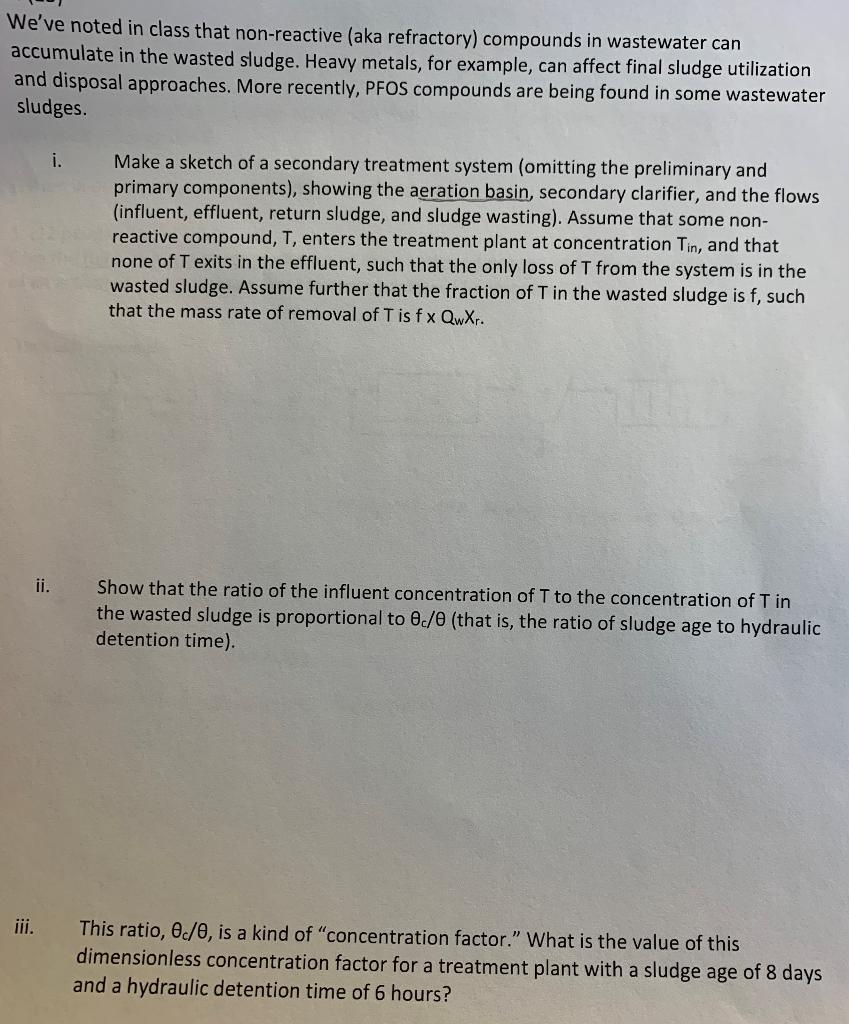
We've noted in class that non-reactive (aka refractory) compounds in wastewater can accumulate in the wasted sludge. Heavy metals, for example, can affect final sludge utilization and disposal approaches. More recently, PFOS compounds are being found in some wastewater sludges. i. Make a sketch of a secondary treatment system (omitting the preliminary and primary components), showing the aeration basin, secondary clarifier, and the flows (influent, effluent, return sludge, and sludge wasting). Assume that some nonreactive compound, T, enters the treatment plant at concentration Tin, and that none of T exits in the effluent, such that the only loss of T from the system is in the wasted sludge. Assume further that the fraction of T in the wasted sludge is f, such that the mass rate of removal of T is fQwXr. ii. Show that the ratio of the influent concentration of T to the concentration of T in the wasted sludge is proportional to c/ (that is, the ratio of sludge age to hydraulic detention time). iii. This ratio, c/, is a kind of "concentration factor." What is the value of this dimensionless concentration factor for a treatment plant with a sludge age of 8 days and a hydraulic detention time of 6 hours
Step by Step Solution
There are 3 Steps involved in it

Get step-by-step solutions from verified subject matter experts