







Question: We've studied the electric fields created by point charges, line charges, surface charges, and charged spherical shells. In addition to the charged spherical shell, another
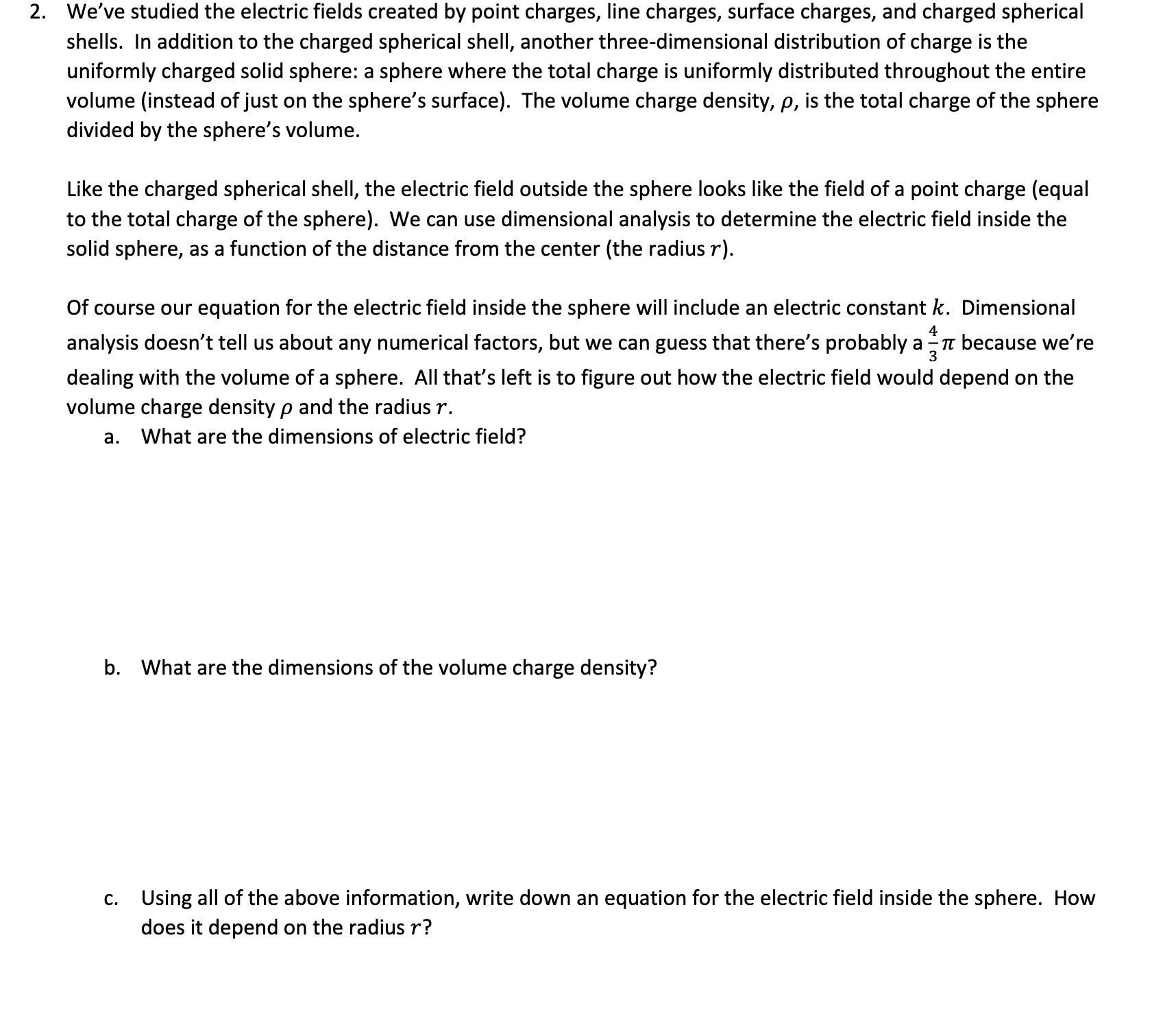
We've studied the electric fields created by point charges, line charges, surface charges, and charged spherical shells. In addition to the charged spherical shell, another three-dimensional distribution of charge is the uniformly charged solid sphere: a sphere where the total charge is uniformly distributed throughout the entire volume (instead ofjust on the sphere's surface). The volume charge density, p, is the total charge of the sphere divided by the sphere's volume. Like the charged spherical shell, the electric field outside the sphere looks like the field of a point charge (equal to the total charge of the sphere). We can use dimensional analysis to determine the electric field inside the solid sphere, as a function of the distance from the center (the radius r). Of course our equation for the electric field inside the sphere will include an electric constant k. Dimensional . . 4 analysrs doesn't tell us about any numerical factors, but we can guess that there's probably a 51: because we're dealing with the volume of a sphere. All that's left is to figure out how the electric field would depend on the volume charge density p and the radius r. a. What are the dimensions of electric field? b. What are the dimensions of the volume charge density? c. Using all of the above information, write down an equation for the electric field inside the sphere. How does it depend on the radius r
Step by Step Solution
There are 3 Steps involved in it

Get step-by-step solutions from verified subject matter experts
 Study Help