


Question: What are the answer to these questions Part 2 - Composite Cone Hazards Locate Johnston Ridge Observatory in Figure 5.5 of Lab 5 - Volcanoes

What are the answer to these questions
What are the answer to these questions Part 2 -
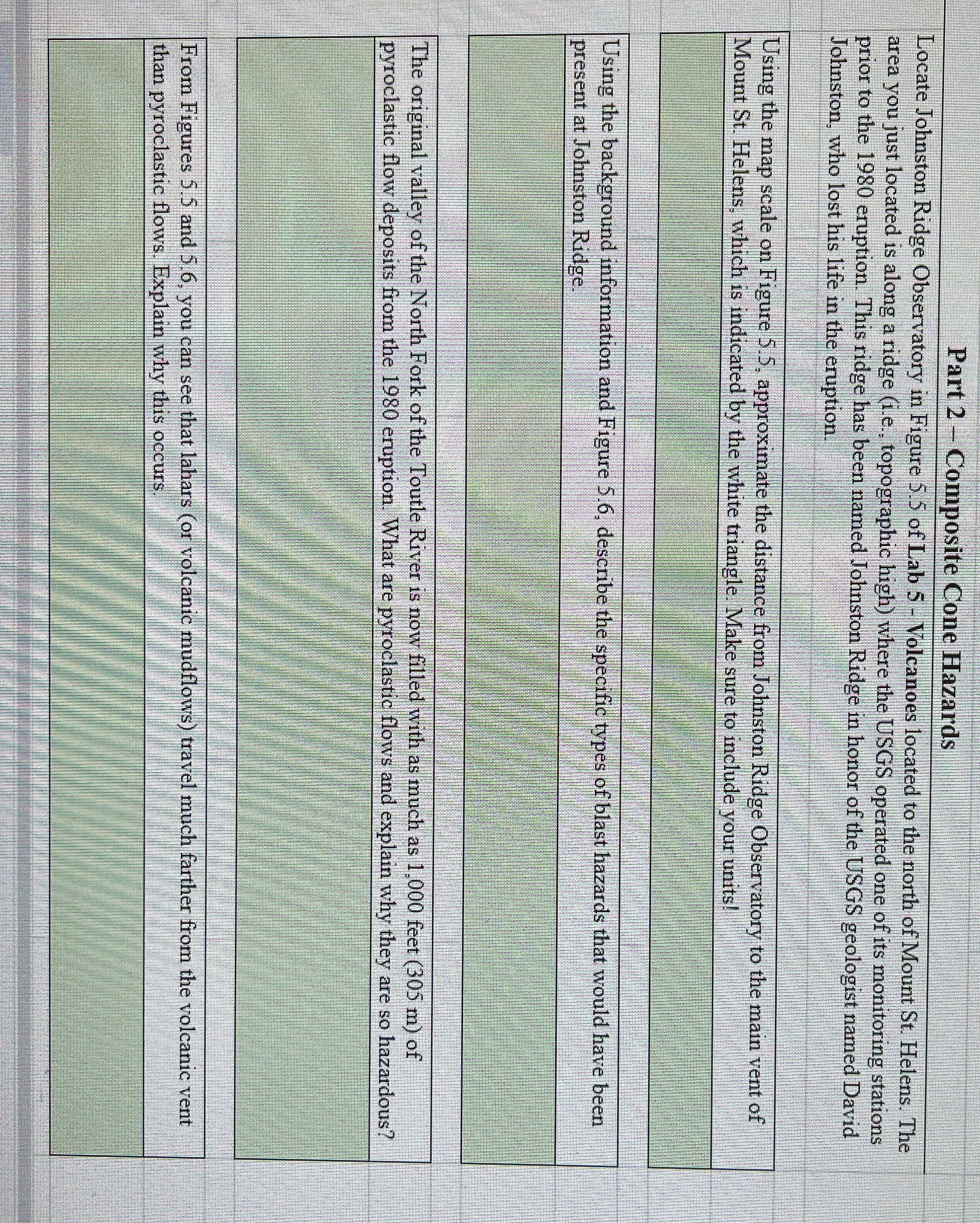
Part 2 - Composite Cone Hazards Locate Johnston Ridge Observatory in Figure 5.5 of Lab 5 - Volcanoes located to the north of Mount St. Helens. The area you just located is along a ridge (i.e., topographic high) where the USGS operated one of its monitoring stations prior to the 1980 eruption. This ridge has been named Johnston Ridge in honor of the USGS geologist named David Johnston. who lost his life in the eruption. Using the map scale on Figure 5.5, approximate the distance from Johnston Ridge Observatory to the main vent of Mount St. Helens, which is indicated by the white triangle. Make sure to include your units! Using the background information and Figure 5.6, describe the specific types of blast hazards that would have been present at Johnston Ridge. The original valley of the North Fork of the Toutle River is now filled with as much as 1,000 feet (305 m) of pyroclastic flow deposits from the 1980 eruption. What are pyroclastic flows and explain why they are so hazardous? From Figures 5.5 and 5.6, you can see that lahars (or volcanic mudflows) travel much farther from the volcanic vent than pyroclastic flows. Explain why this occurs

Step by Step Solution

There are 3 Steps involved in it

1 Expert Approved Answer
Step: 1 Unlock blur-text-image

Question Has Been Solved by an Expert!

Get step-by-step solutions from verified subject matter experts

Step: 2 Unlock
Step: 3 Unlock

Students Have Also Explored These Related Accounting Questions!