







Question: What are the basic features of a network operating system? (100-200 words). 2. Describe resolution procedures that could be followed to address server compatibility.

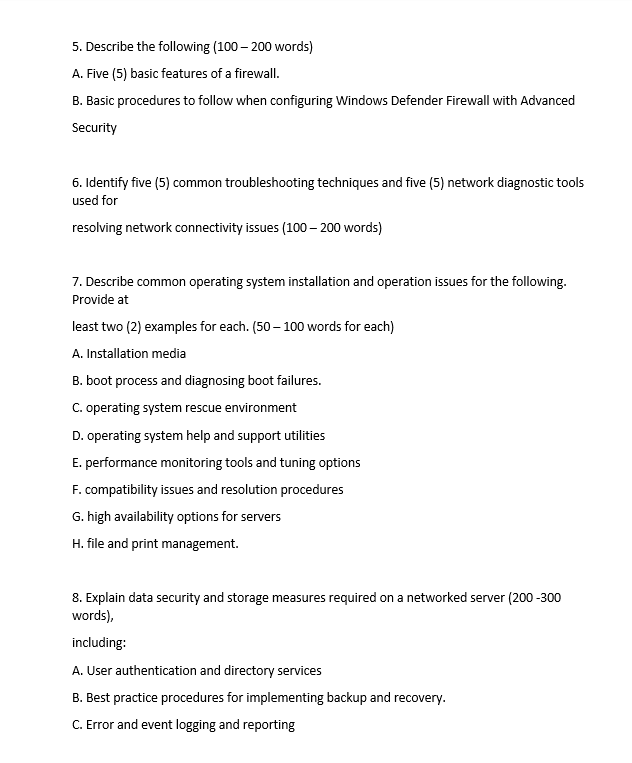
What are the basic features of a network operating system? (100-200 words). 2. Describe resolution procedures that could be followed to address server compatibility. (100-200 words) 3. Explain the purpose and the main configuration tasks for the following NOS roles. (100- 200 words for each). A. Domain Name System (DNS) B. Dynamic Host Configuration Protocol (DHCP) C. File Transfer Protocol (FTP) D. Mail (SMTP) E. Network Time Protocol (NTP) F. Network Policy Server (NPS) G. File and Storage Services (Server messages block (SMB)) H. Web (IIS) 4. Explain the following service statuses regarding network service management (100-200 words): A. Start B. Stop C. Restart D. Start on boot. 5. Describe the following (100-200 words) A. Five (5) basic features of a firewall. B. Basic procedures to follow when configuring Windows Defender Firewall with Advanced Security 6. Identify five (5) common troubleshooting techniques and five (5) network diagnostic tools used for resolving network connectivity issues (100-200 words) 7. Describe common operating system installation and operation issues for the following. Provide at least two (2) examples for each. (50-100 words for each) A. Installation media B. boot process and diagnosing boot failures. C. operating system rescue environment D. operating system help and support utilities E. performance monitoring tools and tuning options F. compatibility issues and resolution procedures G. high availability options for servers H. file and print management. 8. Explain data security and storage measures required on a networked server (200-300 words), including: A. User authentication and directory services B. Best practice procedures for implementing backup and recovery. C. Error and event logging and reporting
Step by Step Solution
There are 3 Steps involved in it
1 Basic features of a network operating system Centralized management and control of network resources User and group account management Shared file and folder access Printer and other device manageme... View full answer

Get step-by-step solutions from verified subject matter experts
 Study Help