







Question: what are the four basic elements for establishing performance standards? Please explain in detail. Chapter 8 Performance Management 307 Strategic Relevance Strategic relevance refers to
what are the four basic elements for establishing performance standards? Please explain in detail.
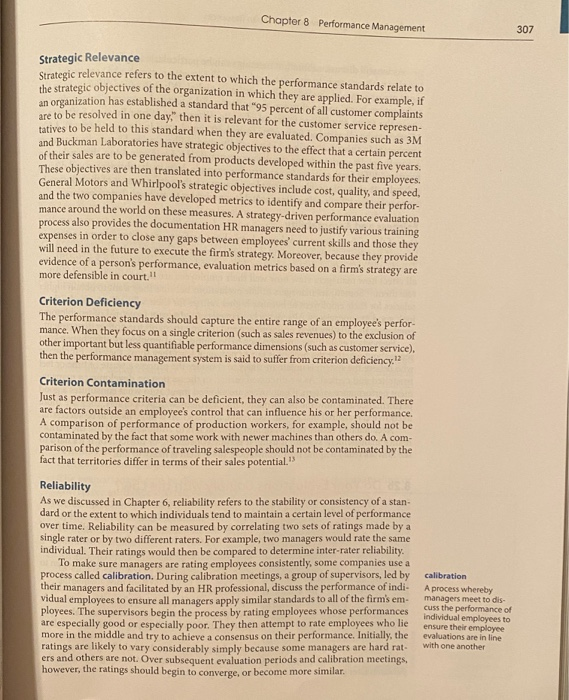
Chapter 8 Performance Management 307 Strategic Relevance Strategic relevance refers to the extent to which the performance standards relate to the strategic objectives of the organization in which they are applied. For example, if an organization has established a standard that "95 percent of all customer complaints are to be resolved in one day, then it is relevant for the customer service represen- tatives to be held to this standard when they are evaluated. Companies such as 3M and Buckman Laboratories have strategic objectives to the effect that a certain percent of their sales are to be generated from products developed within the past five years. These objectives are then translated into performance standards for their employees. General Motors and Whirlpool's strategic objectives include cost, quality, and speed, and the two companies have developed metrics to identify and compare their perfor- mance around the world on these measures. A strategy-driven performance evaluation process also provides the documentation HR managers need to justify various training expenses in order to close any gaps between employees' current skills and those they will need in the future to execute the firm's strategy. Moreover, because they provide evidence of a person's performance, evaluation metrics based on a firm's strategy are more defensible in court." Criterion Deficiency The performance standards should capture the entire range of an employee's perfor mance. When they focus on a single criterion (such as sales revenues) to the exclusion of other important but less quantifiable performance dimensions (such as customer service). then the performance management system is said to suffer from criterion deficiency Criterion Contamination Just as performance criteria can be deficient, they can also be contaminated. There are factors outside an employee's control that can influence his or her performance. A comparison of performance of production workers, for example, should not be contaminated by the fact that some work with newer machines than others do. A com- parison of the performance of traveling salespeople should not be contaminated by the fact that territories differ in terms of their sales potential." Reliability As we discussed in Chapter 6, reliability refers to the stability or consistency of a stan dard or the extent to which individuals tend to maintain a certain level of performance over time. Reliability can be measured by correlating two sets of ratings made by a Single rater or by two different raters. For example, two managers would rate the same individual. Their ratings would then be compared to determine inter-rater reliability To make sure managers are rating employees consistently, some companies use a process called calibration. During calibration meetings, a group of supervisors, led by their managers and facilitated by an HR professional, discuss the performance of indi. vidual employees to ensure all managers apply similar standards to all of the firm's em ployees. The supervisors begin the process by rating employees whose performances are especially good or especially poor. They then attempt to rate employees who lie more in the middle and try to achieve a consensus on their performance. Initially, the ratings are likely to vary considerably simply because some managers are hard rat ers and others are not. Over subsequent evaluation periods and calibration meetings, however, the ratings should begin to converge, or become more similar. calibration A process whereby managers meet to dis- cuss the performance of individual employees to ensure their employee evaluations are in line with one another Step by Step Solution
There are 3 Steps involved in it
1 Expert Approved Answer
Step: 1 Unlock

Question Has Been Solved by an Expert!
Get step-by-step solutions from verified subject matter experts
Step: 2 Unlock
Step: 3 Unlock
 Study Help