







Question: What are the implications of a phase gradient Vo(a), e.g. the phase at one end of a super- conducting sample (L) is different to
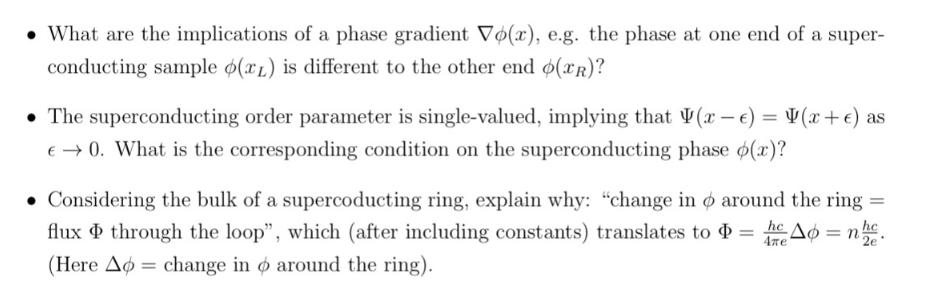
What are the implications of a phase gradient Vo(a), e.g. the phase at one end of a super- conducting sample (L) is different to the other end o(R)? The superconducting order parameter is single-valued, implying that V(x e) = v(x+e) as 0. What is the corresponding condition on the superconducting phase (x)? Considering the bulk of a supercoducting ring, explain why: "change in o around the ring = flux through the loop", which (after including constants) translates to = c Are = n =n. = (Here A change in o around the ring).
Step by Step Solution
There are 3 Steps involved in it
1 Expert Approved Answer
Step: 1 Unlock

Question Has Been Solved by an Expert!
Get step-by-step solutions from verified subject matter experts
Step: 2 Unlock
Step: 3 Unlock
 Study Help