Question: What are the key differences between relationship and task conflict? Why is task conflict more productive in groups than relationship conflict, and what are some
What are the key differences between relationship and task conflict? Why is task conflict more productive in groups than relationship conflict, and what are some of the ways to turn relationship conflict into task conflict for the greater good of the group?
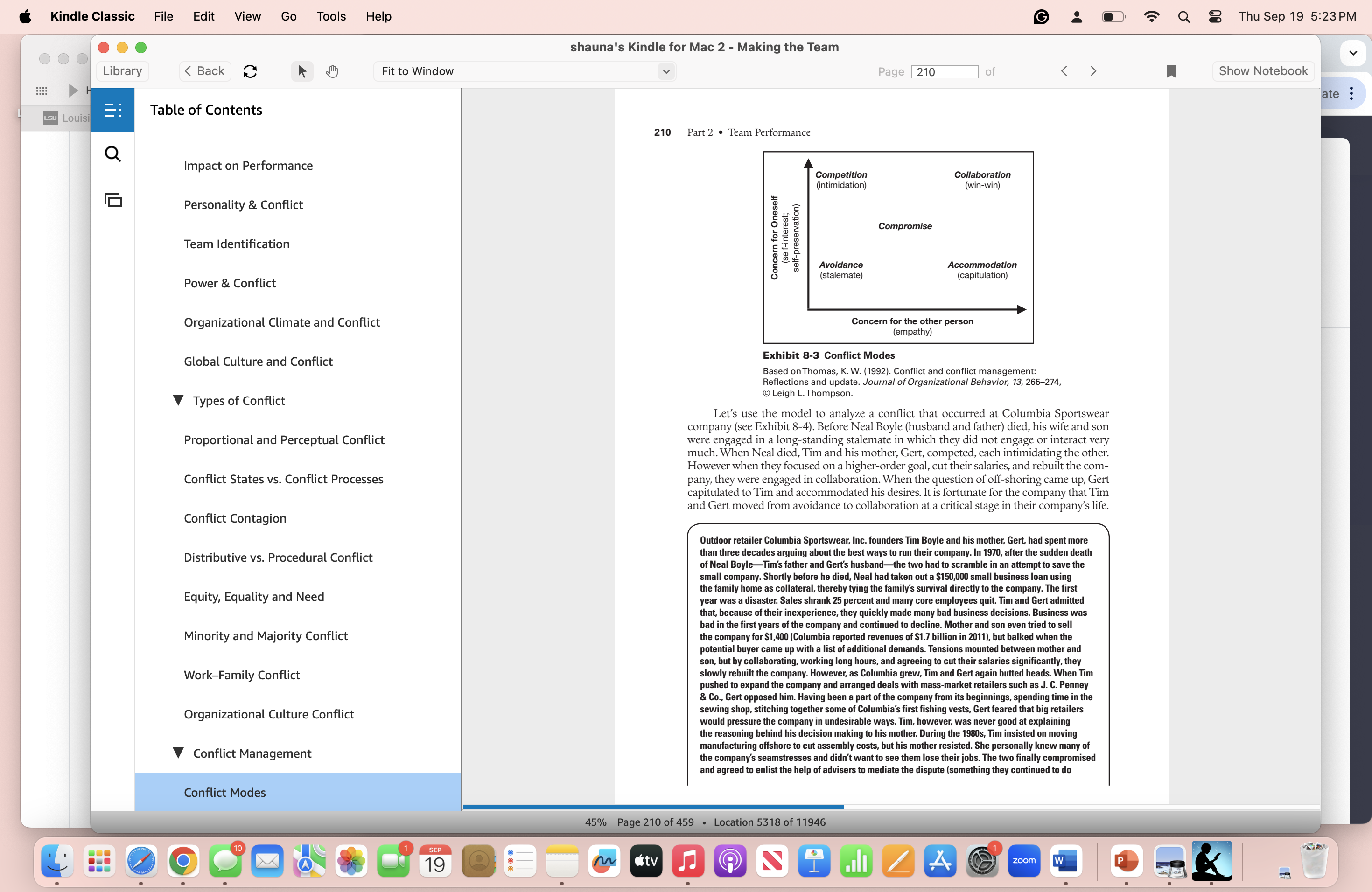
What are the main courses of action team members take when confronted with conflict? Think of a conflict that occurred in a team you were a part of and analyze it according to the Conflict Mode Model (Exhibit 8-3 in Textbook).
What interventions can be used to improve the quality of conflict a team is experiencing?
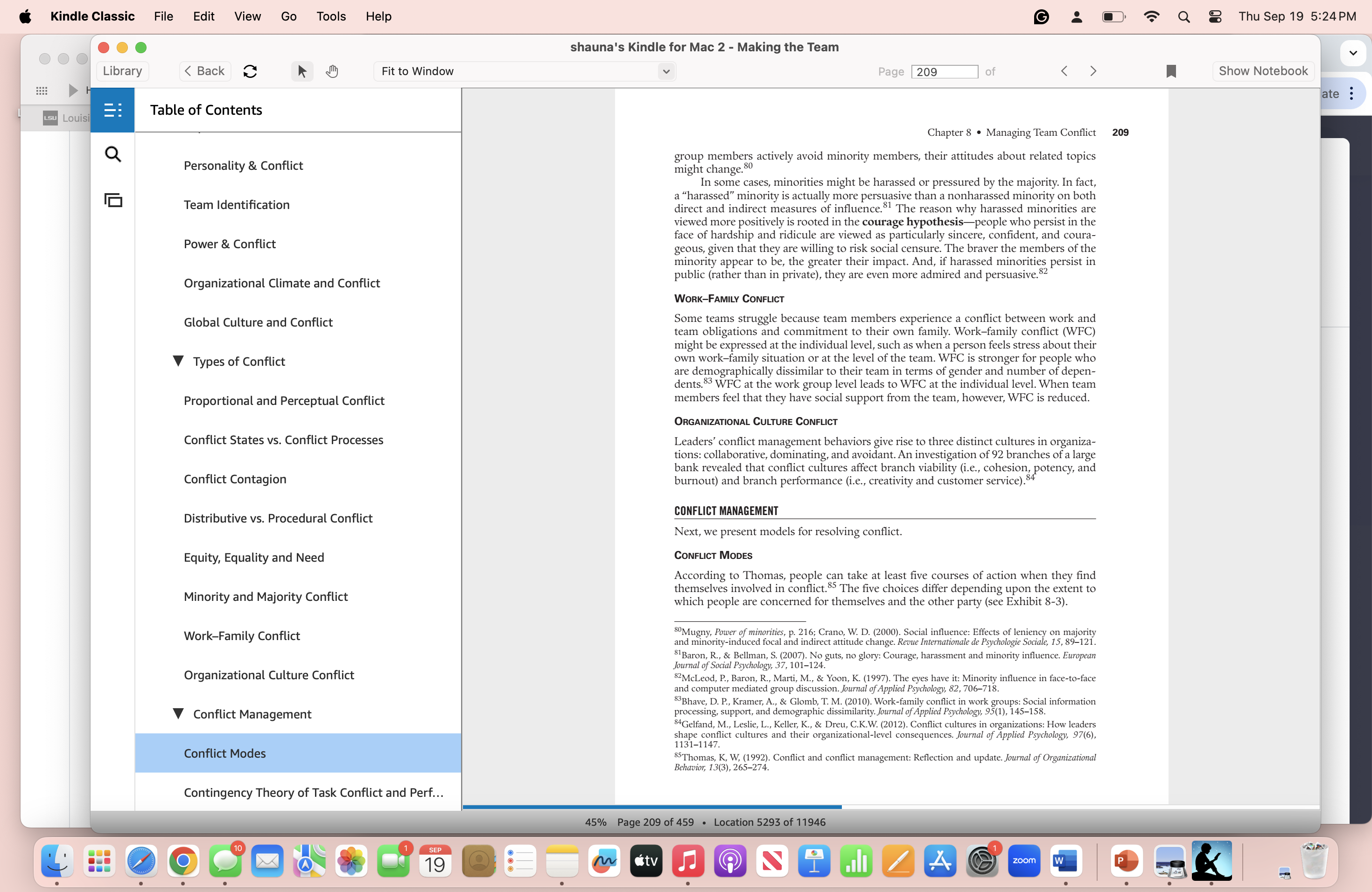
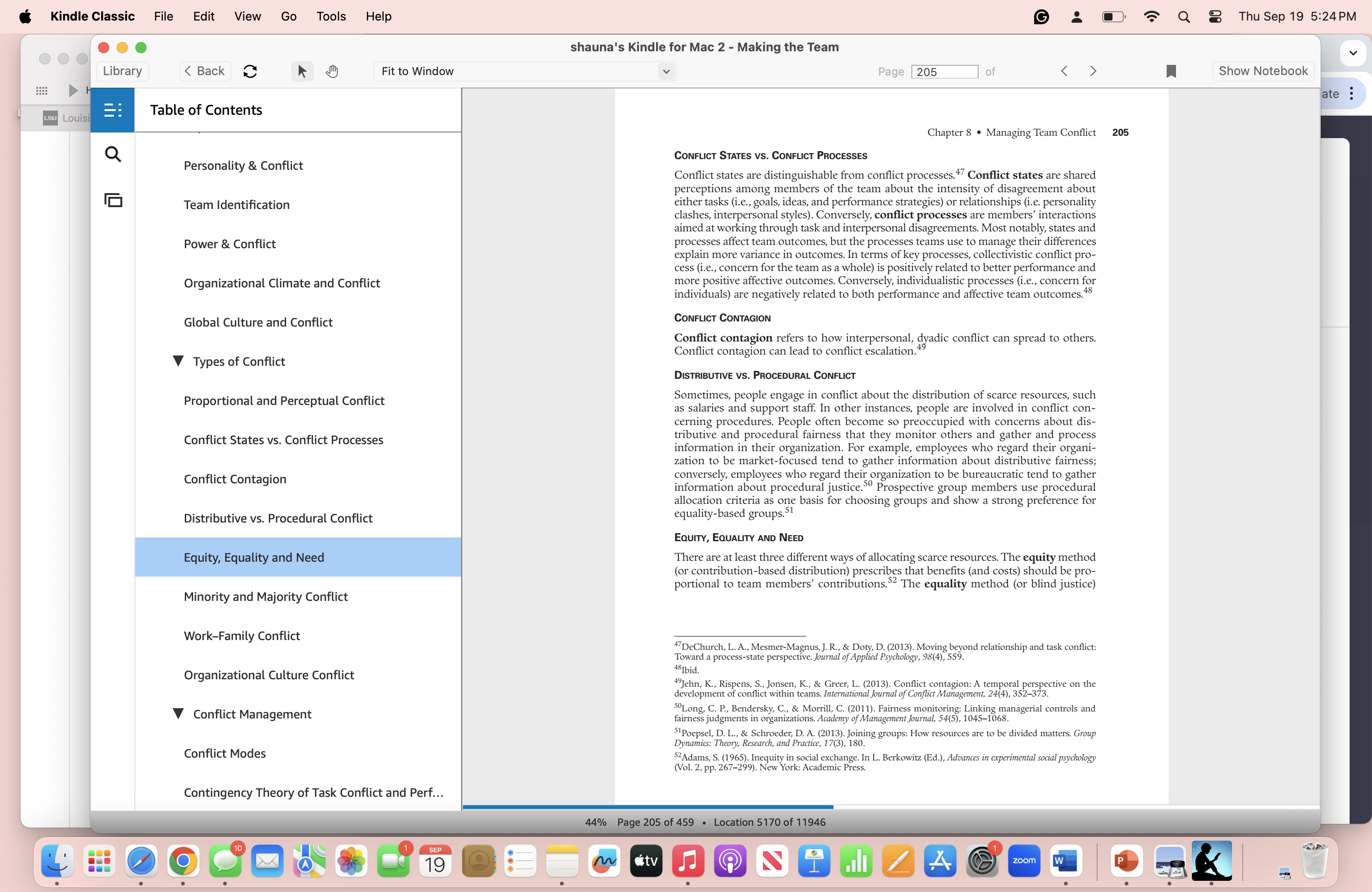
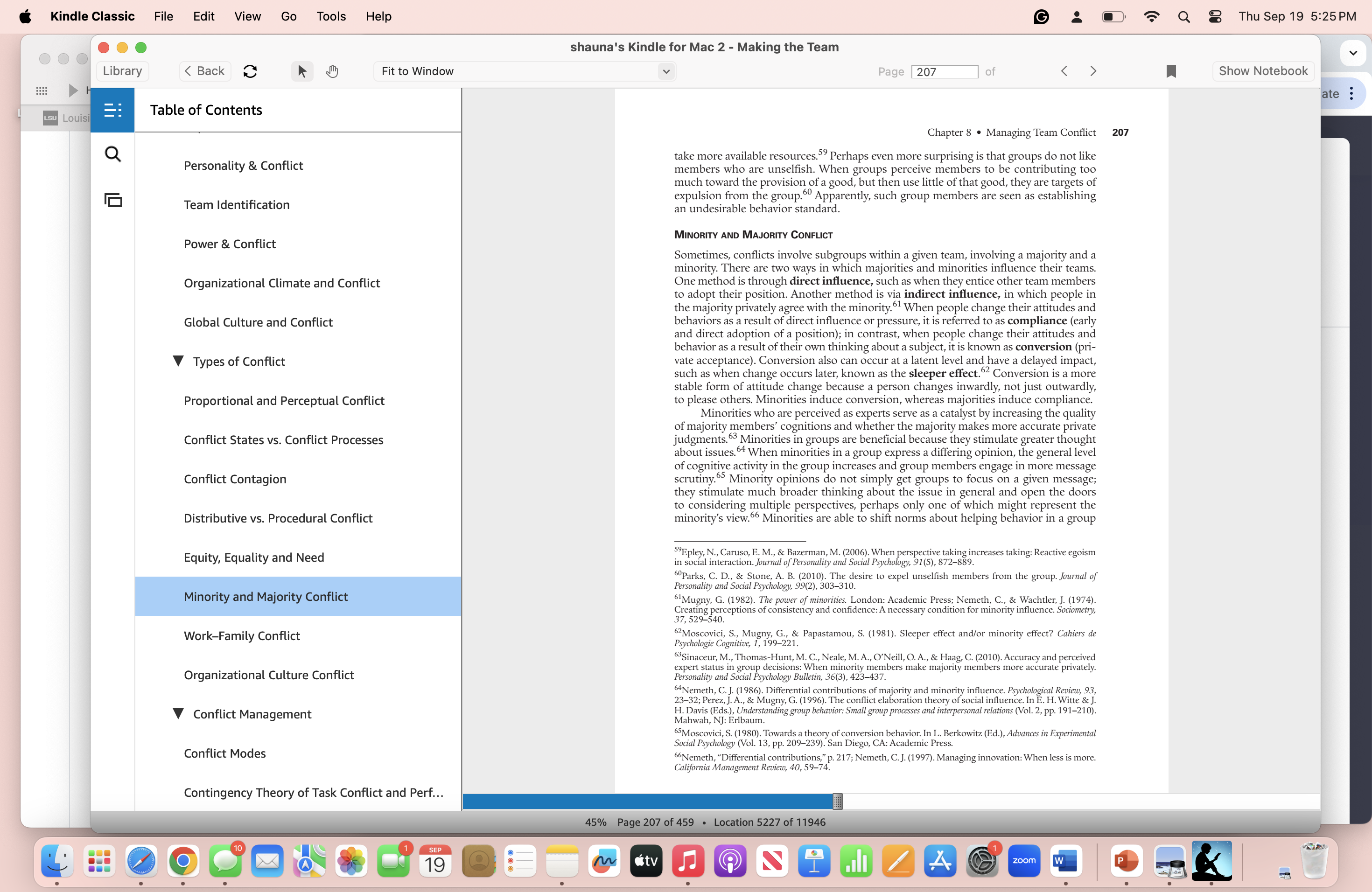
@ KindleClassic File Edit View Go Tools Help 2 ) % Q & ThuSep19 5:23PM o shauna's Kindle for Mac 2 - Making the Team " Library = Luui;= Table of Contents Impact on Performance Personality & Conflict Team Identification Power & Conflict Organizational Climate and Conflict Global Culture and Conflict V Types of Conflict Proportional and Perceptual Conflict Conflict States vs. Conflict Processes Conflict Contagion Distributive vs. Procedural Conflict Equity, Equality and Need Minority and Majority Conflict Work-Family Conflict Organizational Culture Conflict V Conflict Management Conflict Modes Part 2 Team Performance Competition Collaboration (intimidation) (win-win) Compromise Avoidance Accommodation (stalemate) (capitulation) Concern for Oneself (self-interest; self-preservation) Concern for the other person (empathy) Exhibit 8-3 Conflict Modes Based onThomas, K. W. (1992). Conflict and conflict management: Reflections and update. Journal of Organizational Behavior, 13, 265274, Leigh L. Thompson. Let's use the model to analyze a conflict that occurred at Columbia Sportswear company (see Exhibit 8-4). Before Neal Boyle (husband and father) died, his wife and son were engaged in a long-standing stalemate in which they did not engage or interact very much. When Neal died, Tim and his mother, Gert, competed, each intimidating the other. However when they focused on a higher-order goal, cut their salaries, and rebuilt the com- pany, they were engaged in collaboration. When the question of off-shoring came up, Gert capitulated to Tim and accommodated his desires. It is fortunate for the company that Tim and Gert moved from avoidance to collaboration at a critical stage in their company's life. Outdoor retailer Columbia Sportswear, Inc. founders Tim Boyle and his mother, Gert, had spent more than three decades arguing about the best ways to run their company. In 1970, after the sudden death of Neal BoyleTim's father and Gert hushandthe two had to scramble in an attempt to save the small company. Shortly before he died, Neal had taken out a $150,000 small business loan using the family home as collateral, thereby tying the family's survival directly to the company. The first year was a disaster. Sales shrank 25 percent and many core employees quit. Tim and Gert admitted that, because of their inexperience, they quickly made many bad business decisions. Business was bad in the first years of the company and continued to decline. Mother and son even tried to sell the company for $1,400 (Columbia reported revenues of $1.7 billion in 2011), but balked when the potential buyer came up with a list of additional demands. Tensions mounted between mother and son, but by collaborating, working long hours, and agreeing to cut their salaries significantly, they slowly rebuilt the company. However, as Columbia grew, Tim and Gert again butted heads. When Tim pushed to expand the company and arranged deals with mass-market retailers such as J. C. Penney &Co., Gert opposed him. Having been a part of the company from its beginnings, spending time in the sewing shop, stitching together some of Columbia's irst ishing vests, Gert feared that big retailers would pressure the company in undesirable ways. Tim, however, was never good at explai the reasoning behind his decision making to his mother. During the 1980s, Tim insisted on moving manufacturing offshore to cut assembly costs, but his mother resisted. She personally knew many of the company's seamstresses and didn't want to see them lose their jobs. The two finally compromised and agreed to enlist the help of advisers to mediate the dispute (something they continued to do ate @& KindleClassic File Edit View Go Tools Help 2 ) T Q & ThuSep19 5:24PM 090 shauna's Kindle for Mac 2 - Making the Team { B Louis Table of Contents Library Personality & Conflict a L Team Identification Power & Conflict Organizational Climate and Conflict Global Culture and Conflict V Types of Conflict Proportional and Perceptual Conflict Conflict States vs. Conflict Processes Conflict Contagion Distributive vs. Procedural Conflict Equity, Equality and Need Minority and Majority Conflict Work-Family Conflict Organizational Culture Conflict V Conflict Management Conflict Modes Contingency Theory of Task Conflict and Perf... Chapter 8 Managing Team Conflict group members actively avoid minority members, their attitudes about related topics might change.5 In some cases, minorities might be harassed or pressured by the majority. In fact, a \"harassed\" minority is actually more persuasive than a nonharassed minority on both direct and indirect measures of influence.! The reason why harassed minorities are viewed more positively is rooted in the courage hypothesispeople who persist in the face of hardship and ridicule are viewed as particularly sincere, confident, and coura- geous, given that they are willing to risk social censure. The braver the members of the minority appear to be, the greater their impact. And, if harassed minorities persist in public (rather than in private), they are even more admired and persuasive.*? WoRk-FAMILY CONFLICT Some teams struggle because team members experience a conflict between work and team obligations and commitment to their own family. Work-family conflict (WFC) might be expressed at the individual level, such as when a person feels stress about their own work-family situation or at the level of the team. WFC is stronger for people who are demographically dissimilar to their team in terms of gender and number of depen- dents.3* WFC at the work group level leads to WFC at the individual level. When team members feel that they have social support from the team, however, WFC is reduced. ORGANIZATIONAL CULTURE CONFLICT Leaders' conflict management behaviors give rise to three distinct cultures in organiza- tions: collaborative, dominating, and avoidant. An investigation of 92 branches of a large bank revealed that conflict cultures affect branch viability (i.e., cohesion,'polency, and burnout) and branch performance (i.e., creativity and customer service). CONFLICT MANAGEMENT Next, we present models for resolving conflict. Conruict Mopes According to Thomas, people can take at least five courses of action when they find themselves involved in conflict.*S The five choices differ depending upon the extent to which people are concerned for themselves and the other party (see Exhibit 8-3). $9Mugny, Power of minorities, p. 216; Crano, W. D. (2000). Social influence: Effects of leniency on majority and minority-induced focal and indirect attitude change. Revue Internationale de Psychologie Sociale, 15, 89-121. S1Baron, R., & Bellman, S. (2007). No guts, no glory: Courage, harassment and minority influence. European Journal of Social Psychology, 37, 101-124. $2McLeod, P., Baron, R., Marti, M., & Yoon, K. (1997). The eyes have it: Minority influence in face-to-face and computer mediated group discussion. Journal of Applied Psychology, 82, 706-718. S3Bhave, D. P., Kramer, A., & Glomb, T. M. (2010). Work-family conflict in work groups: Social information processing, support, and demographic dissimilarity. Journal of Applied Psychology, 95(1), 145-158. $Gelfand, M., Leslie, L., Keller, K., & Dreu, CK.W. (2012). Conflict cultures in organizations: How leaders shape conflict cultures and their organizational-level consequences. Journal of Applied Psychology, 97(6), 1131-1147. 5Thomas, K, W, (1992). Conflict and conflict management: Reflection and update. Journal of Organizational Behavior, 13(3), 265-274. Show Notebook @& KindleClassic File Edit View Go Tools Help 2 ) T Q & ThuSep19 5:24PM 000 shauna's Kindle for Mac 2 - Making the Team v A Library Prospective group members use procedural allocation criteria as one basis for choosing groups and show a strong preference for equality-based groups.! Eauity, EQuauTy AnD NEED There are at least three different ways of allocating scarce resources. The equity method (or contribution-based distribution) prescribes that benefits (and costs) should be pro- portional to team members' contributions.>> The equality method (or blind justice) #"DeChurch, L. A., Mesmer-Magnus, J. R., & Doty, D. (2013). Moving beyond relationship and task conflict: Toward a process-state perspective. Journal of Applied Psychology, 98(4), 559. \"bid. \"Jehn, K., Rispens, development of con Jonsen, K., & Greer, L. (2013). Conflict contagion: A temporal perspective on the t within teams. International Journal of Conflict Management, 24(4), 352-373. Long, C. P, Bendersky, C., & Morill, C. (2011). Faimess monitoring: Linking managerial controls and fairness judgments in organizations. Academy of Management Journal, 54(5), 1045-1068. Stpoepsel, D. L., & Schroeder, D. A. (2013). Joining groups: How resources are to be divided matters. Group Dynamics: Theory, Rescarch, and Practice, 17(3), 180. S2Adams, S. (1965). Inequity in social exchange. In L. Berkowitz (Ed.), Advances in experimental social psychology (Vol. 2, pp. 267-299). New York: Academic Press. 205 @& KindleClassic File Edit View Go Tools Help 2 ) Q & ThuSep19 5:25PM 000 shauna's Kindle for Mac 2 - Making the Team v | Library ate : U o Table of Contents Louisi | Chapter 8 * Managing Team Conflict 207 Q 5 . take more available resources.%\" Perhaps even more surprising is that groups do not like Personality & Conflict members who are unselfish. When groups perceive members to be contributing too much toward the provision of a good, but then use little of that good, they are targets of o expulsion from the group. Apparently, such group members are seen as establishing = Team Identification an undesirable behavior standard. . MinoRITY AND MAJORITY CONFLICT Power & Conflict = s s : : - Sometimes, conflicts involve subgroups within a given team, involving a majority and a minority. There are two ways in which majorities and minorities influence their teams. Organizational Climate and Conflict One method is through direct influence, such as when they entice other team members to adopt their position. Another method is via indirect influence, in which people in the majority privately agree with the minority.! When people change their attitudes and Global Culture and Conflict behaviors as a result of direct influence or pressure, it is referred to as compliance (early and direct adoption of a position); in contrast, when people change their attitudes and behavior as a result of their own thinking about a subject, it is known as conversion (pri- V Types of Conflict vate acceptance). Conversion also can occur at a latent level and have a delayed impact, such as when change occurs later, known as the sleeper effect.? Conversion is a more stable form of attitude change because a person changes inwardly, not just outwardly, Proportional and Perceptual Conflict to please others. Minorities induce conversion, whereas majorities induce compliance. Minorities who are perceived as experts serve as a catalyst by increasing the quality of majority members' cognitions and whether the majority makes more accurate private Conflict States vs. Conflict Processes judgments. Minorities in groups are beneficial because they stimulate greater thought about issues.* When minorities in a group express a differing opinion, the general level of cognitive activity in the group increases and group members engage in more message Conflict Contagion scrutiny.** Minority opinions do not simply get groups to focus on a given message; they stimulate much broader thinking about the issue in general and open the doors to considering multiple perspectives, perhaps only one of which might represent the Distributive vs. Procedural Conflict minority's view. Minorities are able to shift norms about helping behavior in a group P : ) Epley, N., Caruso, E. M., & Bazerman, M. (2006). When perspective taking increases taking: Reactive egoism Equity, Equality and Need in social interaction. journal of Persondlity and Social Psychology, 91(5), 872-889. \"Parks, C. D, & Stone, A. B. (2010). The desire to expel unselfish members from the group. Journal of Personality and Social Psychology, 99(2), 303-310. Minority and Majority Conflict \""Mugny, G. (1982). The power of minorities. London: Academic Press; Nemeth, C., & Wachdler, J. (1974). Creating perceptions of consistency and confidence: A necessary condition for minority influence. Sociomey, 37,529-540. Work-Family Conflict 2Moscovici, S., Mugny, G., & Papastamou, S. (1981). Sleeper effect and/or minority effect? Cahiers de Psychologie Cognitive 1, 199-321. Sinaceur, M., Thomas-Hunt, M. C., Neale, M. A, O'NEill, 0. A., & Haag, C. (2010). Accuracy and perceived L . expert status in group decisions: When minority members make majority members more accurate privately. Organizational Culture Conflict Personality and Social Psychology Bulletin, 36(3), 423-437. Nemeth, C. J. (1986). Differential contributions of majority and minority influence. Psychological Review, 93, 23-32; Perez, . A., & Mugny, G. (1996). The conflict elaboration theory of social influence. In E. H. Witte & J. i H. Davis (Eds.), Understanding group behavior: Small group processes and inierpersonal relations (Vol. 2, pp. 191-210). V Conflict Management Maboh, N B 6SMoscovici, S. (1980). Towards a theory of conversion behavior. In L. Berkowitz (Ed.), Advances in Experimental Social Psychology (Vol. 13, pp. 209-239). San Diego, CA: Academic Press. 66Nemeth, \"Differential contributions,\" p. 217; Nemeth, C.J. (1997). Managing innovation: When less is more. California Management Review, 40, 59-74. Conflict Modes Contingency Theory of Task Conflict and Perf
Step by Step Solution
There are 3 Steps involved in it
1 Expert Approved Answer
Step: 1 Unlock
Question Has Been Solved by an Expert!
Get step-by-step solutions from verified subject matter experts
Step: 2 Unlock
Step: 3 Unlock
Students Have Also Explored These Related General Management Questions!









 Study Help