







Question: - What are TOMS Shoes key Issues? - Include a financial analysis and SWOT analysis - Any recommended actions TOMS Shoes should do TOMS Shoes:
- What are TOMS Shoes key Issues?
- Include a financial analysis and SWOT analysis
- Any recommended actions TOMS Shoes should do
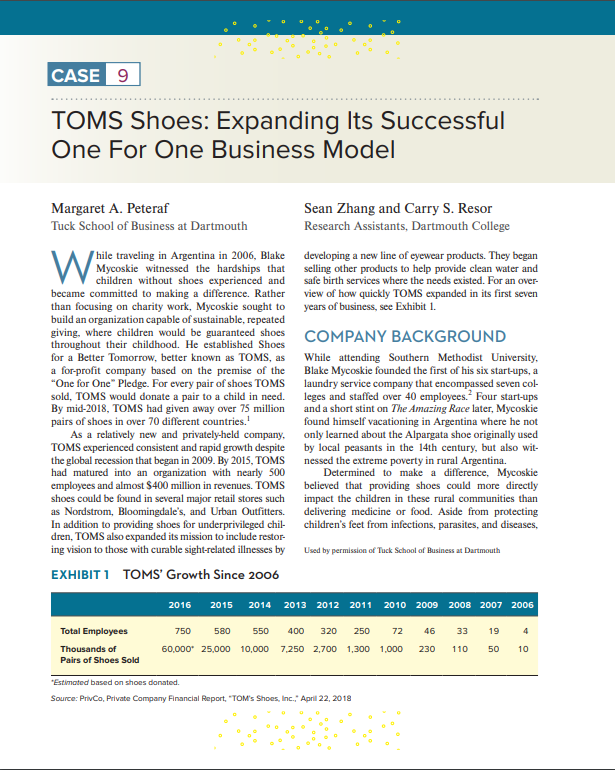
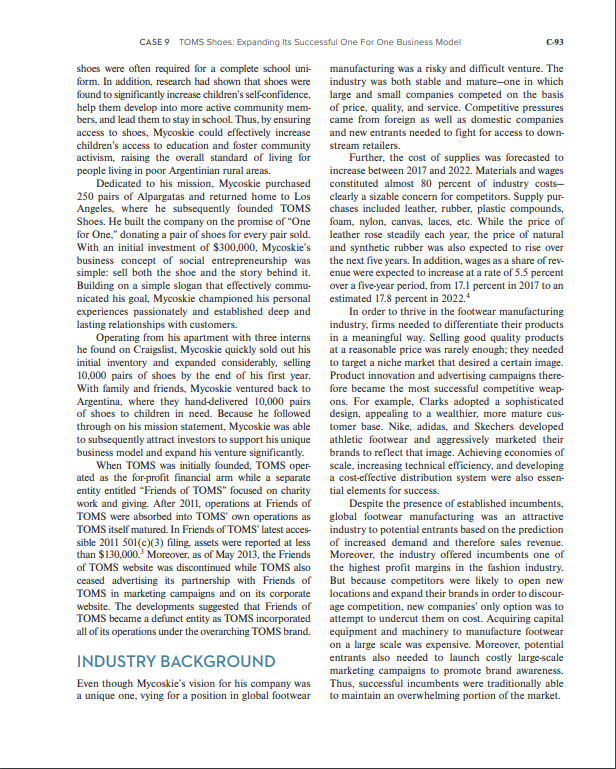
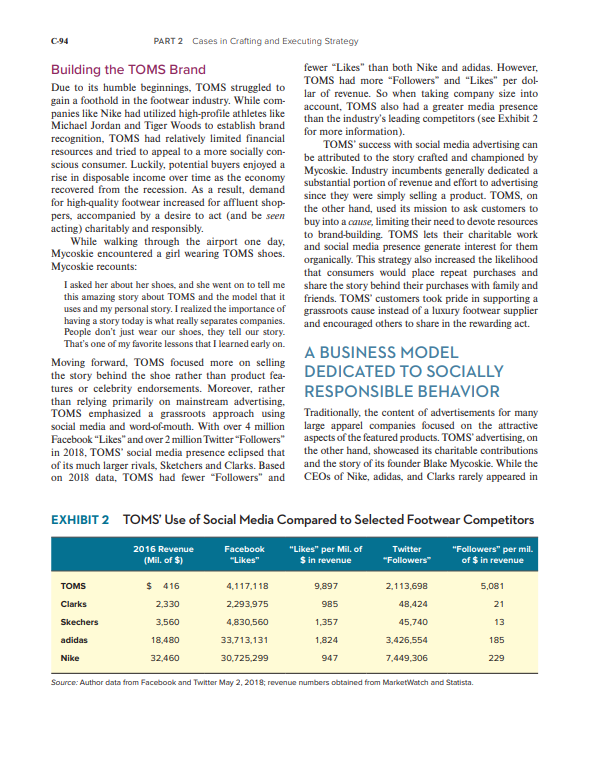
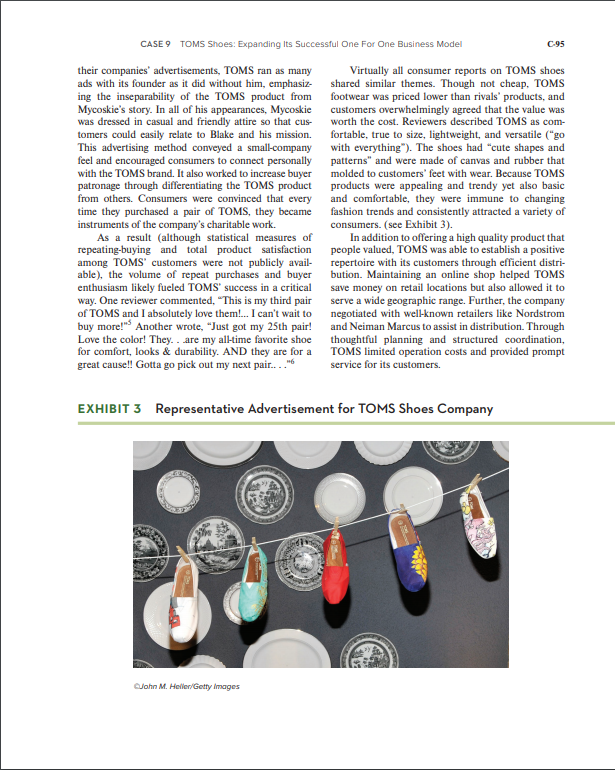
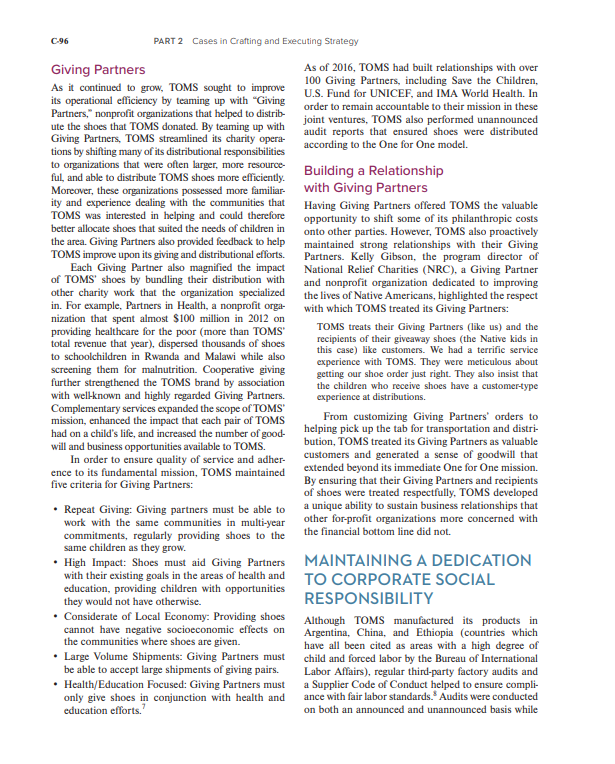
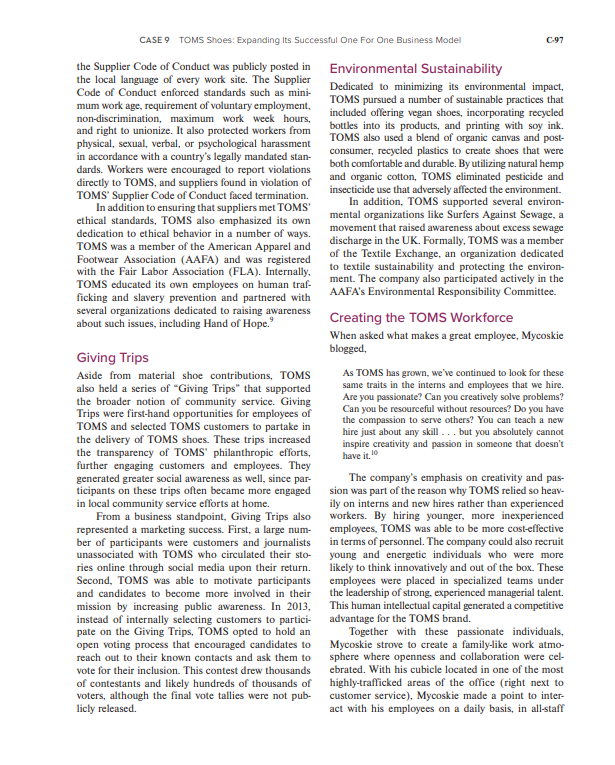
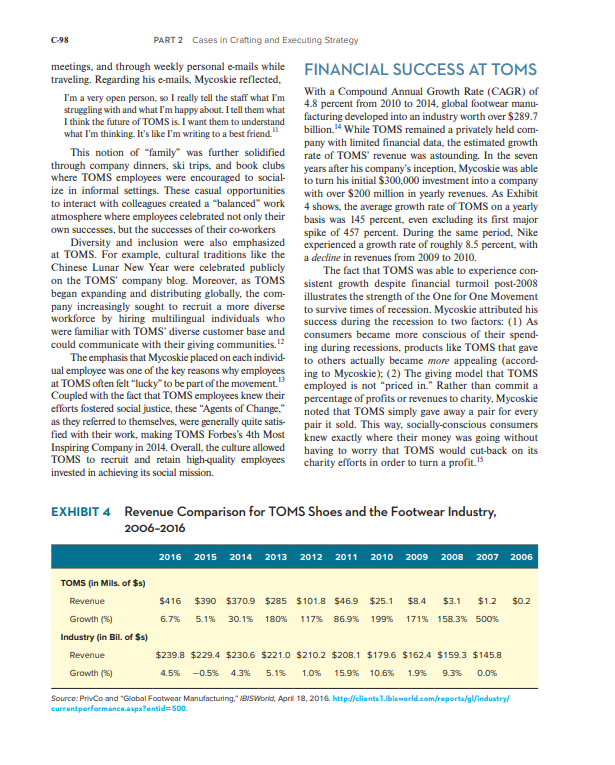
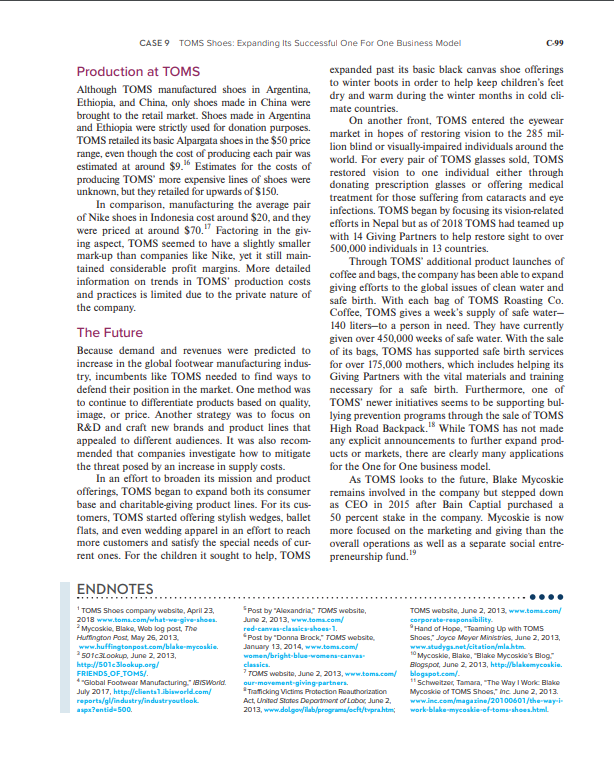
TOMS Shoes: Expanding Its Successful One For One Business Model Sean Zhang and Carry S. Resor Research Assistants, Dartmouth College Vy children without shoes experienced and CASE 9 Margaret A. Peteraf Tuck School of Business at Dartmouth hile traveling in Argentina in 2006, Blake Mycoskie witnessed the hardships that became committed to making a difference. Rather than focusing on charity work, Mycoskie sought to build an organization capable of sustainable, repeated giving, where children would be guaranteed shoes throughout their childhood. He established Shoes for a Better Tomorrow, better known as TOMS, as a for-profit company based on the premise of the One for One Pledge. For every pair of shoes TOMS sold, TOMS would donate a pair to a child in need. By mid-2018, TOMS had given away over 75 million pairs of shoes in over 70 different countries.! As a relatively new and privately-held company, TOMS experienced consistent and rapid growth despite the global recession that began in 2009. By 2015, TOMS had matured into an organization with nearly 500 employees and almost $400 million in revenues. TOMS shoes could be found in several major retail stores such as Nordstrom, Bloomingdale's, and Urban Outfitters. In addition to providing shoes for underprivileged chil- dren, TOMS also expanded its mission to include restor- ing vision to those with curable sight-related illnesses by EXHIBITI TOMS' Growth Since 2006 developing a new line of eyewear products. They began selling other products to help provide clean water and safe birth services where the needs existed. For an over- view of how quickly TOMS expanded in its first seven years of business, see Exhibit 1. COMPANY BACKGROUND While attending Southern Methodist University, Blake Mycoskie founded the first of his six start-ups, a laundry service company that encompassed seven col- leges and staffed over 40 employees. Four start-ups and a short stint on The Amazing Race later, Mycoskie found himself vacationing in Argentina where he not only learned about the Alpargata shoe originally used by local peasants in the 14th century, but also wit- nessed the extreme poverty in rural Argentina. Determined to make a difference, Mycoskie believed that providing shoes could more directly impact the children in these rural communities than delivering medicine or food. Aside from protecting children's feet from infections, parasites, and diseases, Used by permission of Tuck School of Business at Dartmouth 2016 2015 2014 2013 2012 2011 2010 2009 2008 2007 2006 750 580 550 400 320 250 72 46 33 19 4 Total Employees Thousands of Pairs of Shoes Sold 60,000* 25,000 10,000 7.250 2.700 1,300 1,000 230 110 50 10 Estimated based on shoes donated. Source: PrivCo, Private Company Financial Report, "TOM's Shoes, Inc., April 22, 2018 CASE 9 TOMS Shoes: Expanding Its Successful One For One Business Model C-93 shoes were often required for a complete school uni- form. In addition, research had shown that shoes were found to significantly increase children's self-confidence, help them develop into more active community mem- bers, and lead them to stay in school. Thus, by ensuring access to shoes, Mycoskie could effectively increase children's access to education and foster community activism, raising the overall standard of living for people living in poor Argentinian rural areas. Dedicated to his mission, Mycoskie purchased 250 pairs of Alpargatas and returned home to Los Angeles, where he subsequently founded TOMS Shoes. He built the company on the promise of "One for One," donating a pair of shoes for every pair sold. With an initial investment of $300,000, Mycoskie's business concept of social entrepreneurship was simple: sell both the shoe and the story behind it. Building on a simple slogan that effectively commu- nicated his goal, Mycoskie championed his personal experiences passionately and established deep and lasting relationships with customers. Operating from his apartment with three interns he found on Craigslist, Mycoskie quickly sold out his initial inventory and expanded considerably, selling 10,000 pairs of shoes by the end of his first year. With family and friends, Mycoskie ventured back to Argentina, where they hand-delivered 10,000 pairs of shoes to children in need. Because he followed through on his mission statement, Mycoskie was able to subsequently attract investors to support his unique business model and expand his venture significantly. When TOMS was initially founded, TOMS oper- ated as the for-profit financial arm while a separate entity entitled "Friends of TOMS" focused on charity work and giving. After 2011, operations at Friends of TOMS were absorbed into TOMS' own operations as TOMS itself matured. In Friends of TOMS latest acces- sible 2011 501(c)(3) filing, assets were reported at less than $130,000. Moreover, as of May 2013, the Friends of TOMS website was discontinued while TOMS also ceased advertising its partnership with Friends of TOMS in marketing campaigns and on its corporate website. The developments suggested that Friends of TOMS became a defunct entity as TOMS incorporated all of its operations under the overarching TOMS brand. manufacturing was a risky and difficult venture. The industry was both stable and mature-one in which large and small companies competed on the basis of price, quality, and service. Competitive pressures came from foreign as well as domestic companies and new entrants needed to fight for access to down- stream retailers. Further, the cost of supplies was forecasted to increase between 2017 and 2022. Materials and wages constituted almost 80 percent of industry costs- clearly a sizable concern for competitors. Supply pur- chases included leather, rubber, plastic compounds, foam, nylon, canvas, laces, etc. While the price of leather rose steadily each year, the price of natural and synthetic rubber was also expected to rise over the next five years. In addition, wages as a share of rev- enue were expected to increase at a rate of 5.5 percent over a five-year period, from 17.1 percent in 2017 to an estimated 17.8 percent in 2022.4 In order to thrive in the footwear manufacturing industry, firms needed to differentiate their products in a meaningful way. Selling good quality products at a reasonable price was rarely enough; they needed to target a niche market that desired a certain image. Product innovation and advertising campaigns there- fore became the most successful competitive weap- ons. For example, Clarks adopted a sophisticated design, appealing to a wealthier, more mature cus- tomer base. Nike, adidas, and Skechers developed athletic footwear and aggressively marketed their brands to reflect that image. Achieving economies of scale, increasing technical efficiency, and developing a cost-effective distribution system were also essen- tial elements for success. Despite the presence of established incumbents, global footwear manufacturing was an attractive industry to potential entrants based on the prediction of increased demand and therefore sales revenue. Moreover, the industry offered incumbents one of the highest profit margins in the fashion industry. But because competitors were likely to open new locations and expand their brands in order to discour- age competition, new companies' only option was to attempt to undercut them on cost. Acquiring capital equipment and machinery to manufacture footwear on a large scale was expensive. Moreover, potential entrants also needed to launch costly large-scale marketing campaigns to promote brand awareness. Thus, successful incumbents were traditionally able to maintain an overwhelming portion of the market. INDUSTRY BACKGROUND Even though Mycoskie's vision for his company was a unique one, vying for a position in global footwear C-94 PART 2 Cases in Crafting and Executing Strategy Building the TOMS Brand fewer "Likes" than both Nike and adidas. However, Due to its humble beginnings, TOMS struggled to TOMS had more "Followers" and "Likes" per dol- gain a foothold in the footwear industry. While com- lar of revenue. So when taking company size into panies like Nike had utilized high-profile athletes like account, TOMS also had a greater media presence than the industry's leading competitors (see Exhibit 2 Michael Jordan and Tiger Woods to establish brand recognition, TOMS had relatively limited financial for more information). resources and tried to appeal to a more socially con- TOMS' success with social media advertising can scious consumer. Luckily, potential buyers enjoyed a be attributed to the story crafted and championed by rise in disposable income over time as the economy Mycoskie. Industry incumbents generally dedicated a substantial portion of revenue and effort to advertising recovered from the recession. As a result, demand for high-quality footwear increased for affluent shop- since they were simply selling a product. TOMS, on pers, accompanied by a desire to act (and be seen the other hand, used its mission to ask customers to acting) charitably and responsibly. buy into a cause, limiting their need to devote resources to brand-building. TOMS lets their charitable work While walking through the airport one day, and social media presence generate interest for them Mycoskie encountered a girl wearing TOMS shoes. organically. This strategy also increased the likelihood Mycoskie recounts: that consumers would place repeat purchases and I asked her about her shoes, and she went on to tell me share the story behind their purchases with family and this amazing story about TOMS and the model that it friends. TOMS customers took pride in supporting a uses and my personal story. I realized the importance of grassroots cause instead of a luxury footwear supplier having a story today is what really separates companies. and encouraged others to share in the rewarding act. People don't just wear our shoes, they tell our story. That's one of my favorite lessons that I learned early on. A BUSINESS MODEL Moving forward. TOMS focused more on selling the story behind the shoe rather than product fea DEDICATED TO SOCIALLY tures or celebrity endorsements. Moreover, rather RESPONSIBLE BEHAVIOR than relying primarily on mainstream advertising, TOMS emphasized a grassroots approach using Traditionally, the content of advertisements for many social media and word-of-mouth. With over 4 million large apparel companies focused on the attractive Facebook "Likes" and over 2 million Twitter Followers" aspects of the featured products. TOMS'advertising, on in 2018, TOMS' social media presence eclipsed that the other hand, showcased its charitable contributions of its much larger rivals, Sketchers and Clarks. Based and the story of its founder Blake Mycoskie. While the on 2018 data, TOMS had fewer "Followers" and CEOs of Nike, adidas, and Clarks rarely appeared in EXHIBIT 2 TOMS' Use of Social Media Compared to Selected Footwear Competitors 2016 Revenue Facebook "Likes" per Mil. of Twitter "Followers per mil. (Mil. of $) "Likes" $ in revenue "Followers of $ in revenue TOMS 2,113,698 5,081 $ 416 2,330 4,117,118 2,293,975 9.897 985 Clarks 48,424 21 1,357 13 Skechers adidas 3,560 18,480 32.460 4,830,560 33,713,131 45,740 3.426,554 1.824 185 Nike 30,725,299 947 7,449,306 229 Source: Author data from Facebook and Twitter May 2, 2018; revenue numbers obtained from MarketWatch and Statista. CASE 9 TOMS Shoes: Expanding Its Successful One For One Business Model C-95 their companies' advertisements, TOMS ran as many Virtually all consumer reports on TOMS shoes ads with its founder as it did without him, emphasiz shared similar themes. Though not cheap. TOMS ing the inseparability of the TOMS product from footwear was priced lower than rivals" products, and Mycoskie's story. In all of his appearances, Mycoskie customers overwhelmingly agreed that the value was was dressed in casual and friendly attire so that cus worth the cost. Reviewers described TOMS as com- tomers could easily relate to Blake and his mission. fortable, true to size, lightweight, and versatile ("go This advertising method conveyed a small-company with everything"). The shoes had "cute shapes and feel and encouraged consumers to connect personally patterns" and were made of canvas and rubber that with the TOMS brand. It also worked to increase buyer molded to customers' feet with wear. Because TOMS patronage through differentiating the TOMS product products were appealing and trendy yet also basic from others. Consumers were convinced that every and comfortable, they were immune to changing time they purchased a pair of TOMS, they became fashion trends and consistently attracted a variety of instruments of the company's charitable work. consumers. (see Exhibit 3). As a result (although statistical measures of In addition to offering a high quality product that repeating-buying and total product satisfaction people valued, TOMS was able to establish a positive among TOMS customers were not publicly avail repertoire with its customers through efficient distri- able), the volume of repeat purchases and buyer bution. Maintaining an online shop helped TOMS enthusiasm likely fueled TOMS' success in a critical save money on retail locations but also allowed it to way. One reviewer commented, This is my third pair serve a wide geographic range. Further, the company of TOMS and I absolutely love them!... I can't wait to negotiated with well-known retailers like Nordstrom buy more!" Another wrote, "Just got my 25th pair! and Neiman Marcus to assist in distribution. Through Love the color! They are my all-time favorite shoe thoughtful planning and structured coordination, for comfort, looks & durability. AND they are for a TOMS limited operation costs and provided prompt great cause!! Gotta go pick out my next pair...." service for its customers. EXHIBIT 3 Representative Advertisement for TOMS Shoes Company PORN John M. Heller/Getty Images C-96 PART 2 Cases in Crafting and Executing Strategy Giving Partners As of 2016, TOMS had built relationships with over As it continued to grow, TOMS sought to improve 100 Giving Partners, including Save the Children, its operational efficiency by teaming up with "Giving U.S. Fund for UNICEF, and IMA World Health. In Partners," nonprofit organizations that helped to distrib- order to remain accountable to their mission in these ute the shoes that TOMS donated. By teaming up with joint ventures, TOMS also performed unannounced Giving Partners, TOMS streamlined its charity opera- audit reports that ensured shoes were distributed tions by shifting many of its distributional responsibilities according to the One for One model. to organizations that were often larger, more resource ful, and able to distribute TOMS shoes more efficiently. Building a Relationship Moreover, these organizations possessed more familiar with Giving Partners ity and experience dealing with the communities that Having Giving Partners offered TOMS the valuable TOMS was interested in helping and could therefore opportunity to shift some of its philanthropic costs better allocate shoes that suited the needs of children in onto other parties. However, TOMS also proactively the area. Giving Partners also provided feedback to help maintained strong relationships with their Giving TOMS improve upon its giving and distributional efforts. Partners. Kelly Gibson, the program director of Each Giving Partner also magnified the impact National Relief Charities (NRC), a Giving Partner of TOMS' shoes by bundling their distribution with and nonprofit organization dedicated to improving other charity work that the organization specialized the lives of Native Americans, highlighted the respect in. For example, Partners in Health, a nonprofit orga with which TOMS treated its Giving Partners: nization that spent almost $100 million in 2012 on providing healthcare for the poor (more than TOMS TOMS treats their Giving Partners (like us) and the total revenue that year), dispersed thousands of shoes recipients of their giveaway shoes (the Native kids in this case) like customers. We had a terrific service to schoolchildren in Rwanda and Malawi while also experience with TOMS. They were meticulous about screening them for malnutrition. Cooperative giving getting our shoe order just right. They also insist that further strengthened the TOMS brand by association the children who receive shoes have a customer-type with wellknown and highly regarded Giving Partners. experience at distributions. Complementary services expanded the scope of TOMS mission, enhanced the impact that each pair of TOMS From customizing Giving Partners' orders to had on a child's life, and increased the number of good- helping pick up the tab for transportation and distri- will and business opportunities available to TOMS. bution, TOMS treated its Giving Partners as valuable In order to ensure quality of service and adher- customers and generated a sense of goodwill that ence to its fundamental mission, TOMS maintained extended beyond its immediate One for One mission. five criteria for Giving Partners: By ensuring that their Giving Partners and recipients of shoes were treated respectfully, TOMS developed Repeat Giving: Giving partners must be able to a unique ability to sustain business relationships that work with the same communities in multi-year other for-profit organizations more concerned with commitments, regularly providing shoes to the the financial bottom line did not. same children as they grow. High Impact: Shoes must aid Giving Partners MAINTAINING A DEDICATION with their existing goals in the areas of health and TO CORPORATE SOCIAL education, providing children with opportunities they would not have otherwise. RESPONSIBILITY . Considerate of Local Economy: Providing shoes Although TOMS manufactured its products in cannot have negative socioeconomic effects on Argentina, China, and Ethiopia (countries which the communities where shoes are given. have all been cited as areas with a high degree of Large Volume Shipments: Giving Partners must child and forced labor by the Bureau of International be able to accept large shipments of giving pairs. Labor Affairs), regular third-party factory audits and Health/Education Focused: Giving Partners must a Supplier Code of Conduct helped to ensure compli- only give shoes in conjunction with health and ance with fair labor standards. Audits were conducted education efforts.? on both an announced and unannounced basis while C-97 CASE 9 TOMS Shoes: Expanding Its Successful One For One Business Model the Supplier Code of Conduct was publicly posted in Environmental Sustainability the local language of every work site. The Supplier Code of Conduct enforced standards such as mini- Dedicated to minimizing its environmental impact, mum work age, requirement of voluntary employment, TOMS pursued a number of sustainable practices that non-discrimination, maximum work week hours, included offering vegan shoes, incorporating recycled and right to unionize. It also protected workers from bottles into its products, and printing with soy ink. physical, sexual, verbal, or psychological harassment TOMS also used a blend of organic canvas and post- in accordance with a country's legally mandated stan- consumer, recycled plastics to create shoes that were dards. Workers were encouraged to report violations both comfortable and durable. By utilizing natural hemp directly to TOMS, and suppliers found in violation of and organic cotton, TOMS eliminated pesticide and TOMS Supplier Code of Conduct faced termination. insecticide use that adversely affected the environment. In addition to ensuring that suppliers met TOMS In addition, TOMS supported several environ- ethical standards, TOMS also emphasized its own mental organizations like Surfers Against Sewage, a dedication to ethical behavior in a number of ways. movement that raised awareness about excess sewage TOMS was a member of the American Apparel and discharge in the UK. Formally, TOMS was a member Footwear Association (AAFA) and was registered of the Textile Exchange, an organization dedicated with the Fair Labor Association (FLA). Internally, to textile sustainability and protecting the environ- TOMS educated its own employees on human traf- ment. The company also participated actively in the ficking and slavery prevention and partnered with AAFA's Environmental Responsibility Committee. several organizations dedicated to raising awareness about such issues, including Hand of Hope. Creating the TOMS Workforce When asked what makes a great employee, Mycoskie blogged, Giving Trips Aside from material shoe contributions, TOMS As TOMS has grown, we've continued to look for these also held a series of "Giving Trips" that supported same traits in the interns and employees that we hire. the broader notion of community service. Giving Are you passionate? Can you creatively solve problems? Trips were first-hand opportunities for employees of Can you be resourceful without resources? Do you have the compassion to serve others? You can teach a new TOMS and selected TOMS customers to partake in hire just about any skill... but you absolutely cannot the delivery of TOMS shoes. These trips increased inspire creativity and passion in someone that doesn't the transparency of TOMS philanthropic efforts, have it. further engaging customers and employees. They generated greater social awareness as well, since par The company's emphasis on creativity and pas- ticipants on these trips often became more engaged sion was part of the reason why TOMS relied so heav- in local community service efforts at home. ily on interns and new hires rather than experienced From a business standpoint, Giving Trips also workers. By hiring younger, more inexperienced represented a marketing success. First, a large num employees, TOMS was able to be more cost-effective ber of participants were customers and journalists in terms of personnel. The company could also recruit unassociated with TOMS who circulated their sto young and energetic individuals who were more ries online through social media upon their return. likely to think innovatively and out of the box. These Second, TOMS was able to motivate participants employees were placed in specialized teams under and candidates to become more involved in their the leadership of strong, experienced managerial talent. mission by increasing public awareness. In 2013, This human intellectual capital generated a competitive instead of internally selecting customers to partici advantage for the TOMS brand. pate on the Giving Trips, TOMS opted to hold an Together with these passionate individuals, open voting process that encouraged candidates to Mycoskie strove to create a family-like work atmo- reach out to their known contacts and ask them to sphere where openness and collaboration were cel- vote for their inclusion. This contest drew thousands ebrated. With his cubicle located in one of the most of contestants and likely hundreds of thousands of highly-trafficked areas of the office (right next to voters, although the final vote tallies were not pub customer service), Mycoskie made a point to inter- licly released. act with his employees on a daily basis, in all-staff C-98 PART 2 Cases in Crafting and Executing Strategy meetings, and through weekly personal e-mails while FINANCIAL SUCCESS AT TOMS traveling. Regarding his e-mails, Mycoskie reflected, I'm a very open person, so I really tell the staff what I'm With a Compound Annual Growth Rate (CAGR) of struggling with and what I'm happy about. I tell them what 4.8 percent from 2010 to 2014, global footwear manu- I think the future of TOMS is. I want them to understand facturing developed into an industry worth over $289.7 what I'm thinking. It's like I'm writing to a best friend." billion. While TOMS remained a privately held com- pany with limited financial data, the estimated growth This notion of "family" was further solidified rate of TOMS" revenue was astounding. In the seven through company dinners, ski trips, and book clubs years after his company's inception, Mycoskie was able where TOMS employees were encouraged to social to turn his initial $300,000 investment into a company ize in informal settings. These casual opportunities with over $200 million in yearly revenues. As Exhibit to interact with colleagues created a "balanced" work 4 shows, the average growth rate of TOMS on a yearly atmosphere where employees celebrated not only their basis was 145 percent, even excluding its first major own successes, but the successes of their co-workers spike of 457 percent. During the same period, Nike Diversity and inclusion were also emphasized experienced a growth rate of roughly 8.5 percent, with at TOMS. For example, cultural traditions like the a decline in revenues from 2009 to 2010. Chinese Lunar New Year were celebrated publicly The fact that TOMS was able to experience con- on the TOMS' company blog. Moreover, as TOMS sistent growth despite financial turmoil post-2008 began expanding and distributing globally, the com illustrates the strength of the One for One Movement pany increasingly sought to recruit a more diverse to survive times of recession. Mycoskie attributed his workforce by hiring multilingual individuals who success during the recession to two factors: (1) As were familiar with TOMS' diverse customer base and consumers became more conscious of their spend could communicate with their giving communities. 12 ing during recessions, products like TOMS that gave The emphasis that Mycoskie placed on each individ to others actually became more appealing (accord- ual employee was one of the key reasons why employees ing to Mycoskie); (2) The giving model that TOMS at TOMS often felt "lucky to be part of the movement. employed is not "priced in." Rather than commit a Coupled with the fact that TOMS employees knew their percentage of profits or revenues to charity, Mycoskie efforts fostered social justice, these "Agents of Change," noted that TOMS simply gave away a pair for every as they referred to themselves, were generally quite satis- fied with their work, making TOMS Forbes's 4th Most knew exactly where their money was going without pair it sold. This way, socially conscious consumers Inspiring Company in 2014. Overall , the culture allowed having to worry that TOMS would cut-back on its TOMS to recruit and retain high-quality employees charity efforts in order to turn a profit." invested in achieving its social mission. EXHIBIT 4 Revenue Comparison for TOMS Shoes and the Footwear Industry, 2006-2016 2016 2015 2014 2013 2012 2011 2010 2009 2008 2007 2006 TOMS (in Mils. of $s) Revenue $416 $390 $370.9 $285 $101.8 $46.9 $25.1 $8.4 $3.1 $1.2 $0.2 Growth (%) 6.7% 5.1% 30.1% 180% 117% 86.9% 99% 171% 158.3% 500% Industry (in Bil of $s) Revenue $239.8 $229.4 $230.6 $221.0 $210.2 $208.1 $179.6 $162.4 $159.3 $145.8 Growth (%) 4.5% -0.5% 4.3% 5.1% 1.0% 15.9% 10.6% 1.9% 0.0% 9.3% Source: PrivCo and Global Footwear Manufacturing." IBISWorld, April 18, 2016. http://clients 1.ibisworld.com/reports/gl/industry currentperformance.aspx?entid=500 CASE 9 TOMS Shoes: Expanding Its Successful One For One Business Model C-99 Production at TOMS Although TOMS manufactured shoes in Argentina, Ethiopia, and China, only shoes made in China were brought to the retail market. Shoes made in Argentina and Ethiopia were strictly used for donation purposes. TOMS retailed its basic Alpargata shoes in the $50 price range, even though the cost of producing each pair was estimated at around $9. Estimates for the costs of producing TOMS'more expensive lines of shoes were unknown, but they retailed for upwards of $150. In comparison, manufacturing the average pair of Nike shoes in Indonesia cost around $20, and they were priced at around $70." Factoring in the giv- ing aspect, TOMS seemed to have a slightly smaller mark-up than companies like Nike, yet it still main- tained considerable profit margins. More detailed information on trends in TOMS' production costs and practices is limited due to the private nature of the company. The Future Because demand and revenues were predicted to increase in the global footwear manufacturing indus- try, incumbents like TOMS needed to find ways to defend their position in the market. One method was to continue to differentiate products based on quality, image, or price. Another strategy was to focus on R&D and craft new brands and product lines that appealed to different audiences. It was also recom- mended that companies investigate how to mitigate the threat posed by an increase in supply costs. In an effort to broaden its mission and product offerings, TOMS began to expand both its consumer base and charitable-giving product lines. For its cus- tomers, TOMS started offering stylish wedges, ballet flats, and even wedding apparel in an effort to reach more customers and satisfy the special needs of cur- rent ones. For the children it sought to help, TOMS expanded past its basic black canvas shoe offerings to winter boots in order to help keep children's feet dry and warm during the winter months in cold cli- mate countries. On another front, TOMS entered the eyewear market in hopes of restoring vision to the 285 mil- lion blind or visually-impaired individuals around the world. For every pair of TOMS glasses sold, TOMS restored vision to one individual either through donating prescription glasses or offering medical treatment for those suffering from cataracts and eye infections. TOMS began by focusing its vision-related efforts in Nepal but as of 2018 TOMS had teamed up with 14 Giving Partners to help restore sight to over 500,000 individuals in 13 countries. Through TOMS' additional product launches of coffee and bags, the company has been able to expand giving efforts to the global issues of clean water and safe birth. With each bag of TOMS Roasting Co. Coffee, TOMS gives a week's supply of safe water- 140 liters-to a person in need. They have currently given over 450,000 weeks of safe water. With the sale of its bags, TOMS has supported safe birth services for over 175,000 mothers, which includes helping its Giving Partners with the vital materials and training necessary for a safe birth. Furthermore, one of TOMS newer initiatives seems to be supporting bul- lying prevention programs through the sale of TOMS High Road Backpack. While TOMS has not made any explicit announcements to further expand prod- ucts or markets, there are clearly many applications for the One for One business model. As TOMS looks to the future, Blake Mycoskie remains involved in the company but stepped down as CEO in 2015 after Bain Captial purchased a 50 percent stake in the company. Mycoskie is now more focused on the marketing and giving than the overall operations as well as a separate social entre- preneurship fund." ENDNOTES TOMS Shoes company website, April 23, 2018 www.toms.com/what-we-give-shoes 2 Mycoskio, Blake, Weblog post, The Huffington Post, May 26, 2013. www.huffingtonpost.com/blake-mycoskie 2501ca.cop, June 2, 2013, http://501c3lookup.org/ FRIENDS OF TOMS/ * Global Footwear Manufacturing." IBS World. July 2017, http://client1.ibiworld.com/ reports/gl/industry/industryoutlook. aspx?entid-500 Post by "Alexandria." TOMS website, June 2, 2013, www.toms.com/ red-canvas-classic-shoes-1. Post by "Donna Brock." TOMS website. January 13, 2014, www.tom.com/ women/bright-blue-womens canvas classics TOMS website, June 2, 2013, www.tom.com/ our movement-giving partners. Trafficking Victims Protection Roauthorization Act, United States Department of Lobor, June 2 2013, www.dolgailab/program/act/tvpra.htm TOMS website, June 2, 2013, www.toms.com/ corporate responsibility Hand of Hope. "Teaming Up with TOMS Shoes." Joyce Meyer Ministries, June 2, 2013, www.study.net/eitation/ml.htm. Mycoskie, Blake, "Blake Mycoske's Blog." Blogspot, June 2, 2013, http://blakemycoskie. blogspot.com/ Schweitzer, Tamara, "The Way I Woric Blace Mycoside of TOMS Shoes." Inc June 2, 2013 www.inc.com/magazine/20100601/the-way.in work-blake-mycoskie-of-tomsshoes.htmlStep by Step Solution
There are 3 Steps involved in it
1 Expert Approved Answer
Step: 1 Unlock

Question Has Been Solved by an Expert!
Get step-by-step solutions from verified subject matter experts
Step: 2 Unlock
Step: 3 Unlock
 Study Help