







Question: what could be a proper critical analysis for this article AJPH EDITORIALS system-involved adolescents in Marijuana Legalization and Marijuana Pennsylvania, a state that has not
what could be a proper critical analysis for this article
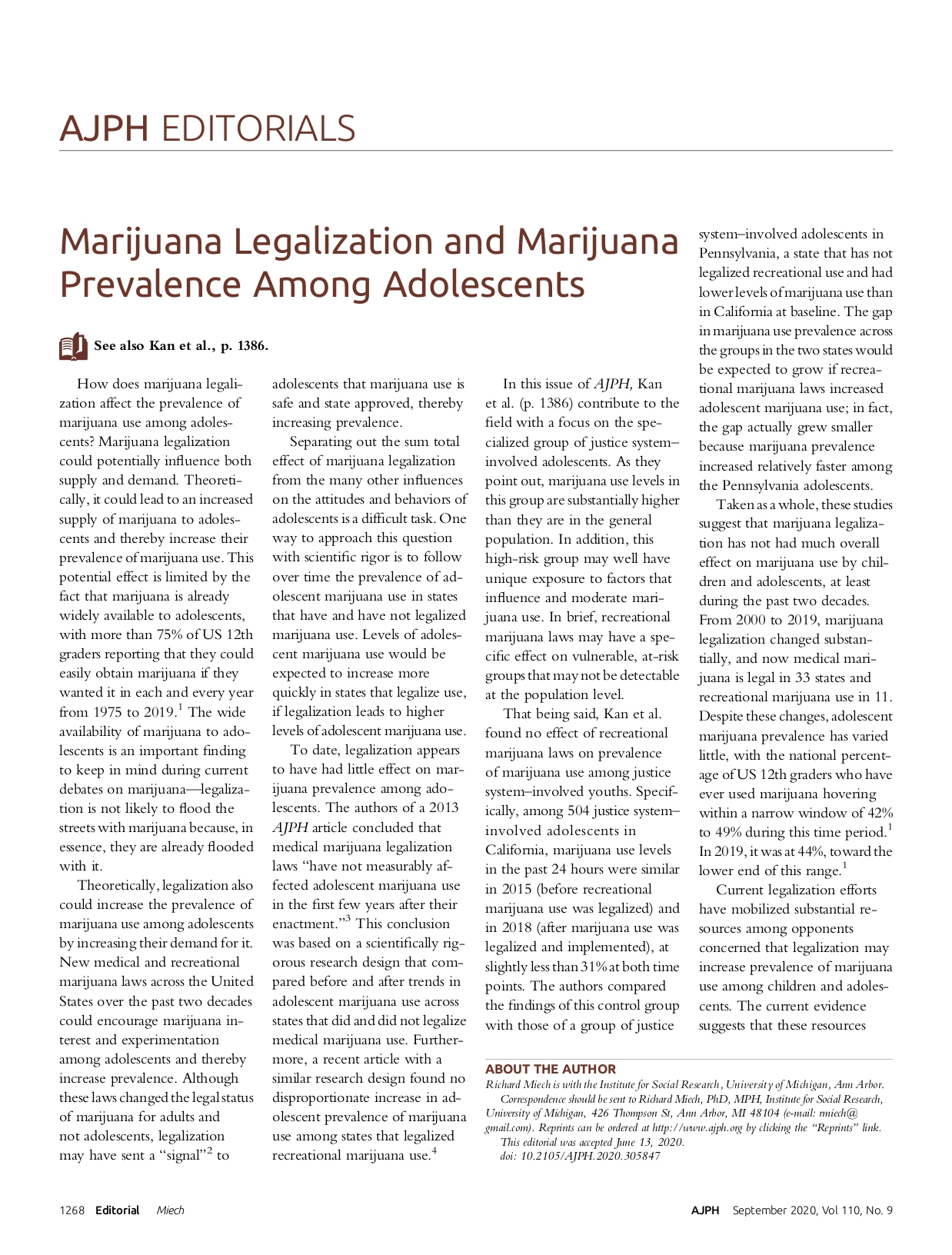
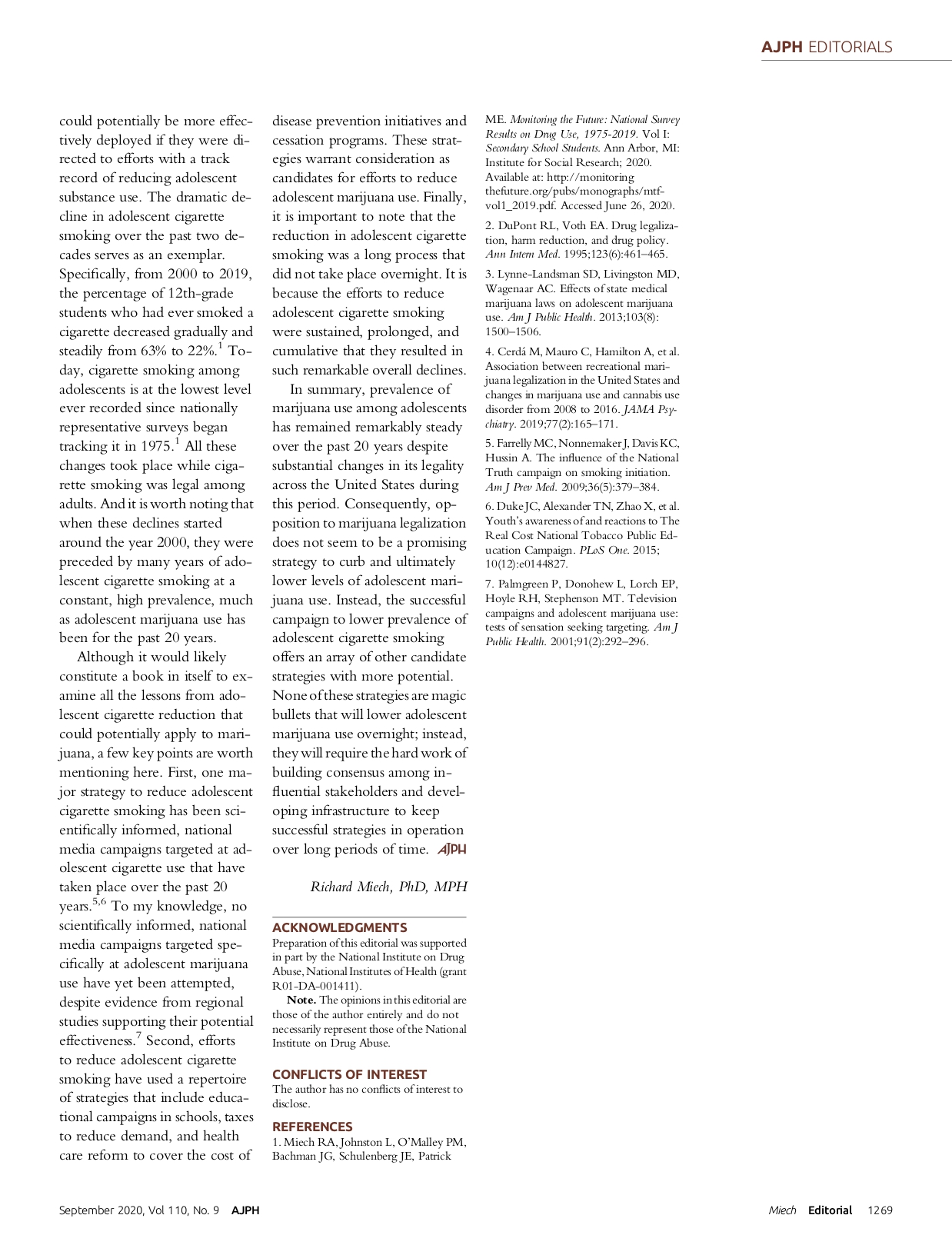
AJPH EDITORIALS system-involved adolescents in Marijuana Legalization and Marijuana Pennsylvania, a state that has not Prevalence Among Adolescents legalized recreational use and had lower levels of marijuana use than in California at baseline. The gap in marijuana use prevalence across the groups in the two states would be expected to grow if recrea- tional marijuana laws increased adolescent marijuana use; in fact, the gap actually grew smaller because marijuana prevalence increased relatively faster among the Pennsylvania adolescents. See also Kan et al., p. 1386. How does marijuana legali- zation affect the prevalence of marijuana use among adoles- cents? Marijuana legalization could potentially influence both supply and demand. Theoreti- cally, it could lead to an increased supply of marijuana to adoles- cents and thereby increase their prevalence of marijuana use. This potential effect is limited by the fact that marijuana is already widely available to adolescents, with more than 75% of US 12th graders reporting that they could easily obtain marijuana if they wanted it in each and every year from 1975 to 2019. The wide availability of marijuana to ado- lescents is an important finding to keep in mind during current debates on marijuana-legaliza- tion is not likely to flood the streets with marijuana because, in essence, they are already flooded with it. Theoretically, legalization also could increase the prevalence of marijuana use among adolescents by increasing their demand for it. New medical and recreational marijuana laws across the United States over the past two decades could encourage marijuana in- terest and experimentation among adolescents and thereby increase prevalence. Although these laws changed the legal status of marijuana for adults and not adolescents, legalization may have sent a "signal to 1268 Editorial Miech adolescents that marijuana use is safe and state approved, thereby increasing prevalence. Separating out the sum total effect of marijuana legalization from the many other influences on the attitudes and behaviors of adolescents is a difficult task. One way to approach this question with scientific rigor is to follow over time the prevalence of ad- olescent marijuana use in states that have and have not legalized marijuana use. Levels of adoles- cent marijuana use would be expected to increase more quickly in states that legalize use, if legalization leads to higher levels of adolescent marijuana use. To date, legalization appears to have had little effect on mar- ijuana prevalence among ado- lescents. The authors of a 2013 AJPH article concluded that medical marijuana legalization laws "have not measurably af- fected adolescent marijuana use in the first few years after their enactment. This conclusion was based on a scientifically rig- orous research design that com- pared before and after trends in adolescent marijuana use across states that did and did not legalize medical marijuana use. Further- more, a recent article with a similar research design found no disproportionate increase in ad- olescent prevalence of marijuana use among states that legalized recreational marijuana use.4 In this issue of AJPH, Kan et al. (p. 1386) contribute to the field with a focus on the spe- cialized group of justice system- involved adolescents. As they point out, marijuana use levels in this group are substantially higher than they are in the general population. In addition, this high-risk group may well have unique exposure to factors that influence and moderate mari- juana use. In brief, recreational marijuana laws may have a spe- cific effect on vulnerable, at-risk groups that may not be detectable at the population level. That being said, Kan et al. found no effect of recreational marijuana laws on prevalence of marijuana use among justice system-involved youths. Specif- ically, among 504 justice system- involved adolescents in California, marijuana use levels in the past 24 hours were similar in 2015 (before recreational marijuana use was legalized) and in 2018 (after marijuana use was legalized and implemented), at slightly less than 31% at both time points. The authors compared the findings of this control group with those of a group of justice Taken as a whole, these studies suggest that marijuana legaliza- tion has not had much overall effect on marijuana use by chil- dren and adolescents, at least during the past two decades. From 2000 to 2019, marijuana legalization changed substan- tially, and now medical mari- juana is legal in 33 states and recreational marijuana use in 11. Despite these changes, adolescent marijuana prevalence has varied little, with the national percent- age of US 12th graders who have ever used marijuana hovering within a narrow window of 42% to 49% during this time period. In 2019, it was at 44%, toward the lower end of this range." 1 Current legalization efforts have mobilized substantial re- sources among opponents concerned that legalization may increase prevalence of marijuana use among children and adoles- cents. The current evidence suggests that these resources ABOUT THE AUTHOR Richard Miech is with the Institute for Social Research, University of Michigan, Ann Arbor. Correspondence should be sent to Richard Miech, PhD, MPH, Institute for Social Research, University of Michigan, 426 Thompson St, Ann Arbor, MI 48104 (e-mail: mniech@ gmail.com). Reprints can be ordered at http://www.ajph.org by clicking the "Reprints" link. This editorial was accepted June 13, 2020. doi: 10.2105/AJPH.2020.305847 AJPH September 2020, Vol 110, No. 9
Step by Step Solution
There are 3 Steps involved in it
A critical analysis of this article involves examining its methodology findings and implications Heres a breakdown Methodology Research Design The art... View full answer

Get step-by-step solutions from verified subject matter experts
 Study Help