







Question: What creative problem-solving methods did the group use, and were they successful? Would other problem-solving methods have been more effective? Why or why not? No
What creative problem-solving methods did the group use, and were they successful? Would other problem-solving methods have been more effective? Why or why not? 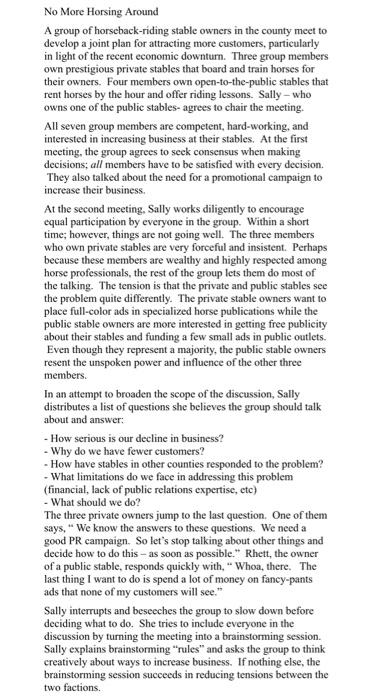
No More Horsing Around A group of horseback-riding stable owners in the county meet to develop a joint plan for attracting more customers, particularly in light of the recent economic downturn. Three group members own prestigious private stables that board and train horses for their owners. Four members own open-to-the-public stables that rent horses by the hour and offer riding lessons. Sally - who owns one of the public stables-agrees to chair the meeting. All seven group members are competent, hard-working, and interested in increasing business at their stables. At the first meeting, the group agrees to seek consensus when making decisions; all members have to be satisfied with every decision. They also talked about the need for a promotional campaign to increase their business At the second meeting, Sally works diligently to encourage equal participation by everyone in the group. Within a short time; however, things are not going well. The three members who own private stables are very forceful and insistent. Perhaps because these members are wealthy and highly respected among horse professionals, the rest of the group lets them do most of the talking. The tension is that the private and public stables see the problem quite differently. The private stable owners want to place full-color ads in specialized horse publications while the public stable owners are more interested in getting free publicity about their stables and funding a few small ads in public outlets. Even though they represent a majority, the public stable owners resent the unspoken power and influence of the other three members. In an attempt to broaden the scope of the discussion, Sally distributes a list of questions she believes the group should talk about and answer: - How serious is our decline in business? - Why do we have fewer customers? - How have stables in other counties responded to the problem? - What limitations do we face in addressing this problem (financial, lack of public relations expertise, etc) - What should we do? The three private owners jump to the last question. One of them says, "We know the answers to these questions. We need a good PR campaign. So let's stop talking about other things and decide how to do this - as soon as possible." Rhett, the owner of a public stable, responds quickly with, Whoa, there. The last thing I want to do is spend a lot of money on fancy-pants ads that none of my customers will see." Sally interrupts and beseeches the group to slow down before deciding what to do. She tries to include everyone in the discussion by turning the meeting into a brainstorming session. Sally explains brainstorming "rules" and asks the group to think creatively about ways to increase business. If nothing else, the brainstorming session succeeds in reducing tensions between the two factions Step by Step Solution
There are 3 Steps involved in it
1 Expert Approved Answer
Step: 1 Unlock

Question Has Been Solved by an Expert!
Get step-by-step solutions from verified subject matter experts
Step: 2 Unlock
Step: 3 Unlock
 Study Help