







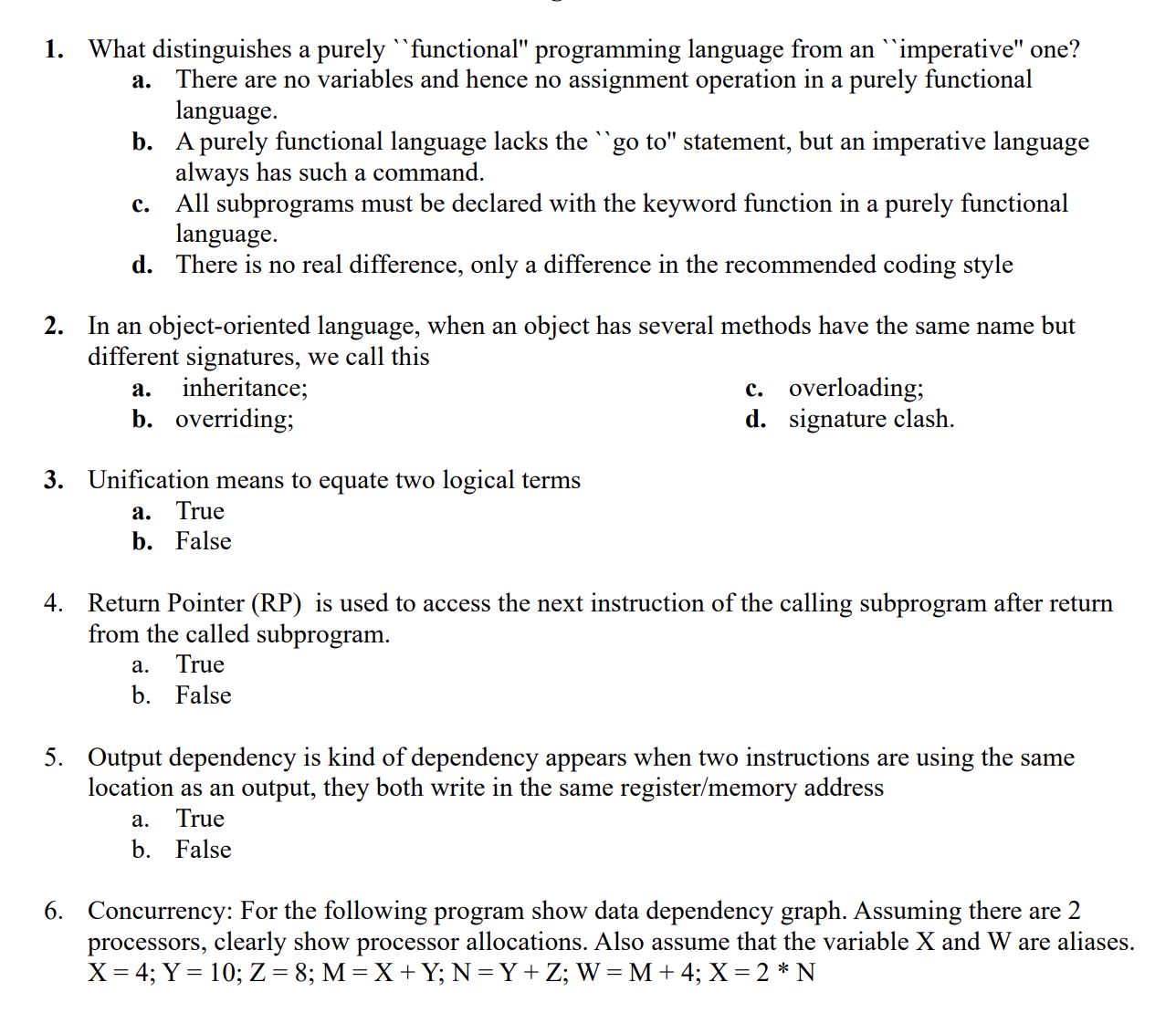
Question: What distinguishes a purely functional programming language from an imperative one? a . There are no variables and hence no assignment operation in a purely
What distinguishes a purely "functional" programming language from an "imperative" one?
a There are no variables and hence no assignment operation in a purely functional
language.
b A purely functional language lacks the go to statement, but an imperative language
always has such a command.
c All subprograms must be declared with the keyword function in a purely functional
language.
d There is no real difference, only a difference in the recommended coding style
In an objectoriented language, when an object has several methods have the same name but
different signatures, we call this
a inheritance;
c overloading;
b overriding;
d signature clash.
Unification means to equate two logical terms
a True
b False
Return Pointer RP is used to access the next instruction of the calling subprogram after return
from the called subprogram.
a True
b False
Output dependency is kind of dependency appears when two instructions are using the same
location as an output, they both write in the same registermemory address
a True
b False
Concurrency: For the following program show data dependency graph. Assuming there are
processors, clearly show processor allocations. Also assume that the variable and are aliases.
;;;;;;
Step by Step Solution
There are 3 Steps involved in it
1 Expert Approved Answer
Step: 1 Unlock

Question Has Been Solved by an Expert!
Get step-by-step solutions from verified subject matter experts
Step: 2 Unlock
Step: 3 Unlock
 Study Help