







Question: What do you see as potential problem(s)? Where do you start? How can Mark address these issues and get the company back on track? Consider
- What do you see as potential problem(s)?
- Where do you start?
- How can Mark address these issues and get the company back on track?
Consider the best way to begin the journey to organize the companys leadership and evaluate solutions. Prepare an outlined response with your recommendations to submit. Write a memo of 750 1,000 words describing your recommended approach.
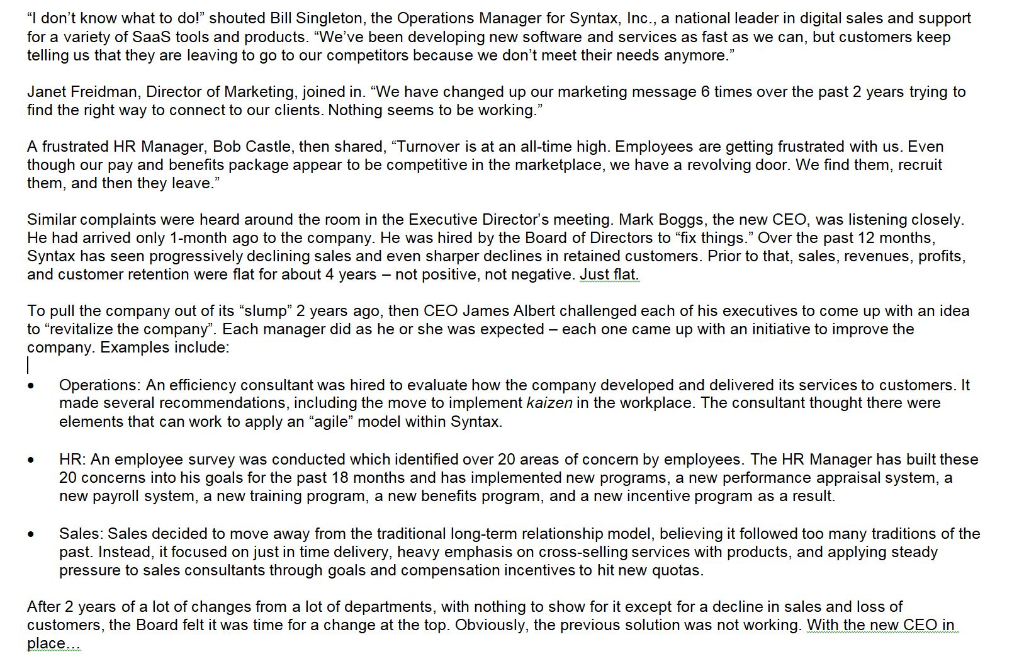
"I don't know what to do!" shouted Bill Singleton, the Operations Manager for Syntax, Inc., a national leader in digital sales and support for a variety of SaaS tools and products. "We've been developing new software and services as fast as we can, but customers keep telling us that they are leaving to go to our competitors because we don't meet their needs anymore." Janet Freidman, Director of Marketing, joined in. "We have changed up our marketing message 6 times over the past 2 years trying to find the right way to connect to our clients. Nothing seems to be working." A frustrated HR Manager, Bob Castle, then shared, "Turnover is at an all-time high. Employees are getting frustrated with us. Even though our pay and benefits package appear to be competitive in the marketplace, we have a revolving door. We find them, recruit them, and then they leave." Similar complaints were heard around the room in the Executive Director's meeting. Mark Boggs, the new CEO, was listening closely. He had arrived only 1-month ago to the company. He was hired by the Board of Directors to "fix things." Over the past 12 months, Syntax has seen progressively declining sales and even sharper declines in retained customers. Prior to that, sales, revenues, profits, and customer retention were flat for about 4 years - not positive, not negative. Just flat. To pull the company out of its "slump" 2 years ago, then CEO James Albert challenged each of his executives to come up with an idea to "revitalize the company". Each manager did as he or she was expected - each one came up with an initiative to improve the company. Examples include: . Operations: An efficiency consultant was hired to evaluate how the company developed and delivered its services to customers. It made several recommendations, including the move to implement kaizen in the workplace. The consultant thought there were elements that can work to apply an "agile" model within Syntax. HR: An employee survey was conducted which identified over 20 areas of concern by employees. The HR Manager has built these 20 concerns into his goals for the past 18 months and has implemented new programs, a new performance appraisal system, a new payroll system, a new training program, a new benefits program, and a new incentive program as a result. . Sales: Sales decided to move away from the traditional long-term relationship model, believing it followed too many traditions of the past. Instead, it focused on just in time delivery, heavy emphasis on cross-selling services with products, and applying steady pressure to sales consultants through goals and compensation incentives to hit new quotas. After 2 years of a lot of changes from a lot of departments, with nothing to show for it except for a decline in sales and loss of customers, the Board felt it was time for a change at the top. Obviously, the previous solution was not working. With the new CEO in placeStep by Step Solution
There are 3 Steps involved in it
1 Expert Approved Answer
Step: 1 Unlock

Question Has Been Solved by an Expert!
Get step-by-step solutions from verified subject matter experts
Step: 2 Unlock
Step: 3 Unlock
 Study Help