Question: What do you think Wal-Mart could do to develop an improved ethical culture and respond more positively to its diverse stakeholders? (Provide a long answer)
- What do you think Wal-Mart could do to develop an improved ethical culture and respond more positively to its diverse stakeholders? (Provide a long answer)
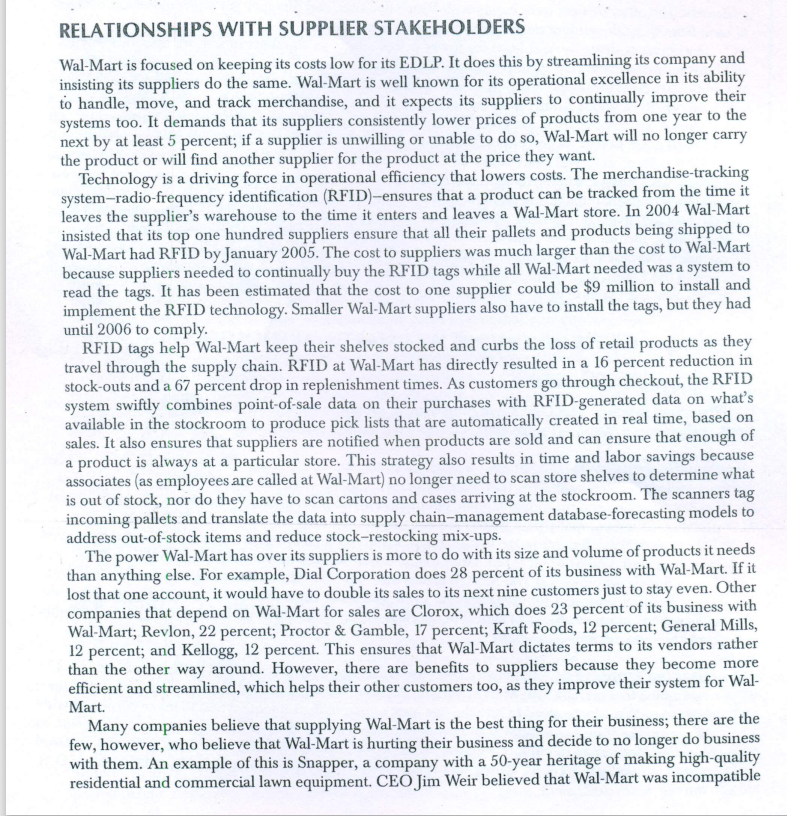
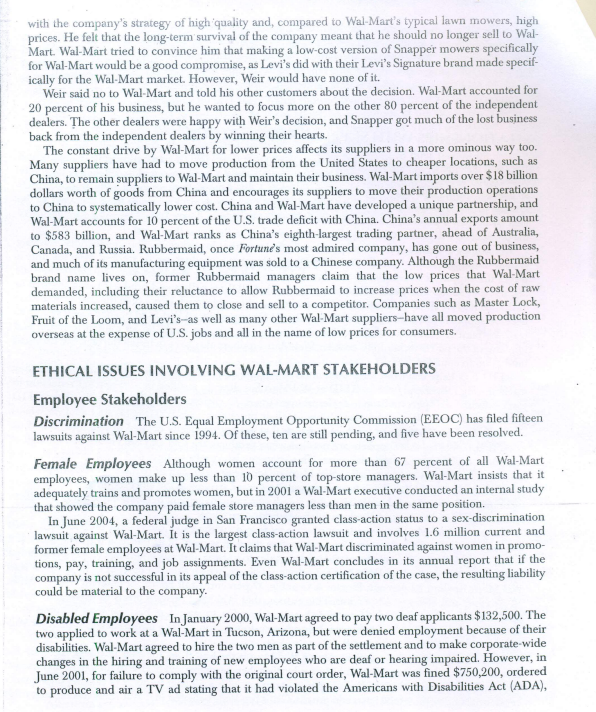
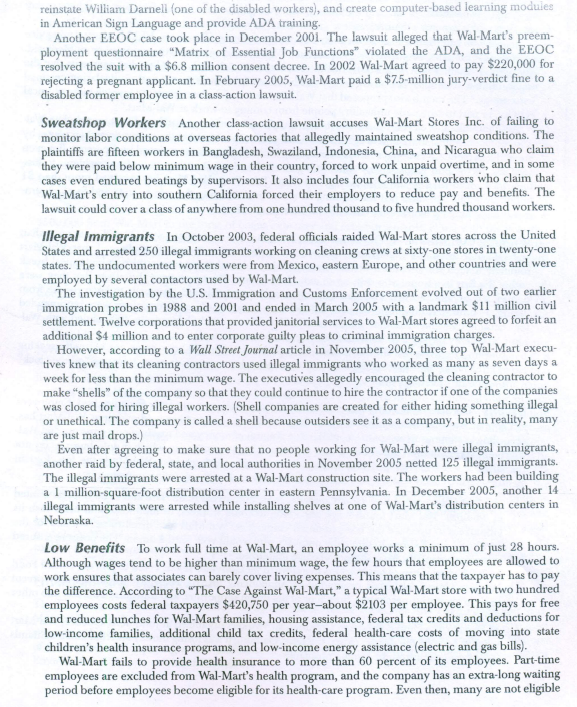
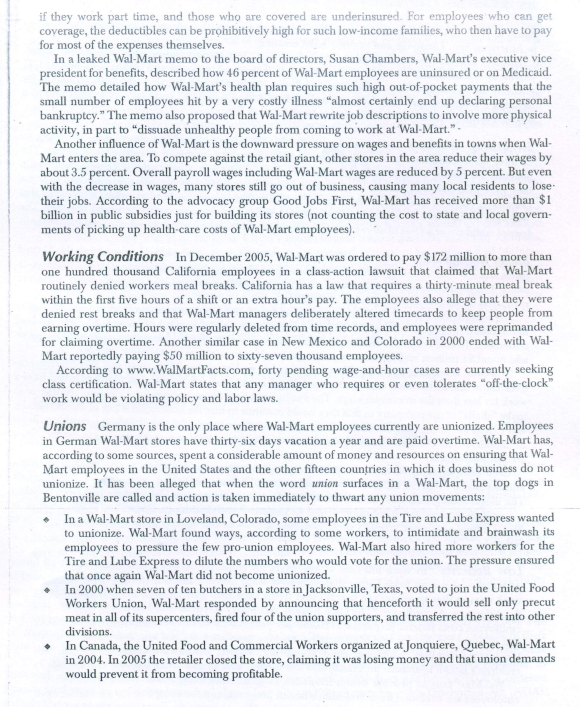
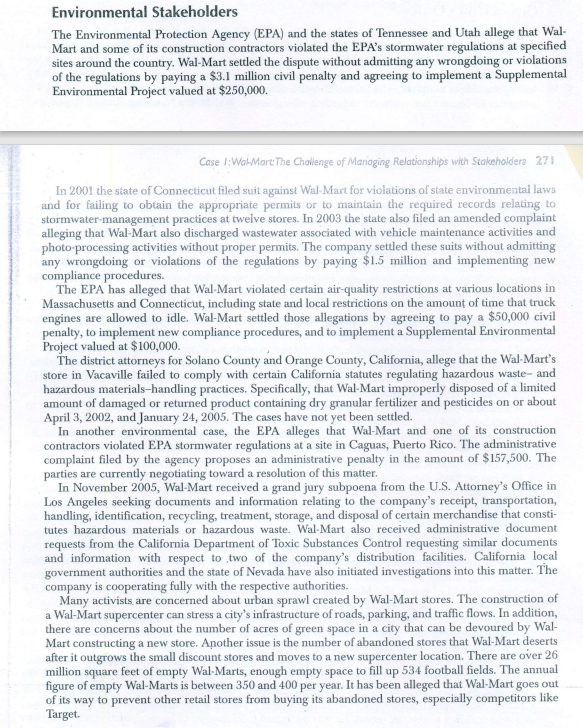
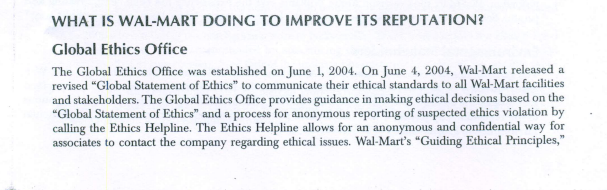
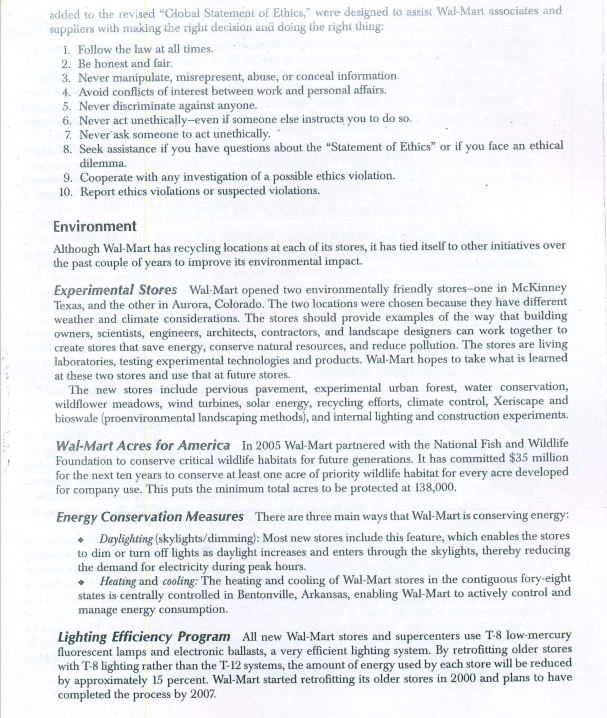
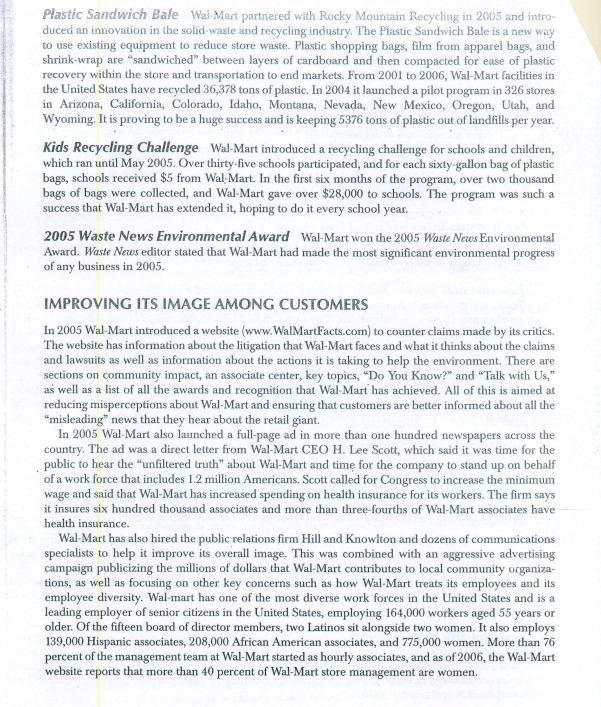
RELATIONSHIPS WITH SUPPLIER STAKEHOLDERS Wal-Mart is focused on keeping its costs low for its EDLP. It does this by streamlining its company and insisting its suppliers do the same. Wal-Mart is well known for its operational excellence in its ability to handle, move, and track merchandise, and it expects its suppliers to continually improve their systems too. It demands that its suppliers consistently lower prices of products from one year to the next by at least 5 percent; if a supplier is unwilling or unable to do so, Wal-Mart will no longer carry the product or will find another supplier for the product at the price they want. Technology is a driving force in operational efficiency that lowers costs. The merchandise-tracking system-radio-frequency identification (RFID)-ensures that a product can be tracked from the time it leaves the supplier's warehouse to the time it enters and leaves a Wal-Mart store. In 2004 Wal-Mart insisted that its top one hundred suppliers ensure that all their pallets and products being shipped to Wal-Mart had RFID by January 2005. The cost to suppliers was much larger than the cost to Wal-Mart because suppliers needed to continually buy the RFID tags while all Wal-Mart needed was a system to read the tags. It has been estimated that the cost to one supplier could be $9 million to install and implement the RFID technology. Smaller Wal-Mart suppliers also have to install the tags, but they had until 2006 to comply. RFID tags help Wal-Mart keep their shelves stocked and curbs the loss of retail products as they travel through the supply chain. RFID at Wal-Mart has directly resulted in a 16 percent reduction in stock-outs and a 67 percent drop in replenishment times. As customers go through checkout, the RFID system swiftly combines point-of-sale data on their purchases with RFID-generated data on what's available in the stockroom to produce pick lists that are automatically created in real time, based on sales. It also ensures that suppliers are notified when products are sold and can ensure that enough of a product is always at a particular store. This strategy also results in time and labor savings because associates (as employees are called at Wal-Mart) no longer need to scan store shelves to determine what is out of stock, nor do they have to scan cartons and cases arriving at the stockroom. The scanners tag incoming pallets and translate the data into supply chain-management database-forecasting models to address out-of-stock items and reduce stock-restocking mix-ups. The power Wal-Mart has over its suppliers is more to do with its size and volume of products it needs than anything else. For example, Dial Corporation does 28 percent of its business with Wal-Mart. If it lost that one account, it would have to double its sales to its next nine customers just to stay even. Other companies that depend on Wal-Mart for sales are Clorox, which does 23 percent of its business with Wal-Mart; Revlon, 22 percent; Proctor & Gamble, 17 percent; Kraft Foods, 12 percent; General Mills, 12 percent; and Kellogg, 12 percent. This ensures that Wal-Mart dictates terms to its vendors rather than the other way around. However, there are benefits to suppliers because they become more efficient and streamlined, which helps their other customers too, as they improve their system for Wal- Mart. Many companies believe that supplying Wal-Mart is the best thing for their business; there are the few, however, who believe that Wal-Mart is hurting their business and decide to no longer do business with them. An example of this is Snapper, a company with a 50-year heritage of making high-quality residential and commercial lawn equipment. CEO Jim Weir believed that Wal-Mart was incompatible with the company's strategy of high quality and, compared to Wal-Mart's typical lawn mowers, high prices. He felt that the long-term survival of the company meant that he should no longer sell to Wal- Mart. Wal-Mart tried to convince him that making a low-cost version of Snapper mowers specifically for Wal-Mart would be a good compromise, as Levi's did with their Levi's Signature brand made specif- ically for the Wal-Mart market. However, Weir would have none of it. Weir said no to Wal-Mart and told his other customers about the decision. Wal-Mart accounted for 20 percent of his business, but he wanted to focus more on the other 80 percent of the independent dealers. The other dealers were happy with Weir's decision, and Snapper got much of the lost business back from the independent dealers by winning their hearts. The constant drive by Wal-Mart for lower prices affects its suppliers in a more ominous way too. Many suppliers have had to move production from the United States to cheaper locations, such as China, to remain suppliers to Wal-Mart and maintain their business. Wal-Mart imports over $18 billion dollars worth of goods from China and encourages its suppliers to move their production operations to China to systematically lower cost. China and Wal-Mart have developed a unique partnership, and Wal-Mart accounts for 10 percent of the U.S. trade deficit with China. China's annual exports amount to $583 billion, and Wal-Mart ranks China's eighth-largest trading partner, ahead of Australia, Canada, and Russia. Rubbermaid, once Fortune's most admired company, has gone out of business, and much of its manufacturing equipment was sold to a Chinese company. Although the Rubbermaid brand name lives on, former Rubbermaid managers claim that the low prices that Wal-Mart demanded, including their reluctance to allow Rubbermaid to increase prices when the cost of raw materials increased, caused them to close and sell to a competitor. Companies such as Master Lock, Fruit of the Loom, and Levi's as well as many other Wal-Mart suppliers have all moved production overseas at the expense of U.S. jobs and all in the name of low prices for consumers. ETHICAL ISSUES INVOLVING WAL-MART STAKEHOLDERS Employee Stakeholders Discrimination The U.S. Equal Employment Opportunity Commission (EEOC) has filed fifteen lawsuits against Wal-Mart since 1994. Of these, ten are still pending, and five have been resolved. Female Employees Although women account for more than 67 percent of all Wal-Mart employees, women make up less than 10 percent of top-store managers. Wal-Mart insists that it adequately trains and promotes women, but in 2001 a Wal-Mart executive conducted an internal study that showed the company paid female store managers less than men in the same position. In June 2004, a federal judge in San Francisco granted class action status to a sex-discrimination lawsuit against Wal-Mart. It is the largest class-action lawsuit and involves 1.6 million current and former female employees at Wal-Mart. It claims that Wal-Mart discriminated against women in promo- tions, pay, training, and job assignments. Even Wal-Mart concludes in its annual report that if the company is not successful in its appeal of the class-action certification of the case, the resulting liability could be material to the company. Disabled Employees In January 2000, Wal-Mart agreed to pay two deaf applicants $132,500. The two applied to work at a Wal-Mart in Tucson, Arizona, but were denied employment because of their disabilities. Wal-Mart agreed to hire the two men as part of the settlement and to make corporate-wide changes in the hiring and training of new employees who are deaf or hearing impaired. However, in June 2001, for failure to comply with the original court order, Wal-Mart was fined $750,200, ordered to produce and air a TV ad stating that it had violated the Americans with Disabilities Act (ADA), reinstate William Darnell (one of the disabled workers), and create computer-based learning modules in American Sign Language and provide ADA training, Another EEOC case took place in December 2001. The lawsuit alleged that Wal-Mart's preem ployment questionnaire "Matrix of Essential Job Functions violated the ADA, and the EEOC resolved the suit with a $6.8 million consent decree. In 2002 Wal-Mart agreed to pay $220,000 for rejecting a pregnant applicant. In February 2005, Wal-Mart paid a $7.5-million jury-verdict fine to a disabled former employee in a class-action lawsuit Sweatshop Workers Another class-action lawsuit accuses Wal-Mart Stores Inc. of failing to monitor labor conditions at overseas factories that allegedly maintained sweatshop conditions. The plaintiffs are fifteen workers in Bangladesh, Swaziland, Indonesia, China, and Nicaragua who claim they were paid below minimum wage in their country, forced to work unpaid overtime, and in some cases even endured beatings by supervisors. It also includes four California workers who claim that Wal-Mart's entry into southern California forced their employers to reduce pay and benefits. The lawsuit could cover a class of anywhere from one hundred thousand to five hundred thousand workers. illegal immigrants In October 2003, federal officials raided Wal-Mart stores across the United States and arrested 250 illegal immigrants working on cleaning crews at sixty-one stores in twenty-one states. The undocumented workers were from Mexico, eastern Europe, and other countries and were employed by several contactors used by Wal-Mart. The investigation by the U.S. Immigration and Customs Enforcement evolved out of two earlier immigration probes in 1988 and 2001 and ended in March 2005 with a landmark $11 million civil settlement. Twelve corporations that provided janitorial services to Wal-Mart stores agreed to forfeit an additional $4 million and to enter corporate guilty pleas to criminal immigration charges. However, according to a Wall Street Journal article in November 2005, three top Wal-Mart execu- tives knew that its cleaning contractors used illegal immigrants who worked as many as seven days a week for less than the minimum wage. The executives allegedly encouraged the cleaning contractor to make "shells" of the company so that they could continue to hire the contractor if one of the companies was closed for hiring illegal workers. (Shell companies are created for either hiding something illegal or unethical. The company is called a shell because outsiders see it as a company, but in reality, many are just mail drops) Even after agreeing to make sure that no people working for Wal-Mart were illegal immigrants, another raid by federal, state, and local authorities in November 2005 netted 125 illegal immigrants. The illegal immigrants were arrested at a Wal-Mart construction site. The workers had been building a 1 million-square-foot distribution center in eastern Pennsylvania. In December 2005, another 14 illegal immigrants were arrested while installing shelves at one of Wal- Mart's distribution centers in Nebraska. Low Benefits to work full time at Wal-Mart, an employee works a minimum of just 28 hours. Although wages tend to be higher than minimum wage, the few hours that employees are allowed to work ensures that associates can barely cover living expenses. This means that the taxpayer has to pay the difference. According to "The Case Against Wal-Mart," a typical Wal-Mart store with two hundred employees costs federal taxpayers $420,750 per year-about $2103 per employee. This pays for free and reduced lunches for Wal-Mart families, housing assistance, federal tax credits and deductions for low-income families, additional child tax credits, federal health-care costs of moving into state children's health insurance programs, and low-income energy assistance (electric and gas bills). Wal-Mart fails to provide health insurance to more than 60 percent of its employees. Part-time employees are excluded from Wal-Mart's health program, and the company has an extra-long waiting period before employees become eligible for its health care program. Even then, many are not eligible if they work part time, and those who are covered are underinsured. For employees who can get coverage, the deductibles can be prohibitively high for such low-income families, who then have to pay for most of the expenses themselves. In a leaked Wal-Mart memo to the board of directors, Susan Chambers, Wal-Mart's executive vice president for benefits, described how 46 percent of Wal-Mart employees are uninsured or on Medicaid. The memo detailed how Wal-Mart's health plan requires such high out-of-pocket payments that the small number of employees hit by a very costly illness almost certainly end up declaring personal bankruptcy." The memo also proposed that Wal-Mart rewrite job descriptions to involve more physical activity, in part to "dissuade unhealthy people from coming to work at Wal-Mart." - Another influence of Wal-Mart is the downward pressure on wages and benefits in towns when Wal- Mart enters the area. To compete against the retail giant, other stores in the area reduce their wages by about 3.5 percent. Overall payroll wages including Wal-Mart wages are reduced by 5 percent. But even with the decrease in wages, many stores still go out of business, causing many local residents to lose their jobs. According to the advocacy group Good Jobs First, Wal-Mart has received more than $1 billion in public subsidies just for building its stores (not counting the cost to state and local govern- ments of picking up health-care costs of Wal-Mart employees). Working Conditions in December 2005, Wal-Mart was ordered to pay $172 million to more than one hundred thousand California employees in a class-action lawsuit that claimed that Wal-Mart routinely denied workers meal breaks. California has a law that requires a thirty-minute meal break within the first five hours of a shift or an extra hour's pay. The employees also allege that they were denied rest breaks and that Wal- Mart managers deliberately altered timecards to keep people from earning overtime. Hours were regularly deleted from time records, and employees were reprimanded for claiming overtime. Another similar case in New Mexico and Colorado in 2000 ended with Wal- Mart reportedly paying $50 million to sixty-seven thousand employees. According to www.WalMartFacts.com, forty pending wage-and-hour cases are currently seeking class certification. Wal-Mart states that any manager who requires or even tolerates "off-the-clock work would be violating policy and labor laws. Unions Germany is the only place where Wal-Mart employees currently are unionized. Employees in German Wal-Mart stores have thirty-six days vacation a year and are paid overtime. Wal-Mart has, according to some sources, spent a considerable amount of money and resources on ensuring that Wal- Mart employees in the United States and the other fifteen countries in which it does business do not unionize. It has been alleged that when the word union surfaces in a Wal-Mart, the top dogs in Bentonville are called and action is taken immediately to thwart any union movements: In a Wal-Mart store in Loveland, Colorado, some employees in the Tire and Lube Express wanted to unionize. Wal-Mart found ways, according to some workers, to intimidate and brainwash its employees to pressure the few pro-union employees. Wal-Mart also hired more workers for the Tire and Lube Express to dilute the numbers who would vote for the union. The pressure ensured that once again Wal-Mart did not become unionized. In 2000 when seven of ten butchers in a store in Jacksonville, Texas, voted to join the United Food Workers Union, Wal-Mart responded by announcing that henceforth it would sell only precut meat in all of its supercenters, fired four of the union supporters, and transferred the rest into other divisions. In Canada, the United Food and Commercial Workers organized at Jonquiere, Quebec, Wal-Mart in 2004. In 2005 the retailer closed the store, claiming it was losing money and that union demands would prevent it from becoming profitable. . Environmental Stakeholders The Environmental Protection Agency (EPA) and the states of Tennessee and Utah allege that Wal- Mart and some of its construction contractors violated the EPA's stormwater regulations at specified sites around the country. Wal-Mart settled the dispute without admitting any wrongdoing or violations of the regulations by paying a $3.1 million civil penalty and agreeing to implement a Supplemental Environmental Project valued at $250,000. Case / Wal Mort The Challenge of Managing Relationships with Stakeholders 271 In 2001 the state of Connecticut filed suit against Wal-Mart for violations of state environmental laws and for failing to obtain the appropriate permits or to maintain the required records relating to stormwater management practices at twelve stores. In 2003 the state also filed an amended complaint alleging that Wal-Mart also discharged wastewater associated with vehicle maintenance activities and photo processing activities without proper permits. The company settled these suits without admitting any wrongdoing or violations of the regulations by paying $1.5 million and implementing new compliance procedures. The EPA has alleged that Wal-Mart violated certain air-quality restrictions at various locations in Massachusetts and Connecticut, including state and local restrictions on the amount of time that truck engines are allowed to idle. Wal-Mart settled those allegations by agreeing to pay a $50,000 civil penalty, to implement new compliance procedures, and to implement a Supplemental Environmental Project valued at $100,000. The district attorneys for Solano County and Orange County, California, allege that the Wal-Mart's store in Vacaville failed to comply with certain California statutes regulating hazardous waste- and hazardous materials-handling practices. Specifically, that Wal-Mart improperly disposed of a limited amount of damaged or returned product containing dry granular fertilizer and pesticides on or about April 3, 2002, and January 24, 2005. The cases have not yet been settled. In another environmental case, the EPA alleges that Wal-Mart and one of its construction contractors violated EPA stormwater regulations at a site in Caguas, Puerto Rico. The administrative complaint filed by the agency proposes an administrative penalty in the amount of $157,500. The parties are currently negotiating toward a resolution of this matter. In November 2005, Wal-Mart received a grand jury subpoena from the U.S. Attorney's Office in Los Angeles seeking documents and information relating to the company's receipt, transportation, handling, identification, recycling, treatment, storage, and disposal of certain merchandise that consti- tutes hazardous materials or hazardous waste. Wal-Mart also received administrative document requests from the California Department of Toxic Substances Control requesting similar documents and information with respect to two of the company's distribution facilities. California local government authorities and the state of Nevada have also initiated investigations into this matter. The company is cooperating fully with the respective authorities. Many activists are concerned about urban sprawl created by Wal-Mart stores. The construction of a Wal-Mart supercenter can stress a city's infrastructure of roads, parking, and traffic flows. In addition, there are concerns about the number of acres of green space in a city that can be devoured by Wal- Mart constructing a new store. Another issue is the number of abandoned stores that Wal-Mart deserts after it outgrows the small discount stores and moves to a new supercenter location. There are over 26 million square feet of empty Wal-Marts, enough empty space to fill up 534 football fields. The annual figure of empty Wal-Marts is between 350 and 400 per year. It has been alleged that Wal-Mart goes out of its way to prevent other retail stores from buying its abandoned stores, especially competitors like Target WHAT IS WAL-MART DOING TO IMPROVE ITS REPUTATION? Global Ethics Office The Global Ethics Office was established on June 1, 2004. On June 4, 2004, Wal-Mart released a revised "Global Statement of Ethics" to communicate their ethical standards to all Wal-Mart facilities and stakeholders. The Global Ethics Office provides guidance in making ethical decisions based on the "Global Statement of Ethics" and a process for anonymous reporting of suspected ethics violation by calling the Ethics Helpline. The Ethics Helpline allows for an anonymous and confidential way for associates to contact the company regarding ethical issues. Wal-Mart's "Guiding Ethical Principles," added to the revised "Global Statement of Ethics," were designed to assist Wal-Mart associates and suppliers with making the right decision and doing the right thing: 1. Follow the law at all times. 2. Be honest and fair. 3. Never manipulate, misrepresent, abuse, or conceal information 4. Avoid conflicts of interest between work and personal affairs. 5. Never discriminate against anyone. 6. Never act unethically-even if someone else instructs you to do so. 7. Never ask someone to act unethically. 8. Seek assistance if you have questions about the Statement of Ethics" or if you face an ethical dilemma. 9. Cooperate with any investigation of a possible ethics violation. 10. Report ethics violations or suspected violations. Environment Although Wal-Mart has recycling locations at each of its stores, it has tied itself to other initiatives over the past couple of years to improve its environmental impact. Experimental Stores Wal-Mart opened two environmentally friendly stores-one in McKinney Texas, and the other in Aurora, Colorado. The two locations were chosen because they have different weather and climate considerations. The stores should provide examples of the way that building owners, scientists, engineers, architects, contractors, and landscape designers can work together to create stores that save energy, conserve natural resources, and reduce pollution. The stores are living laboratories, testing experimental technologies and products. Wal-Mart hopes to take what is learned at these two stores and use that at future stores. The new stores include pervious pavement, experimental urban forest, water conservation, wildflower meadows, wind turbines, solar energy, recycling efforts, climate control, Xeriscape and bioswale (proenvironmental landscaping methods), and internal lighting and construction experiments. Wal-Mart Acres for America in 2005 Wal-Mart partnered with the National Fish and Wildlife Foundation to conserve critical wildlife habitats for future generations. It has committed $35 million for the next ten years to conserve at least one acre of priority wildlife habitat for every acre developed for company use. This puts the minimum total acres to be protected at 138,000. Energy Conservation Measures There are three main ways that Wal-Mart is conserving energy: Daylighting (skylights/dimming): Most new stores include this feature, which enables the stores to dim or turn off lights as daylight increases and enters through the skylights, thereby reducing the demand for electricity during peak hours. Heating and cooling: The heating and cooling of Wal-Mart stores in the contiguous fory-eight states is centrally controlled in Bentonville, Arkansas, enabling Wal-Mart to actively control and manage energy consumption. Lighting Efficiency Program All new Wal- Mart stores and supercenters use T-8 low-mercury fluorescent lamps and electronic ballasts, a very efficient lighting system. By retrofitting older stores with T-8 lighting rather than the T-12 systems, the amount of energy used by each store will be reduced by approximately 15 percent. Wal-Mart started retrofitting its older stores in 2000 and plans to have completed the process by 2007. Plastic Sandwich Bale Wal-Mart partnered with Rocky Mountain Recycling in 2005 and intro- duced an innovation in the solid-waste and recycling industry. The Plastic Sandwich Bale is a new way to use existing equipment to reduce store waste. Plastic shopping bags, film from apparel bags, and shrink-wrap are "sandwiched" between layers of cardboard and then compacted for ease of plastic recovery within the store and transportation to end markets. From 2001 to 2006, Wal- Mart facilities in the United States have recycled 36,378 tons of plastic. In 2004 it launched a pilot program in 326 stores in Arizona, California, Colorado, Idaho, Montana, Nevada, New Mexico, Oregon, Utah, and Wyoming. It is proving to be a huge success and is keeping 5376 tons of plastic out of landfills per year. Kids Recycling Challenge Wal- Mart introduced a recycling challenge for schools and children, which ran until May 2005. Over thirty-five schools participated, and for each sixty-gallon bag of plastic bags, schools received $5 from Wal-Mart. In the first six months of the program, over two thousand bags of bags were collected, and Wal-Mart gave over $28,000 to schools. The program was such a success that Wal-Mart has extended it, hoping to do it every school year. 2005 Waste News Environmental Award Wal-Mart won the 2005 Waste News Environmental Award. Waste News editor stated that Wal-Mart had made the most significant environmental progress of any business in 2005. IMPROVING ITS IMAGE AMONG CUSTOMERS In 2005 Wal-Mart introduced a website (www.WalmartFacts.com) to counter claims made by its critics. The website has information about the litigation that Wal-Mart faces and what it thinks about the claims and lawsuits as well as information about the actions it is taking to help the environment. There are sections on community impact, an associate center, key topics, Do You Know?" and "Talk with Us," as well as a list of all the awards and recognition that Wal-Mart has achieved. All of this is aimed at reducing misperceptions about Wal-Mart and ensuring that customers are better informed about all the "misleading news that they hear about the retail giant. In 2005 Wal-Mart also launched a full-page ad in more than one hundred newspapers across the country. The ad was a direct letter from Wal-Mart CEO H. Lee Scott, which said it was time for the public to hear the "unfiltered truth" about Wal-Mart and time for the company to stand up on behalf of a work force that includes 1.2 million Americans. Scott called for Congress to increase the minimum wage and said that Wal-Mart has increased spending on health insurance for its workers. The firm says it insures six hundred thousand associates and more than three-fourths of Wal-Mart associates have health insurance. Wal-Mart has also hired the public relations form Hill and Knowlton and dozens of communications specialists to help it improve its overall image. This was combined with an aggressive advertising campaign publicizing the millions of dollars that Wal-Mart contributes to local community organiza- tions, as well as focusing on other key concerns such as how Wal-Mart treats its employees and its employee diversity. Wal- mart has one of the most diverse work forces in the United States and is a leading employer of senior citizens in the United States, employing 164,000 workers aged 55 years or older. Of the fifteen board of director members, two Latinos sit alongside two women. It also employs 139,000 Hispanic associates, 208,000 African American associates, and 775,000 women. More than 76 percent of the management team at Wal-Mart started as hourly associates, and as of 2006, the Wal-Mart website reports that more than 40 percent of Wal- Mart store management are women. WAL-MART AND THE ECONOMY Wal-Mart is a driving force in the U.S. economy. Wal-Mart saves working families $2329 a year, on average, according to a study analyzing the national and regional economic impact of Wal-Mart. The consumer savings continue to be especially meaningful to lower-income and retired consumers. Low prices are due to Wal-Mart's higher levels of capital investment in distribution and inventory-control assets, operational excellence, advanced information technology, low import prices from China, and greater efficiency in its whole supply chain. The study by Global Insight, an independent economic analysis firm, concluded that the efficiencies that Wal-Mart has fostered in the retail sector have led to lower prices for the U.S. consumer. The expansion of Wal-Mart over the 1985-2004 period can be associated with a cumulative decline of 9.1 percent in food-at-home prices, a 4.2 percent decline in commodities prices, and a 3.1 percent decline in overall consumer prices as measured by the Consumer Price Index. The 3.1 percent decline in prices was partially offset by a 2.2 percent decline in nominal wages, but there was still a net increase in real disposable income of 0.9 percent. Wal-Mart also created 210,000 jobs nationwide. in Dallas, Fort Worth, and Arlington, Texas, Wal-Mart's effect has been considerable. The cost savings have been 4 percent, and Wal-Mart has provided sixty-three hundred more jobs and a 2.6 percent increase in real disposable income in the Dallas-Fort Worth area. For a new store with about 150 to 350 employees in an area, Wal-Mart typically increases employment in the area by 137 jobs in the short term, which levels off in the long term to an increase of 97 jobs. This is due to the net job decline in food, apparel, and accessory stores but an increase in building materials, garden supply, and general merchandise store jobs. Although Wal-Mart displaces other retail establishments in the short term, it stimulates the overall development of the retail sector, which leads to an overall positive impact (in terms of retail employment) for the countries in which Wal-Mart has expanded. Wal-Mart has contributed modestly to lower import prices because it has been able to purchase imported goods for 5 percent less than traditional retailers due to the high volume and distribution efficiencies. HURRICANE KATRINA Wal-Mart's response to Hurricane Katrina was fast, efficient, and significant. Wal-Mart contributed $17 million in cash to the hurricane relief effort, more than $3 million in merchandise, $ 15 million to the Bush-Clinton Katrina Fund, $1 million to the Salvation Army, and $1 million to the American Red Cross. Wal-Mart also provided more than $8.5 million in cash assistance to impacted associates through Wal-Mart's Associate Disaster Relief Fund. They gave $20,000 in cash donations to assist various animal shelters and organizations taking in lost animals in hurricane-impacted areas. In addition they also dispatched 2450 Wal-Mart truckloads, donated 70 pallets of clothes to help evacuees, set up donation centers in various shelters to help arriving evacuees needing personal health and beauty products, clothing, food, and water. For example, at the Houston Astrodome, Wal-Mart provided five trucks of relief supplies, forty-five associate volunteers, and a computer, fax machine, TV, VCR, and children's movies. Wal-Mart donated one hundred truckloads of water and other supplies to the afflicted area. They also donated food for one hundred thousand meals and the promise of a job for every one of its displaced workers. Cliff Brumfield, executive vice president of the Brookhaven-Lincoln County Chamber of Commerce, said he was impressed with Wal-Mart's preparations: "They were ready before FEMA was." Scott, Wal-Mart's CEO, appeared on Larry King Live to discuss the chain's response to the storm and was singled out and praised by former Presidents George H. W. Bush and Bill Clinton These measures have attempted to stem the tide of negative publicity that has focused on the company. Although it has tried to address all the major concerns of its various stakeholders, only time will tell whether these measures prove effective and whether Wal-Mart can overcome the negative publicity. Consumers always vote with their money. THE FUTURE Wal-Mart indicates it is willing to accept the challenge of improving stakeholder relationships. The firm claims that it is being singled out because of its large size. Moves by the company to enter into the banking industry were rejected due to the banking industry's fears that the retailer would quickly dominate the field. Wal-Mart has also faced criticism for encouraging suppliers to join a group called Working Families for America, an organization that has more than one hundred thousand members and is helping Wal- Mart counter the wave of negative publicity. But because the group is funded in part by Wal-Mart, its suppliers are worried that if they don't join they will face repercussions. Wal-Mart has denied these claims and says that suppliers who do not join will not face any adverse consequences. There is no doubt that Wal-Mart's size and rapid growth has put it at the center of a debate about its impact on workers, unions, suppliers, local communities, competition, and the environment. Wal- Mart's push to import most of its products from China and to force its suppliers to manufacture in China creates an issue that significantly affects the U.S. economy. However, Wal-Mart is continuing to move into new areas, increasing its focus on organic foods and even moving into more expensive products for upscale clientele. Wal-Mart remains controversial and there are different points of view. Consider these quotes: Some well-meaning critics believe that Wal-Mart Stores today, because of our size, should, in fact, play the role that is believed that General Motors played after World War II. And that is to establish this post-World War middle class that the country is so proud of... The facts are that retail does not perform that role in the economy.-Wal-Mart CEO H. Lee Scott This is one of our nation's great companies... The story of Wal-Mart exemplifies some of the very best qualities in our country-hard work, the spirit of enterprise, fair dealing and integrity.- Vice President Dick Cheney It is extremely troubling when the vice president... praises a company that paye low wagos and benefits, discriminates on the basis of gender, locks its own workers into slones at night, busts unions and violates child-labor laws.-Representative George Miller (D., Calif.) It's time for Wal-Mart to understand that their company practices run counter to the very values that make this country great-fairness, opportunity and equality-Senator Edward Kennedy (D., Mass.)









 Study Help