







Question: What do you value most when shopping in a retail store? According to a survey, 26% of consumers value personalized experience most. Complete parts (a)
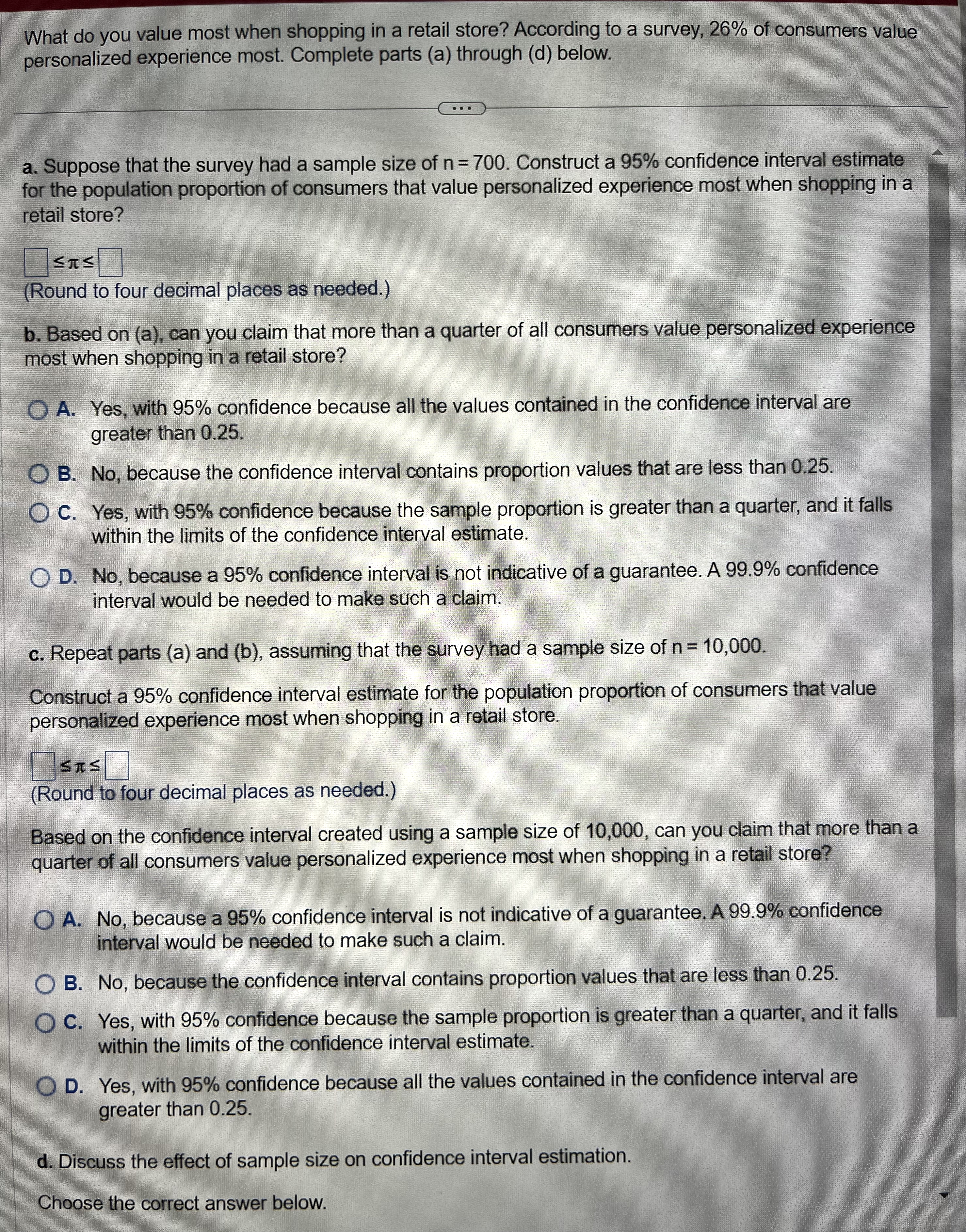
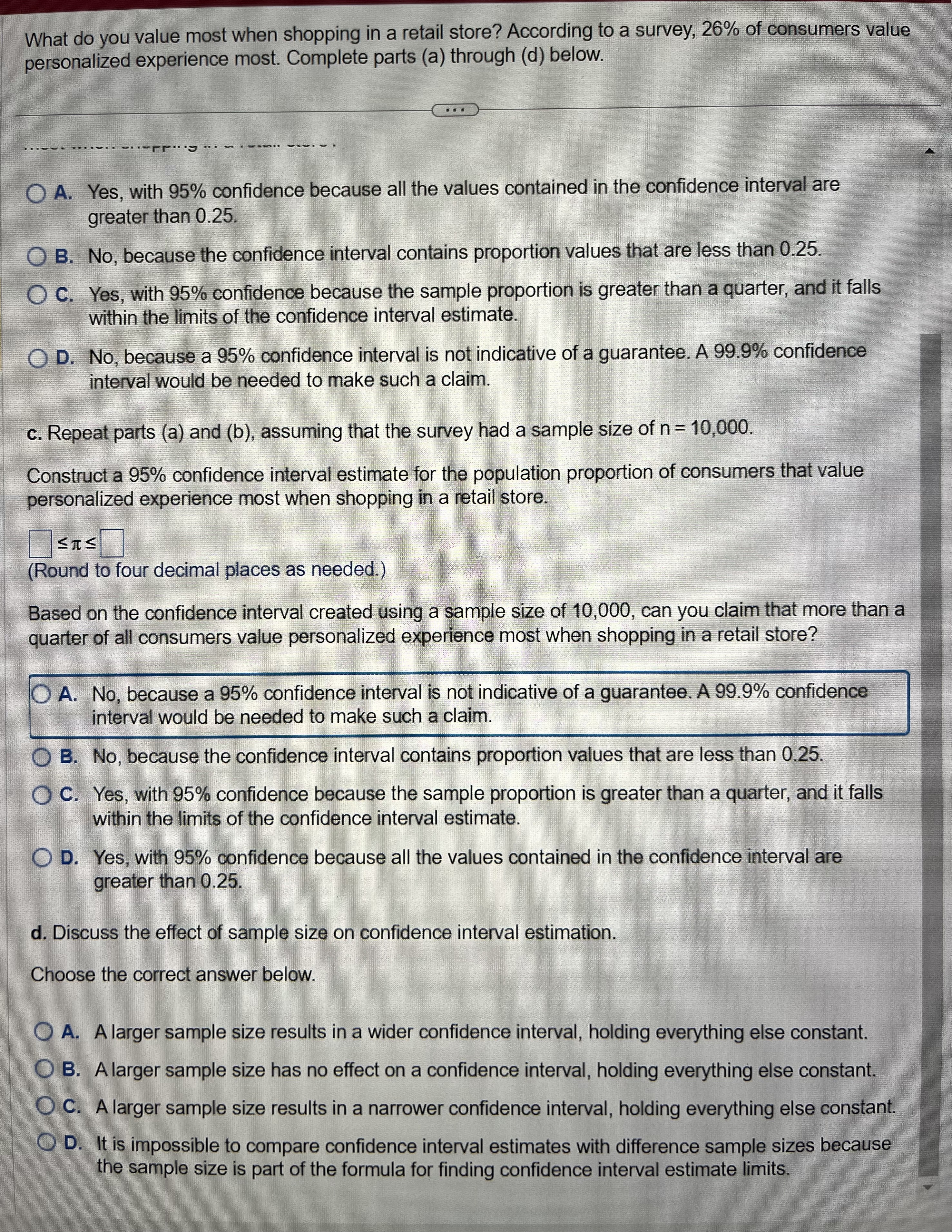
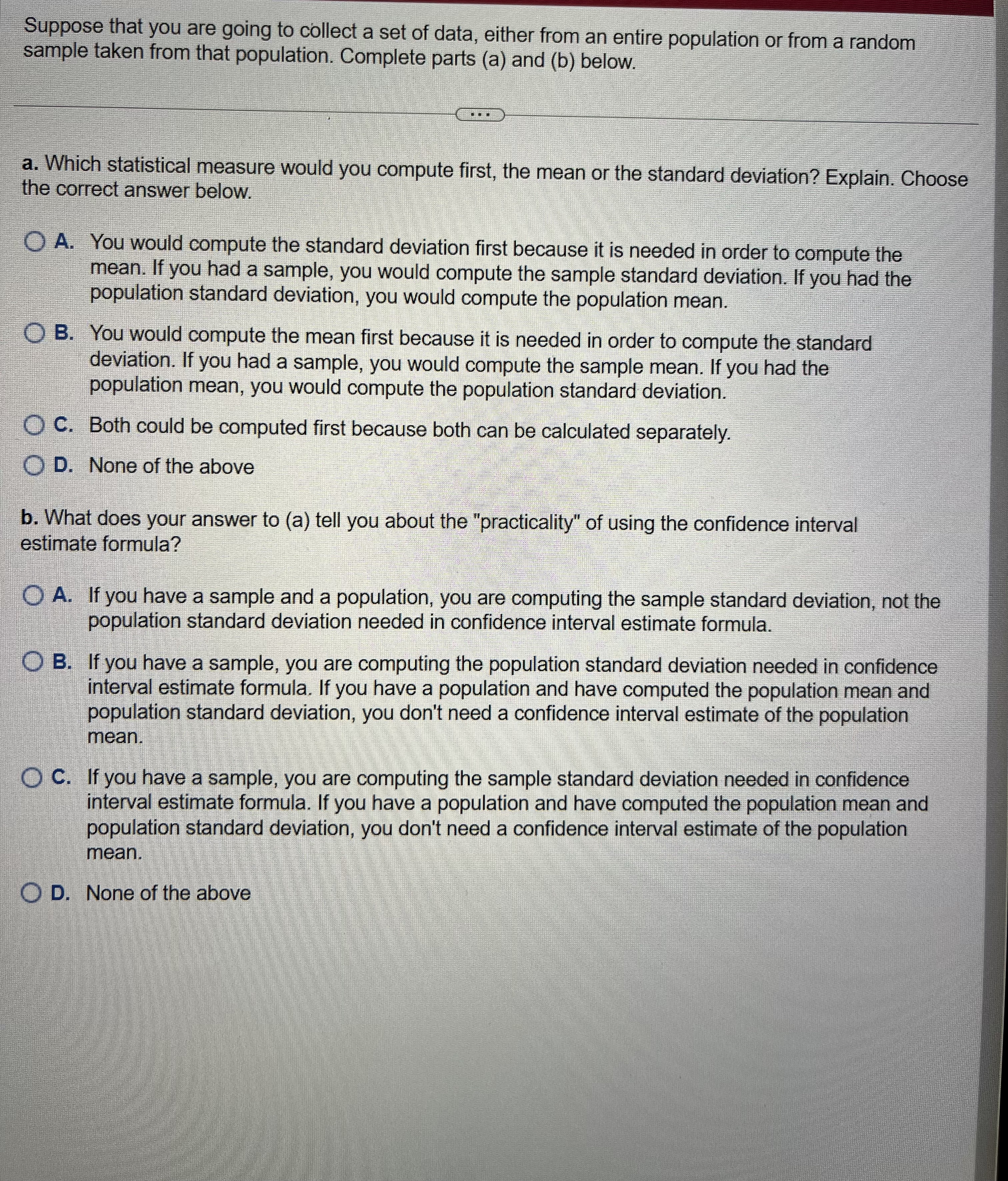
What do you value most when shopping in a retail store? According to a survey, 26% of consumers value personalized experience most. Complete parts (a) through (d) below. a. Suppose that the survey had a sample size of n = 700. Construct a 95% confidence interval estimate for the population proportion of consumers that value personalized experience most when shopping in a retail store? STUS Round to four decimal places as needed.) b. Based on (a), can you claim that more than a quarter of all consumers value personalized experience most when shopping in a retail store? O A. Yes, with 95% confidence because all the values contained in the confidence interval are greater than 0.25. O B. No, because the confidence interval contains proportion values that are less than 0.25. O C. Yes, with 95% confidence because the sample proportion is greater than a quarter, and it falls within the limits of the confidence interval estimate. O D. No, because a 95% confidence interval is not indicative of a guarantee. A 99.9% confidence interval would be needed to make such a claim. c. Repeat parts (a) and (b), assuming that the survey had a sample size of n = 10,000. Construct a 95% confidence interval estimate for the population proportion of consumers that value personalized experience most when shopping in a retail store. STS (Round to four decimal places as needed.) Based on the confidence interval created using a sample size of 10,000, can you claim that more than a quarter of all consumers value personalized experience most when shopping in a retail store? O A. No, because a 95% confidence interval is not indicative of a guarantee. A 99.9% confidence interval would be needed to make such a claim. O B. No, because the confidence interval contains proportion values that are less than 0.25. O C. Yes, with 95% confidence because the sample proportion is greater than a quarter, and it falls within the limits of the confidence interval estimate. O D. Yes, with 95% confidence because all the values contained in the confidence interval are greater than 0.25. d. Discuss the effect of sample size on confidence interval estimation. Choose the correct answer below.What do you value most when shopping in a retail store? According to a survey, 26% of consumers value personalized experience most. Complete parts (a) through (d) below. A. Yes, with 95% confidence because all the values contained in the confidence interval are greater than 0.25. O B. No, because the confidence interval contains proportion values that are less than 0.25. O C. Yes, with 95% confidence because the sample proportion is greater than a quarter, and it falls within the limits of the confidence interval estimate. O D. No, because a 95% confidence interval is not indicative of a guarantee. A 99.9% confidence interval would be needed to make such a claim. c. Repeat parts (a) and (b), assuming that the survey had a sample size of n = 10,000. Construct a 95% confidence interval estimate for the population proportion of consumers that value personalized experience most when shopping in a retail store. STS (Round to four decimal places as needed.) Based on the confidence interval created using a sample size of 10,000, can you claim that more than a quarter of all consumers value personalized experience most when shopping in a retail store? A. No, because a 95% confidence interval is not indicative of a guarantee. A 99.9% confidence interval would be needed to make such a claim. O B. No, because the confidence interval contains proportion values that are less than 0.25. O C. Yes, with 95% confidence because the sample proportion is greater than a quarter, and it falls within the limits of the confidence interval estimate. O D. Yes, with 95% confidence because all the values contained in the confidence interval are greater than 0.25. d. Discuss the effect of sample size on confidence interval estimation. Choose the correct answer below. O A. A larger sample size results in a wider confidence interval, holding everything else constant. O B. A larger sample size has no effect on a confidence interval, holding everything else constant. O C. A larger sample size results in a narrower confidence interval, holding everything else constant. D. It is impossible to compare confidence interval estimates with difference sample sizes because the sample size is part of the formula for finding confidence interval estimate limits.Suppose that you are going to collect a set of data, either from an entire population or from a random sample taken from that population. Complete parts (a) and (b) below. a. Which statistical measure would you compute first, the mean or the standard deviation? Explain. Choose the correct answer below. A. You would compute the standard deviation first because it is needed in order to compute the mean. If you had a sample, you would compute the sample standard deviation. If you had the population standard deviation, you would compute the population mean. O B. You would compute the mean first because it is needed in order to compute the standard deviation. If you had a sample, you would compute the sample mean. If you had the population mean, you would compute the population standard deviation. O C. Both could be computed first because both can be calculated separately. O D. None of the above b. What does your answer to (a) tell you about the "practicality" of using the confidence interval estimate formula? O A. If you have a sample and a population, you are computing the sample standard deviation, not the population standard deviation needed in confidence interval estimate formula. O B. If you have a sample, you are computing the population standard deviation needed in confidence interval estimate formula. If you have a population and have computed the population mean and population standard deviation, you don't need a confidence interval estimate of the population mean. O C. If you have a sample, you are computing the sample standard deviation needed in confidence interval estimate formula. If you have a population and have computed the population mean and population standard deviation, you don't need a confidence interval estimate of the population mean. O D. None of the above
Step by Step Solution
There are 3 Steps involved in it

Get step-by-step solutions from verified subject matter experts
 Study Help