







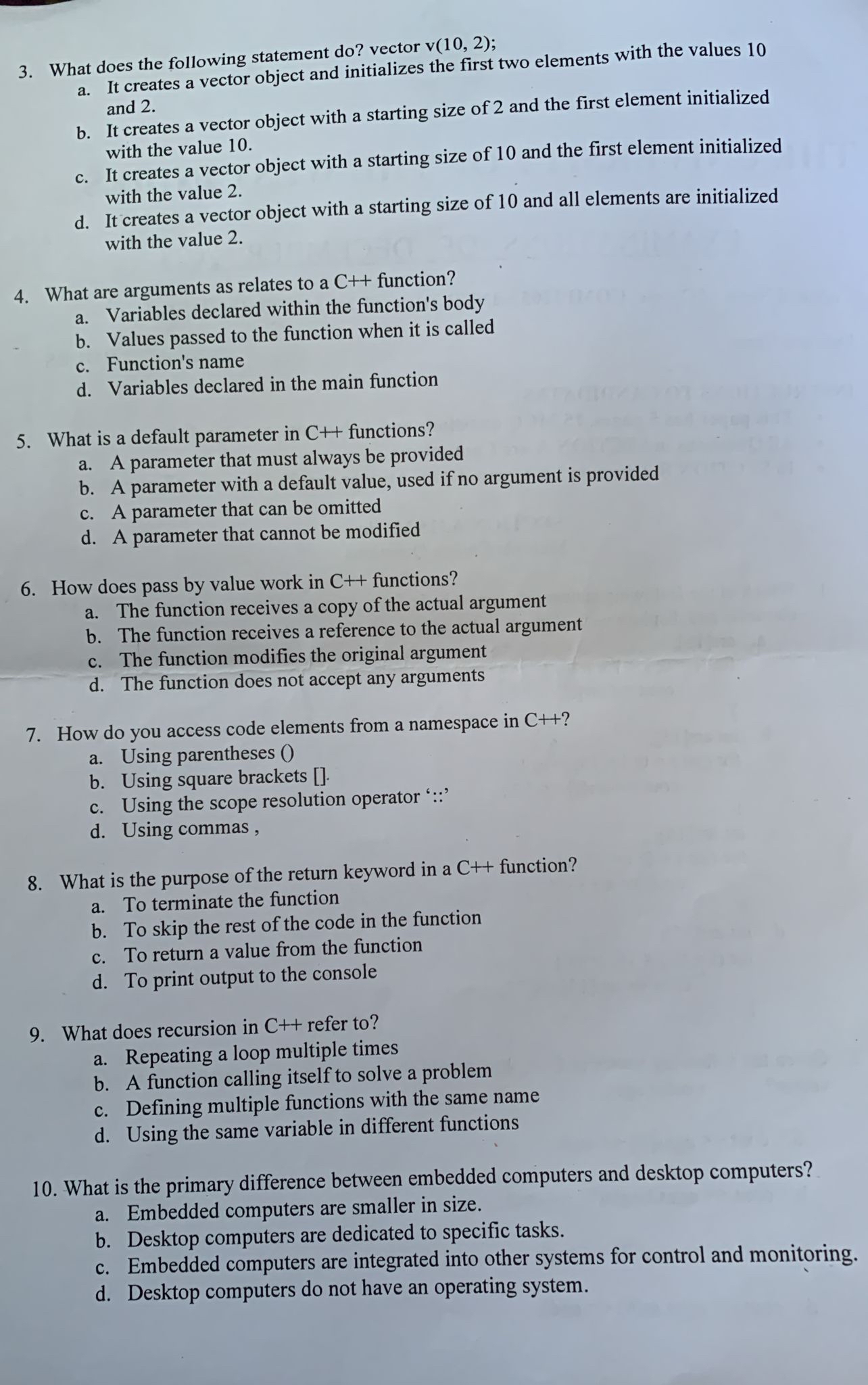
Question: What does the following statement do ? vector v ( 1 0 , 2 ) ; a . It creates a vector object and initializes
What does the following statement do vector ;
a It creates a vector object and initializes the first two elements with the values and
b It creates a vector object with a starting size of and the first element initialized with the value
c It creates a vector object with a starting size of and the first element initialized with the value
d It creates a vector object with a starting size of and all elements are initialized with the value
What are arguments as relates to a function?
a Variables declared within the function's body
b Values passed to the function when it is called
c Function's name
d Variables declared in the main function
What is a default parameter in functions?
a A parameter that must always be provided
b A parameter with a default value, used if no argument is provided
c A parameter that can be omitted
d A parameter that cannot be modified
How does pass by value work in functions?
a The function receives a copy of the actual argument
b The function receives a reference to the actual argument
c The function modifies the original argument
d The function does not accept any arguments
How do you access code elements from a namespace in
a Using parentheses
b Using square brackets
c Using the scope resolution operator ::
d Using commas,
What is the purpose of the return keyword in a function?
a To terminate the function
b To skip the rest of the code in the function
c To return a value from the function
d To print output to the console
What does recursion in refer to
a Repeating a loop multiple times
b A function calling itself to solve a problem
c Defining multiple functions with the same name
d Using the same variable in different functions
What is the primary difference between embedded computers and desktop computers?
a Embedded computers are smaller in size.
b Desktop computers are dedicated to specific tasks.
c Embedded computers are integrated into other systems for control and monitoring.
d Desktop computers do not have an operating system.
Step by Step Solution
There are 3 Steps involved in it
1 Expert Approved Answer
Step: 1 Unlock

Question Has Been Solved by an Expert!
Get step-by-step solutions from verified subject matter experts
Step: 2 Unlock
Step: 3 Unlock
 Study Help