







Question: What does the term clipping refer to in computer graphics? ( a ) Removing hidden surfaces in a 3 D scene. ( b ) Adjusting
What does the term "clipping" refer to in computer graphics?
a Removing hidden surfaces in a D scene.
b Adjusting the brightness and contrast of an image.
c Representing D or D points using an additional coordinate for transformations.
d Removing portions of graphical objects that fall outside a defined boundary.
Which colour model is most commonly used for digital displays like monitors and TVs
a CMYK
b RGB
c HSL
d YIQ
What type of mathematical object is characterised by both magnitude and direction?
a Vector
b Matrix
c Scalar
d Point
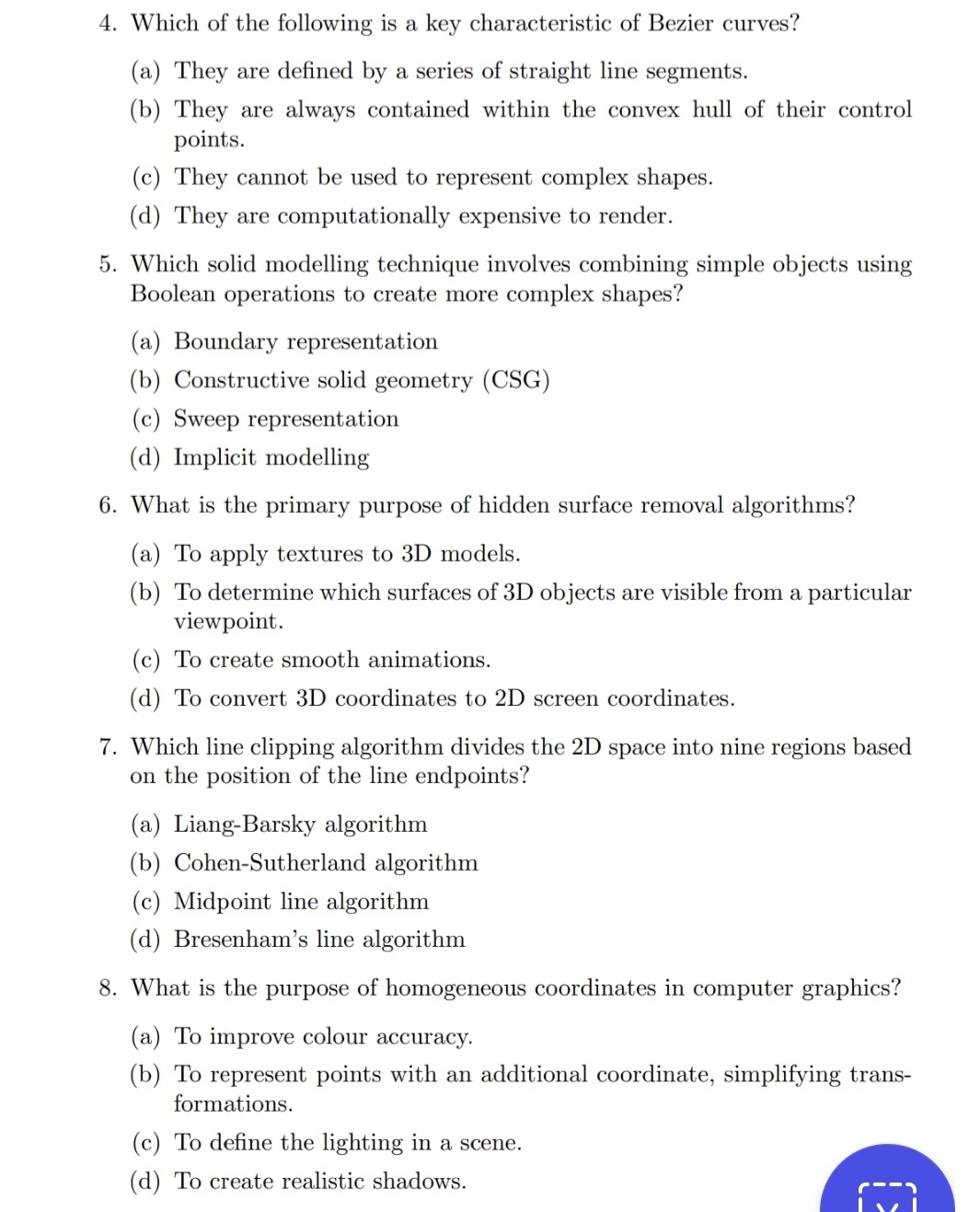
Which of the following is a key characteristic of Bezier curves?
a They are defined by a series of straight line segments.
b They are always contained within the convex hull of their control points.
c They cannot be used to represent complex shapes.
d They are computationally expensive to render.
Which solid modelling technique involves combining simple objects using Boolean operations to create more complex shapes?
a Boundary representation
b Constructive solid geometry CSG
c Sweep representation
d Implicit modelling
What is the primary purpose of hidden surface removal algorithms?
a To apply textures to D models.
b To determine which surfaces of D objects are visible from a particular viewpoint.
c To create smooth animations.
d To convert D coordinates to D screen coordinates.
Which line clipping algorithm divides the D space into nine regions based on the position of the line endpoints?
a LiangBarsky algorithm
b CohenSutherland algorithm
c Midpoint line algorithm
d Bresenham's line algorithm
What is the purpose of homogeneous coordinates in computer graphics?
a To improve colour accuracy.
b To represent points with an additional coordinate, simplifying transformations.
c To define the lighting in a scene.
d To create realistic shadows.
Step by Step Solution
There are 3 Steps involved in it
1 Expert Approved Answer
Step: 1 Unlock

Question Has Been Solved by an Expert!
Get step-by-step solutions from verified subject matter experts
Step: 2 Unlock
Step: 3 Unlock
 Study Help