Question: What else do I need to add? Consider the following constraints for logistics network design: a. There is a budget limit. b. There is a
What else do I need to add? 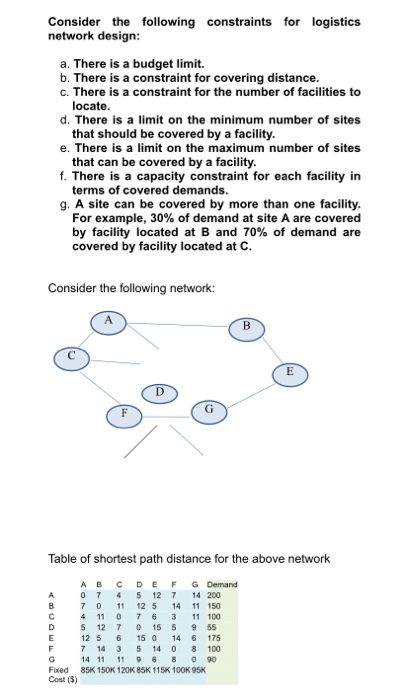
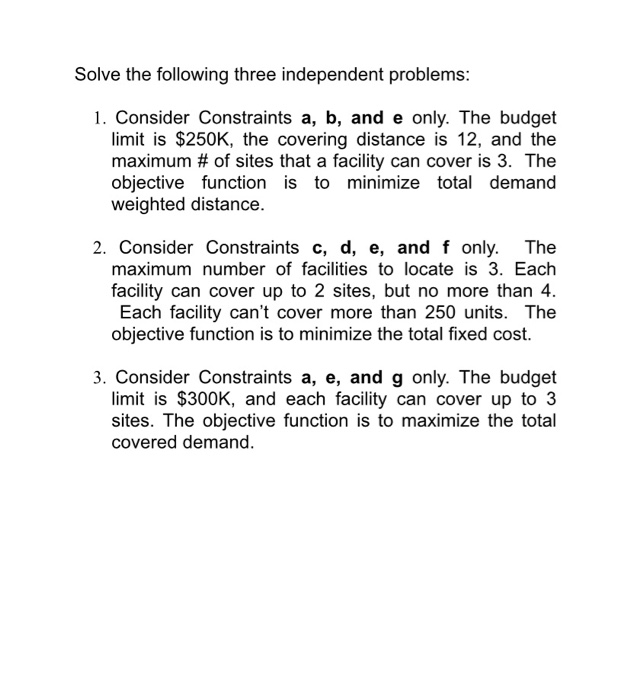
Consider the following constraints for logistics network design: a. There is a budget limit. b. There is a constraint for covering distance. c. There is a constraint for the number of facilities to locate. d. There is a limit on the minimum number of sites that should be covered by a facility. e. There is a limit on the maximum number of sites that can be covered by a facility. f. There is a capacity constraint for each facility in terms of covered demands. g. A site can be covered by more than one facility. For example, 30% of demand at site A are covered by facility located at B and 70% of demand are covered by facility located at C. Consider the following network: Table of shortest path distance for the above network C D A B C D E F G Demand A 0 7 4 5 12 7 14 200 B 7 0 11 12 5 14 11 150 4 11 0 7 6 3 11 100 5 127 0 15 5 9 55 12 5 6 15 0 14 6 175 7 14 3 5 14 0 8 100 14 11 11 6 8 0 90 Fixed 85K 150K 120K 85K 115K 100K 95K Cost ($) Solve the following three independent problems: 1. Consider Constraints a, b, and e only. The budget limit is $250K, the covering distance is 12, and the maximum # of sites that a facility can cover is 3. The objective function is to minimize total demand weighted distance. 2. Consider Constraints c, d, e, and f only. The maximum number of facilities to locate is 3. Each facility can cover up to 2 sites, but no more than 4. Each facility can't cover more than 250 units. The objective function is to minimize the total fixed cost. 3. Consider Constraints a, e, and g only. The budget limit is $300K, and each facility can cover up to 3 sites. The objective function is to maximize the total covered demand. Consider the following constraints for logistics network design: a. There is a budget limit. b. There is a constraint for covering distance. c. There is a constraint for the number of facilities to locate. d. There is a limit on the minimum number of sites that should be covered by a facility. e. There is a limit on the maximum number of sites that can be covered by a facility. f. There is a capacity constraint for each facility in terms of covered demands. g. A site can be covered by more than one facility. For example, 30% of demand at site A are covered by facility located at B and 70% of demand are covered by facility located at C. Consider the following network: Table of shortest path distance for the above network C D A B C D E F G Demand A 0 7 4 5 12 7 14 200 B 7 0 11 12 5 14 11 150 4 11 0 7 6 3 11 100 5 127 0 15 5 9 55 12 5 6 15 0 14 6 175 7 14 3 5 14 0 8 100 14 11 11 6 8 0 90 Fixed 85K 150K 120K 85K 115K 100K 95K Cost ($) Solve the following three independent problems: 1. Consider Constraints a, b, and e only. The budget limit is $250K, the covering distance is 12, and the maximum # of sites that a facility can cover is 3. The objective function is to minimize total demand weighted distance. 2. Consider Constraints c, d, e, and f only. The maximum number of facilities to locate is 3. Each facility can cover up to 2 sites, but no more than 4. Each facility can't cover more than 250 units. The objective function is to minimize the total fixed cost. 3. Consider Constraints a, e, and g only. The budget limit is $300K, and each facility can cover up to 3 sites. The objective function is to maximize the total covered demand









 Study Help