







Question: what information do you need? it's just a rewriting formula. putting that thing to a cnf:) which is conjunctive normal form:) 4 CNF Conversion Consider
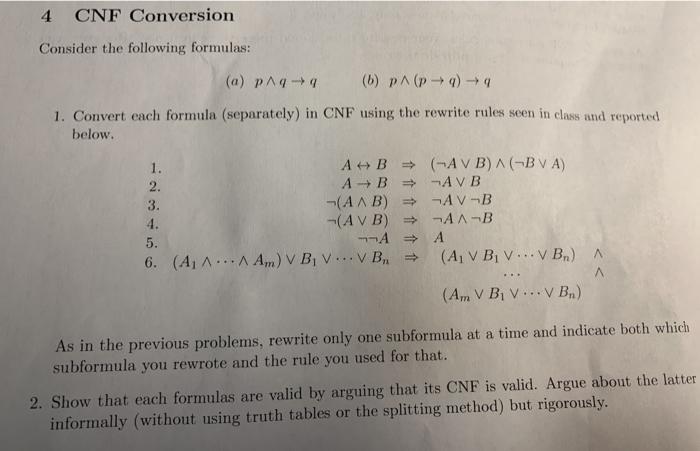
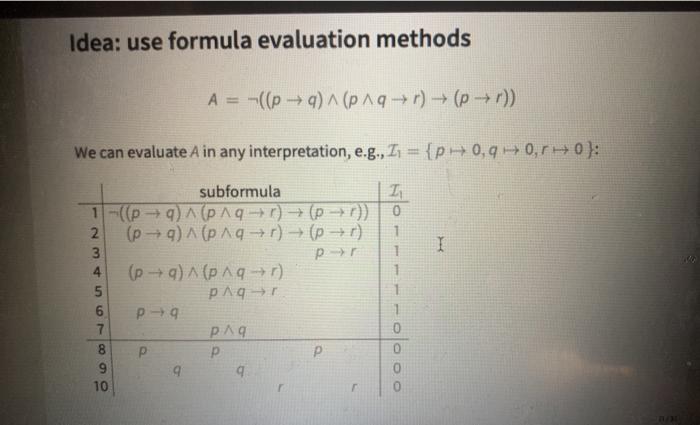
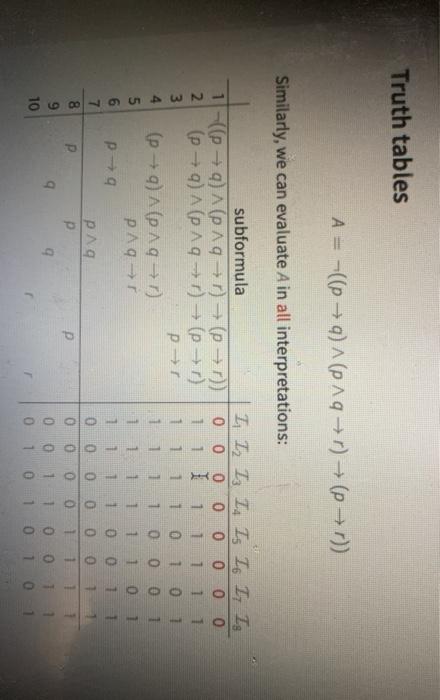
4 CNF Conversion Consider the following formulas: (a) p19 (6) p (p) 1. Convert each formula (separately) in CNF using the rewrite rules seen in class and reported below. 1. A B = (-AVB) A(-B VA) 2. A B - AVB 3. (AAB) = -AV-B 4. (AVB) AA-B 5. A A 6. (A, A... A) VB, V...VB, (A, V BI V...VB.) A A (Amv Bi V...VB.) As in the previous problems, rewrite only one subformula at a time and indicate both which subformula you rewrote and the rule you used for that. 2. Show that each formulas are valid by arguing that its CNF is valid. Argue about the latter informally (without using truth tables or the splitting method) but rigorously. Idea: use formula evaluation methods A = -((p q)^(p^q + r) + (p+r)) We can evaluate A in any interpretation, e.g., I1 = {p +0,9 0,H0}: I 0 1 subformula 1 -((p 9) (PAT) (p >)) 2 (p-1)^( pq+) (p =0) 3 4 (+9) (p AQ ->) 5 png r P-9 7 png 8 P 9 9 9 10 1 1 1 1 O CO 0 Truth tables A = -((p + 9) A (p1qr) ( pr)) Similarly, we can evaluate A in all interpretations: subformula 14 I Iz Iz It Is Is It Is 1 -((p + 9) A (p 4g + r) ( pr)) 0 0 0 0 0 0 0 0 2. (p 9) A (p 19 ) ( pr) 1 1 1 1 1 Ptr 0 4 (p + 9) A (p Aar) 1 1 1 1 0 0 0 1 pAq- 11 1 1 0 1 6 P - 9 1 1 0 paq 0 0 0 0 0 0 8 P 0 0 0 0 1 9 0 0 1 1 0 0 1 10 0 1 0 1 0 1 = 0 P b
Step by Step Solution
There are 3 Steps involved in it

Get step-by-step solutions from verified subject matter experts
 Study Help