







Question: What internal data to you need for your analysis? Case 3-2 Lambert-Martin Automotive Systems Inc. Arthur Thomas, vice president of global purchasing, En Bill suggested
What internal data to you need for your analysis?
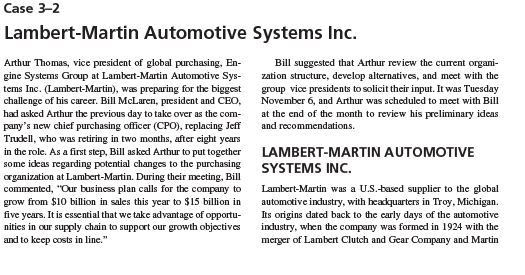
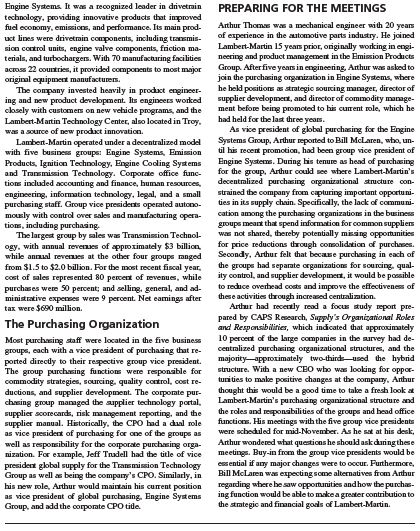
Case 3-2 Lambert-Martin Automotive Systems Inc. Arthur Thomas, vice president of global purchasing, En Bill suggested that Arthur review the current organi- gine Systems Group at Lambert-Martin Automotive Sys zation structure, develop alternatives, and meet with the tems Inc. (Lambert-Martin), was preparing for the biggest group vice presidents to solicit their input. It was Tuesday challenge of his career. Bill McLaren, president and CEO, November 6, and Arthur was scheduled to meet with Bill had asked Arthur the previous day to take over as the com at the end of the month to review his preliminary ideas pany's new chief purchasing officer (CPO), replacing Jeff and recommendations. Trudell, who was retiring in two months after eight years in the role. As a first step, Bill asked Arthur to put together LAMBERT-MARTIN AUTOMOTIVE some ideas regarding potential changes to the purchasing organization at Lambert-Martin. During their meeting, Bill SYSTEMS INC. commented, "Our business plan calls for the company to Lambert-Martin was a U.S.-based supplier to the global grow from $10 billion in sales this year to $15 billion in automotive industry, with headquarters in Troy, Michigan. five years. It is essential that we take advantage of opportu Its origins dated back to the carly days of the automotive nities in our supply chain to support our growth objectives industry, when the company was formed in 1924 with the and to keep costs in line." merger of Lambert Clutch and Gear Company and Martin Engine Systems. It was a recognized leader in drivetrain technology, providing innovative products that improved fuel economy. emissions, and performance. Its main prod. uct lines were drivetrain components, including transmis- sion control units, engine valve components, friction ma- terials, and turbochargers. With 70 manufacturing facilities across 22 countries, it provided components to most major original equipment manufacturen. The company invested heavily in product engineer- ing and new product development. Its engineers worked closely with customers on new vehicle programs, and the Lambert-Martin Technology Center, also located in Troy. was a source of new product innovation Lambert-Martin operated under a decentralized model with five business groups: Engine Systems, Emission Products, Ignition Technology, Engine Cooling Systems and Transmission Technology. Corporate office func- tiones included accounting and finance, human resources. engineering, information technology, legal, and a small purchasing staff. Group vice presidents operated autono- mously with control over sales and manufacturing opera tions, including purchasing The largest group by sales was Transmission Technol- ogy, with annual revenues of approximately $3 billion while annual revenues at the other four groups ranged from $1.5 to $2.0 billion. For the most recent fiscal year, cost of sales represented 80 percent of revenues, while purchases were 50 percent; and selling general, and ad ministrative expenses were 9 percent. Net eamings after tax were $690 million The Purchasing Organization Most purchasing staff were located in the five business groups, each with a vice president of purchasing that re- ported directly to their respective group vice president. The group purchasing functions were responsible for commodity strategies, sourcing, quality control, cost re- ductions, and supplier development. The corporate pur- chasing group managed the supplier technology portal supplier scorecard, risk management reporting, and the supplier manual. Historically, the CPO had a dual role as vice president of purchasing for ce of the groups as well as responsibility for the corporate purchasing orga- nization. For example, Jeff Trudell had the title of vice president global supply for the Transmission Technology Group as well as being the company's CPO. Similarly, in his new role, Arthur would maintain his current position as vice president of global purchasing. Hngine Systems Group, and add the corporate CPO tidle. PREPARING FOR THE MEETINGS Arthur Thoms was a mechanical engineer with 20 years of experience in the automotive parts industry. He joined Lambert-Martin 15 years prior originally working in engi- neering and product management in the mission Products Group. After five years in engineering Arthur was asked to join the purchasing organization in Engine Systems, where he held position strategic Sourcing manager, director of supplier development, and director of commodity manage- ment before being promoted to his current role, which he had held for the last three years. As vice president of global purchasing for the Engine Systems Group, Arthur reported to Bill McLaren, who, un- til his recent promotion, had been group vice president of Engine Systeme. During his tenure as head of purchasing for the group. Arthur could see where Lambert-Martin's decentralized purchasing organizational structure con- strained the company from capturing important opportuni- ties in its supply chain. Specifically, the lack of communi- cation among the purchasing organizations in the business groups meant that spend information for common suppliers was not shared, thereby potentially missing opportunities for price reductions through consolidation of purchases. Secondy, Arthur felt that because purchasing in cach of the groups had separate organizations for sourcing, qual- ity control, and supplier development, it would be possible to reduce overhead costs and improve the effectiveness of these activities through increased centralization Arthur had recently read a focus study report pre- pared by CAPS Rearch, Supply's Organisational Rokes and Responsibilities, which indicated that approximately 10 percent of the large companies in the survey had de- centralized purchasing organizational structures, and the majority-approximately two-thirds used the hybrid structure. With a new CEO who was looking for oppor- tunities to make positive changes at the company. Arthur thought this would be a good time to take a fresh look at Lambert-Martin's purchasing organizational structure and the roles and responsibilities of the groups and head office functions. His meetings with the five group vice presidents were scheduled for mid-November. As he sat at his desk, Arthur wondered what questions he should ask during these meetings. Buy-in from the group vice presidents would be essential if any major changes were to occur. Furthermore, Bill McLaren was expecting some alternatives from Arthur regarding where he saw opportunities and how the purchas- ing function would be able to make a greater contribution to the strategic and financial goals of Lambert-MartinStep by Step Solution
There are 3 Steps involved in it
1 Expert Approved Answer
Step: 1 Unlock

Question Has Been Solved by an Expert!
Get step-by-step solutions from verified subject matter experts
Step: 2 Unlock
Step: 3 Unlock
 Study Help