







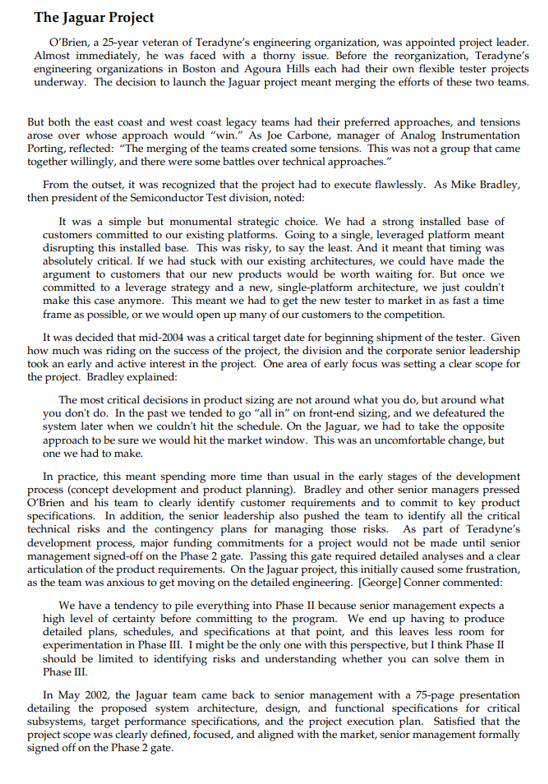
Question: what is the 2 Major Problems and 2 Minor Problems of The Jaguar Project O'Brien, a 2 5 - year veteran of Teradyne's engineering organization,
what is the Major Problems and Minor Problems of The Jaguar Project
O'Brien, a year veteran of Teradyne's engineering organization, was appointed project leader.
Almost immediately, he was faced with a thorny issue. Before the reorganization, Teradyne's
engineering organizations in Boston and Agoura Hills each had their own flexible tester projects
underway. The decision to launch the Jaguar project meant merging the efforts of these two teams.
But both the east coast and west coast legacy teams had their preferred approaches, and tensions
arose over whose approach would "win." As Joe Carbone, manager of Analog Instrumentation
Porting, reflected: "The merging of the teams created some tensions. This was not a group that came
together willingly, and there were some battles over technical approaches."
From the outset, it was recognized that the project had to execute flawlessly. As Mike Bradley,
then president of the Semiconductor Test division, noted:
It was a simple but monumental strategic choice. We had a strong installed base of
customers committed to our existing platforms. Going to a single, leveraged platform meant
disrupting this installed base. This was risky, to say the least. And it meant that timing was
absolutely critical. If we had stuck with our existing architectures, we could have made the
argument to customers that our new products would be worth waiting for. But once we
committed to a leverage strategy and a new, singleplatform architecture, we just couldn't
make this case anymore. This meant we had to get the new tester to market in as fast a time
frame as possible, or we would open up many of our customers to the competition.
It was decided that mid was a critical target date for beginning shipment of the tester. Given
how much was riding on the success of the project, the division and the corporate senior leadership
took an early and active interest in the project. One area of early focus was setting a clear scope for
the project. Bradley explained:
The most critical decisions in product sizing are not around what you do but around what
you don't do In the past we tended to go "all in on frontend sizing, and we defeatured the
system later when we couldn't hit the schedule. On the Jaguar, we had to take the opposite
approach to be sure we would hit the market window. This was an uncomfortable change, but
one we had to make.
In practice, this meant spending more time than usual in the early stages of the development
process concept development and product planning Bradley and other senior managers pressed
O'Brien and his team to clearly identify customer requirements and to commit to key product
specifications. In addition, the senior leadership also pushed the team to identify all the critical
technical risks and the contingency plans for managing those risks. As part of Teradyne's
development process, major funding commitments for a project would not be made until senior
management signedoff on the Phase gate. Passing this gate required detailed analyses and a clear
articulation of the product requirements. On the Jaguar project, this initially caused some frustration,
as the team was anxious to get moving on the detailed engineering. George Conner commented:
We have a tendency to pile everything into Phase II because senior management expects a
high level of certainty before committing to the program. We end up having to produce
detailed plans, schedules, and specifications at that point, and this leaves less room for
experimentation in Phase III. I might be the only one with this perspective, but I think Phase II
should be limited to identifying risks and understanding whether you can solve them in
Phase III.
In May the Jaguar team came back to senior management with a page presentation
detailing the proposed system architecture, design, and functional specifications for critical
subsystems, target performance specifications, and the project execution plan. Satisfied that the
project scope was clearly defined, focused, and aligned with the market, senior management formally
signed off on the Phase gate.
Step by Step Solution
There are 3 Steps involved in it
1 Expert Approved Answer
Step: 1 Unlock

Question Has Been Solved by an Expert!
Get step-by-step solutions from verified subject matter experts
Step: 2 Unlock
Step: 3 Unlock
 Study Help