







Question: What is the 3rd node to be eliminated from the set S = {A,B,C,D,E,F,G}? What is the full shortest path from node H to node
What is the 3rd node to be eliminated from the set S = {A,B,C,D,E,F,G}?
What is the full shortest path from node H to node B? (e.g. for a path from H to D you would type "H-D" without the quotes)
What is the cost of the shortest path from node H to node B?
Fill in the complete routing table for node H, as it would be calculated by Dijkstra's algorithm and stored inside router H. (It's OK to do this by inspection; you don't have to crank through Dijkstra's algorithm for each destination.)
| Destination | First Hop |
| A | |
| B | |
| C | |
| D | |
| E | |
| F | |
| G |
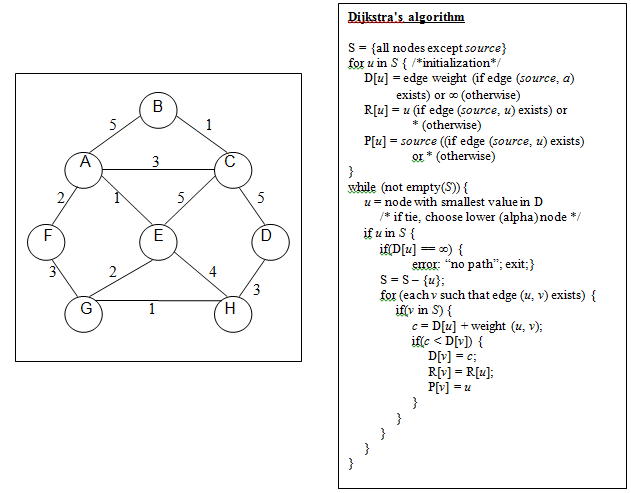
S fall nodes exceptsource) for u in S f /*initialization*/ D[u] - edge weight (if edge (source, a) R[u] = u (if edge (source, u) exists) or P[al-source (it edge (Gource, u) exists) exists) or r (otherwise) * (otherwise) or* (otherwise) while (not empty(S)) u= node wth smallest value m D if tie, choose lower (alpha) node */ ifuin S { eror: "no path"; exit;) for (eachv such that edge (u, v) exists) { iffv in S)\ c= D[u] + weight (u, v); ific
Step by Step Solution
There are 3 Steps involved in it

Get step-by-step solutions from verified subject matter experts
 Study Help