







Question: What is the background information of this case study? Chapter 10 Warehousing Management 201 fulticlient war e of public an me to warehous a decision
What is the background information of this case study?
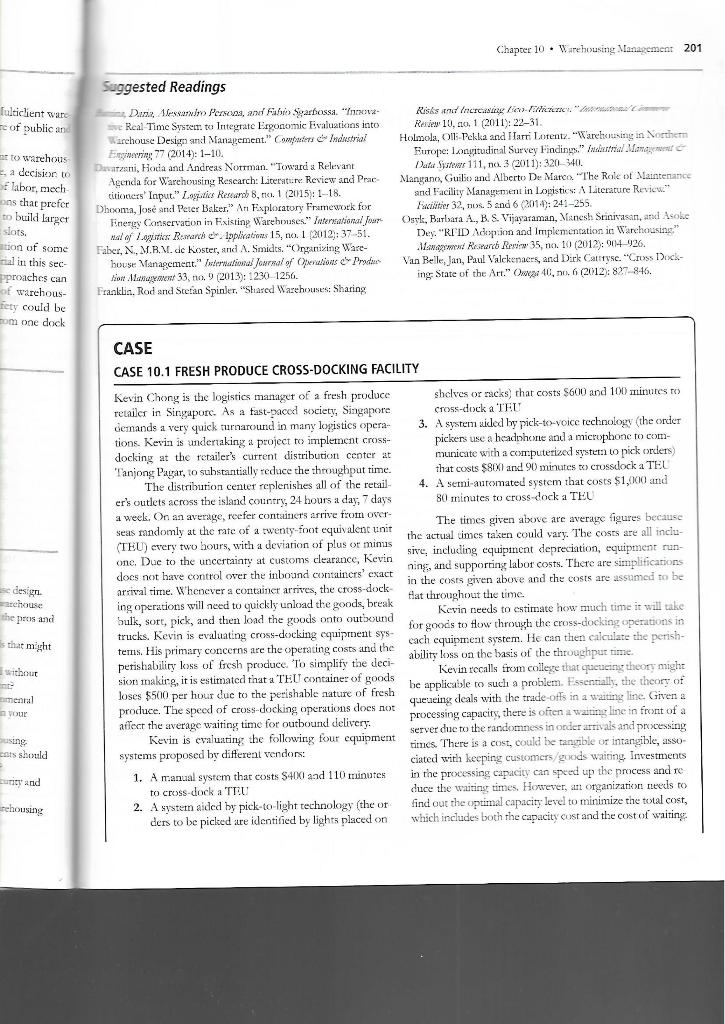
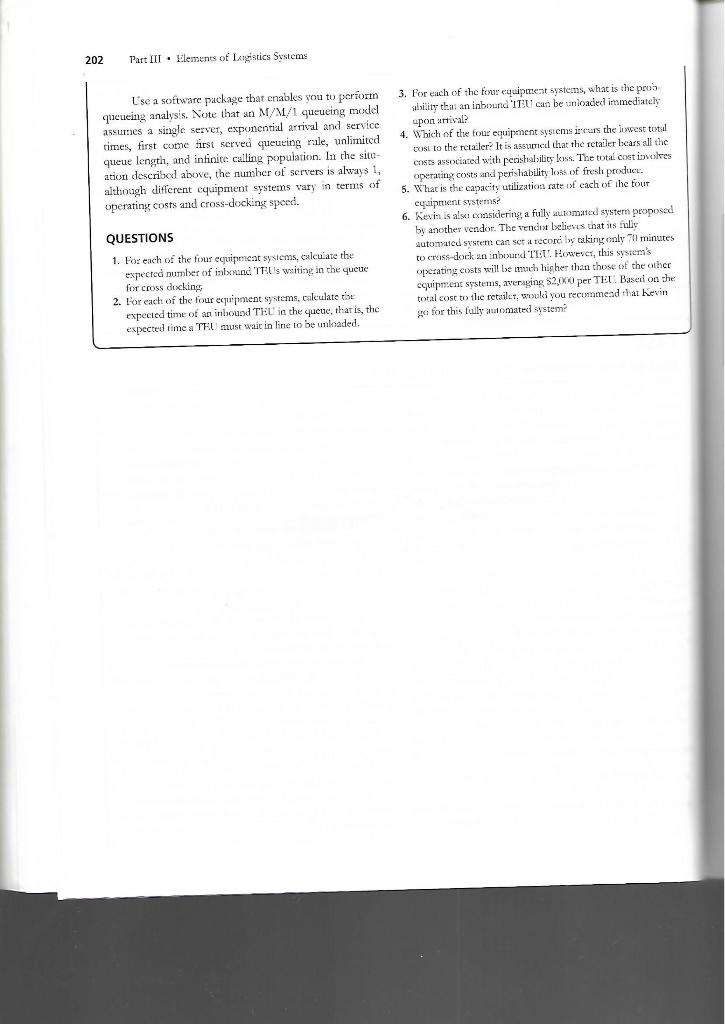
Chapter 10 Warehousing Management 201 fulticlient war e of public an me to warehous a decision to Of labor, crech- ons that prefer to build larget slots. ation of some rial in this sec pproaches can of warehous- fety could be tom poe dock Suggested Readings Dan Hessarimo Perseas, and fub Syarbossa. "Inova- we Real Time System: to Integrate Ergonomie Evaluations into Warehouse Design and Management." Computers e Industrial Engine 77 (2014): 1-10. Duvarza, Hacia and Andreas Norman. "Toward a Relevant Agenda for Warehousing Research: Literature Review and Peac citioners' Input." Low Reseamob 8. c. 1 (2015): 1-18. Dhooma, Jos and Peter Baker." An Exploratory Framework for Energy Conservation in Existing Warehouses." International for Nalo/stics Rewardh e dopirations 15, no. 1 (2012): 37 51. Faber, N.M.B.M.de Koster, and A. Smidts. "Organizing Ware- house Management." Iwernational Journal of Operations du Prodees How Manyen 33, no. 1 (2013): 1230 1256. Franklin, Rod and Stefan Spinler. "Shared Warehouses: Sharing Risks and increasing lat, Reivew 10.00, 1 (2011): 22-31 Homola, Oll Pekka and Ilarri Lorentz. "Warehousing in Northern Europe: longitudinal Survey Findings." Industrial Management Date 111, no. 3 (2011): 320 340. Mangano, Guilies and Alberto De Marco The Role of Maintenance and Facility Management in Logistics: A Literature Review." Faciliter 32, tos. 5 and 6 (2014): 247-255 Osyk, Barbara A., B. S. Vijayaraman, Nanesh Stinivasan, and Asoke Dey. "RrID Adprion and Implementation in Warehousing." awww Research Rewiw 35, no. 10 (2012): 004-926. Van Belle, Jan, Paul Valckenaces, and Dirk Cartuse. "CIUS Dock- ing State of the Ari." Ow40, 0, 6 (2012): 827 846. se design archouse the peos and CASE CASE 10.1 FRESH PRODUCE CROSS-DOCKING FACILITY Kevin Chong is the logistics manager of a fresh produce shelves or racks that costs $600 and 100 minutes to retailer in Singaporc. As a fast-paced society, Singapore cross-duck a TEU demands a very quick surnaround in many logistics opera 3. A system sided by pick-to-voice technology (the order tions. Kevin is undertaking a project to implement cross pickers use a headphone and a microphone to com docking at the retailer's current distribution center at municate with a computerized systeta to pick orders) "Tanjong Pagar, to substantially reduce the throughput time. that costs $80X) and 90 minutes to crosscock a TEU The distribution center replenishes all of the retail 4. A semi-automated system that costs $1,000 and er's outlets across the island country, 24 hours a day, 7 days 80 minutes to cross-dock a TEU a week, On an average, reefer containers arrive from over- seas randomly at the rate of a twenty-foot equivalent unit The times given above are average figures because the actual times taken could vary. The costs are all inclu- (TEU) every two hours, with a deviation of plus or minus sive, including equipient depreciation, equipment run- one. Due to the uncertainty at customs clearance, Kevin does not have control over the inbound containers' exact ning, and supporting labor costs. There are simplifications arrival time. Whenever a container arrives, the cross-dock in the costs given above and the costs are assumed to be ing operations will need to quickly unload the goods, break Hat throughout the time. bulk, sort, pick, and then load the goods onto outbound Kevin needs to estimate how much time it will take trucks. Kevin is evaluating cross-decking equipment sys- for goods to How through the cross-docking operations in ters. His primary concerns are the operating costs and the cach equipment system. He can then calculate the perish- ability loss on the basis of the throughpur time. petishability less of fresh produce. To simplify the deci- sion making, it is estimated that a TEU container of goods Kevin recalls from college that queueing theory might loses $500 per hour due to the perishable nature of fresh be applicable to such a problem. Essentially, the theory of produce. The speed of cross-docking operations does not queueing deals with the trade-offs in a waiting line. Given a affect the average waiting time for outbound delivery. processing capacity, there is often a waiting line in front of a Kevin is evaluating the following four equipment server due to the randomness in order arrivals and processing times. There is a cost, could be tangible or intangible, asso- systems proposed by different vendor ciated with keeping customers/goods waiting Investments 1. A manual system that costs $40X1 and 110 minutes in the processing capacity can speed up the process and te to cross-dock a TEU duce the waiting times. However, an organization needs to 2. A systern aided by pick-to light technology (the or find out the optimal capacity level to minimize the total cost, ders to be picked are identified by lights placed on which includes both the capacity cost and the cost of waiting that might without imental your using ents should curity and arehousing 202 Part III. Elements of Lagistics Systems L'se a software package that cnables you to perform queueing analysis. Note that an M/M/1 queueing model assumes a single server, exponential arrival and service times, first come first served queueing rule, unlimited queue length, and intinite calling population. In the situ- ation described above, the number of servers is always 1, although different equipment systems vary in terms of operating costs and cross-docking speed. 3. For each of the four equipment systems, what is the prob sability that an inbound IE can be unloaded immediately upon artisal? 4. Which of the four equipment systems incurs the lowest tutul Cost to the retailer? It is assumed that the retailer bears all the costs associated with perishability less. The total cost is les operating costs and perishability loss of fresh produce 5. What is the capacity utilization rate of each of the four captent Systems 6. Kevin is also considering a fully automated system proposed by another vendor. The vendut believes that its fully automated system can set a record lwy taking only 7 minutes to cross-dock an inbud TEU. However, this system's operating costs will be much higher than those of the other equipment systems, averaging S2, Xper TEL. Basei on the total cost to the retailer, would you recommend that Kevin go for this fully automated system? QUESTIONS 1. For each of the four equipment systems, calculate the expected number of inbound TEUs writing in the queue for cross cucking 2. For each of the four equipment systems, calculate the expected time of an inbound Tee in the queue, that is, the expected time a TEU must wait in line to be ukradedStep by Step Solution
There are 3 Steps involved in it
1 Expert Approved Answer
Step: 1 Unlock

Question Has Been Solved by an Expert!
Get step-by-step solutions from verified subject matter experts
Step: 2 Unlock
Step: 3 Unlock
 Study Help