Question: what is the case about? what is the problem? what was the solution? CASE 3-2 In the Matter of the Loewen Group Inc. and Raymond
what is the case about?
what is the problem?
what was the solution?
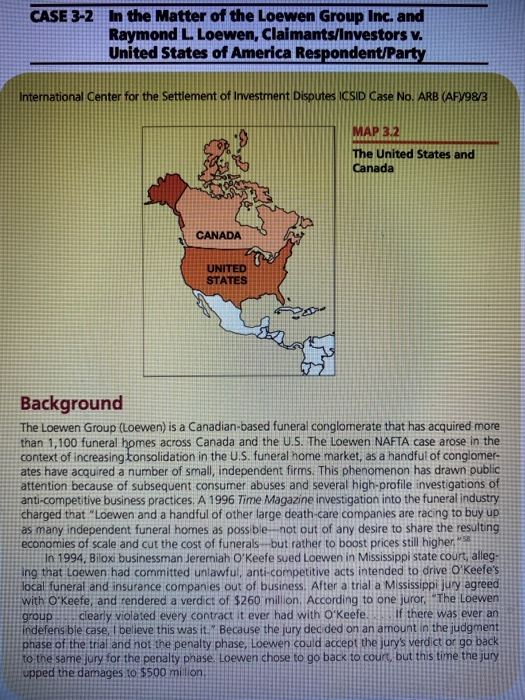
CASE 3-2 In the Matter of the Loewen Group Inc. and Raymond L. Loewen, Claimants/Investors v. United States of America Respondent/Party International Center for the Settlement of Investment Disputes ICSID Case No. ARB (AFY98/3 MAP 3.2 The United States and Canada CANADA UNITED STATES Background The Loewen Group (Loewen) is a Canadian-based funeral conglomerate that has acquired more than 1,100 funeral homes across Canada and the U.S. The Loewen NAFTA case arose in the context of increasing tonsolidation in the U.S. funeral home market, as a handful of conglomer- ates have acquired a number of small, independent firms. This phenomenon has drawn public attention because of subsequent consumer abuses and several high-profile investigations of anti-competitive business practices. A 1996 Time Magazine investigation into the funeral indus charged that "Loewen and a handful of other large death-care companies are raong to buy up as many independent funeral homes as possible not out of any desire to share the resulting economies of scale and cut the cost of funerals but rather to boost prices still higher In 1994. Biloxi businessman Jeremiah O'Keefe sued Loewen in Mississippi state court, alleg ing that toewen had committed unlawful, anti-competitive acts intended to drive O'Keeley local funeral and insurance companies out of business. After a trial a Mississippi juy agreed with O'Keefe, and rendered a verdict of $260 million. According to one juror, The Loewen group clearly violated every contract it ever had with O'Keefe. If there was ever an lederens ble case, I believe this was it. Because the jury dec ded on an amount in the judgment phase of the trial and not the penalty phase, Loewen could accept the jury's verdict or go back e same jury for the penalty phase. Loewen chose to go back to court but this time the jury upped the damages to $500 milion Loewen decided to appeal the jury verdict to a higher court, but wanted to be exempt from posting a bond worth 125% of the damages owed, Posting a bond on appeal is fairly standard practice in U.S. state court. The purpose of this rule is to prevent defendants from using the lengthy appeals process to hide assets or otherwise evade liability to buy a bond, a defendant will typically put forward 10% of the bond requirement in cash and pledge the rest in collateral, Loewen's request to be exempt from the rule was rejected, and Loewen appealed the issue to the Mississippi Supreme Court. In 1996 the Mississippi Supreme Court rejected Loewens demand Rather than post the large bond or pursue other legal avenues, Loewen decided to settle the case with O'Keefe, and on January 29, 1996, the company settled for approximately $150 mil lion, 30% of the jury verdict. On October 30, 1998 Loewen filed suit against the United States in ICSID under Chapter Eleven of the NAFTA. Although Loewen only paid out a fraction of the original jury award, the company demanded 5725 million in compensation from the U.S. government, arguing that the verdict (including the punitive damages) and the bond requirement violated its rights as an inves- tor under Article Eleven of NAFTA. The company claimed that the judge allowed the plaintiff's attorney to appeal to the "anti-Canadian, racial and class biases of a Mississippi jury in viola. tion of national treatment rules in NAFTA Article 1102. The company also claimed that the bond requirement effectively forced Loewen to settle denying its right to appeal in violation of Article 1105 (requiring fair and equitable treatment). Finally, Loewen argued that the excessive verdict, denial of appeal, and coerced settlement were tantamount to an uncompensated expropriation in violation of Article 1110 of NAFTA." Loewen represented the first instance in which a jury ruling has been challenged under NAFTA. In March 1999, ICSID formed a NAFTA panel to hear the case consisting of Anthony Mason (Australia), L. Yves Fortier (Canada), and former Congressman and U.S. federal court judge Abner J. Mikva, On January 9, 2001, the panel issued an interim decision rejecting a variety of U.S. arguments, including the argument that a jury decision in private contract litigation did not constitute a governmental measure under NAFTA. Instead, the panel found NAFTA jurisdiction, and placed no limits on what types of court action or decision it considers covered by NAFTA rules. This ruling opens up the possibility that all court decisions, even those of the U.S. Supreme Court, are now open to review by NAFTA tribunals. The Judgment of the ICSID Arbitration Panel In its award on the merits, the tribunal concluded that the conduct of the trial by the trial judge was so flawed that it constituted a miscarriage of justice amounting to a manifest injustice as that expression is understood in international law." The tribunal faulted the trial judge for allowing several different kinds of prejudicial behavior repeated references to Loewens Canadian nationality, suggestions that Loewen did business only with white people, and appeals to class-based prejudice. Article 1105(1) provides: "Each party shall accord to investments of inves- tors of another party treatment in accordance with international law, including fair and equitable treatment and full protection and security. Although Loewen did not establish that the judge or jury was actually biased against it, the tribunal concluded that "bad faith or malicious inten- tion" was not required. "Manifest injustice in the sense of a lack of due process leading to an outcome which offends a sense of judicial propriety is enough.... Applying this standard, the tribunal said that the whole trial and its resultant verdict were clearly improper and discredit- able and cannot be squared with minimum standards of international law and fair and equitable treatment." UIJPUIL SETTLEME Yet the tribunal rejected the Loewens Article 1105 daim because it had failed to exhaust its domestic remedies in the U.S. judicial system. LG had failed to pursue its domestic remedies, noting that Loewen should have taken the judicial process to the highest level before resorting to a NAFTA ICSID tribunal. If this were not true, the tribunal noted, it would encourage resort to NAFTA bunals rather than resort to the appellate courts and review processes of the host State, an outcome which would seem surprising, having regard to the sophisticated legal systems of the NAFTA Par- ties. Further, it is unlikely that the Parties to NAFTA would have wished to encourage recourse to NAFTA arbitration at the expense of domestic appeal or review when, in the general run of cases, domestic appeal or review would offer more wide-ranging review, as they are not confined to breaches of international law. The central difficulty in Loewen's case, the tribunal concluded, was that "Loewen failed to present evidence disclosing its reasons for entering into the settlement agreement in preference to pursuing other options, in particular the Supreme Court option s The tribunal did offer an explanation as to why it had declined to correct what it saw as a clear miscarriage of justice. Emphasizing the limits of review in Chapter 11 cases, the tribunal stated: "As we have sought to make clear, we find nothing in NAFTA to justify the exercise by this Tribunal of an appellate function parallel to that which belongs to the courts of the host nation. In the last resort, a failure by that nation to provide adequate means of remedy may amount to an international wrong but only in the last resort... Too great a readiness to step from outside into the domestic arena, attributing the shape of an international wrong to what is really a local error (however serious), will damage both the integrity of the domestic judicial system and the viability of NAFTA itself." Casepoint Investors based in Canada, Mexico, or the United States may bring Chapter 11 investment protection claims to ICSID or UNCITRAL arbitration alleging failure of the host government to provide national treatment or failure to expropriate in accordance with international law standards. Challenges can be brought not only for legislative acts, but also for acts of judicial bodies. However, the claimant must completely exhaust domestic judicial remedies before resorting to an arbitral tribunal









 Study Help