







Question: What is the first integer that can't be stored (with its correct value) as a double-precision floating point number? (Question 3) If anyone can answer
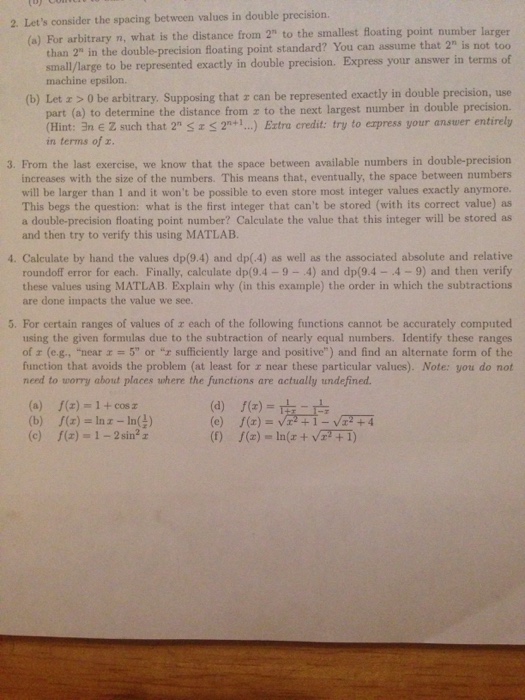
2. Let's consider the spacing between values in double precision. a) For arbitrary n, what is the distance from 2 to the smallest loating point number larger than 2" in the double-precision floating point standard? You can assume that 2" is not too small/large to be represented exactly in double precision. Express your answer in terms of machine epsilon. (b) Let z >0 be arbitrary. Supposing that z can be represented exactly in double precision, use part (a) to determine the distance from z to the next largest number in double precision. (Hint: 3n 2 such that 2" S z S 2+..) Extra credit: try to express your answer entirely in terms of . 3. From the last exercise, we know that the space between available numbers in double-precision increases with the size of the numbers. This means that, eventually, the space between numbers will be larger than 1 and it won't be possible to even store most integer values exactly anymore. This begs the question: what is the first integer that can't be stored (with its correct value) as a double-precision floating point number? Calculate the value that this integer will be stored as and then try to verify this using MATLAB. 4. Calculate by hand the values dp(9.4) and dp(.4) as well as the associated absolute and relative roundof error for each. Finally, calculate dp(9.4-9- 4) and dp (9.4-4-9) and then verify these values using MATLAB. Explain why (in this example) the order in which the subtractions are done impacts the value we see. 5. For certain ranges of values of each of the following functions cannot be accurately computed using the given formulas due to the subtraction of nearly equal numbers. Identify these ranges ofz (e.g., "near= 5" or "z sufficiently large and positive ) and find an alternate form of the function that avoids the problem (at least for r near these particular values). Note: you do not need to worry about places where the functions are actually undefined. (a) (b) (c) f(x)-1+ cosz /(z)=In z-In() f(x)- 1-2sin2 z (f) /(z)-In(z + VF 1)
Step by Step Solution
There are 3 Steps involved in it

Get step-by-step solutions from verified subject matter experts
 Study Help