







Question: What is the geometric average return over the 10 year period? and if you invested $100 at the beginning, how much would you have at
What is the geometric average return over the 10 year period? and if you invested $100 at the beginning, how much would you have at the end?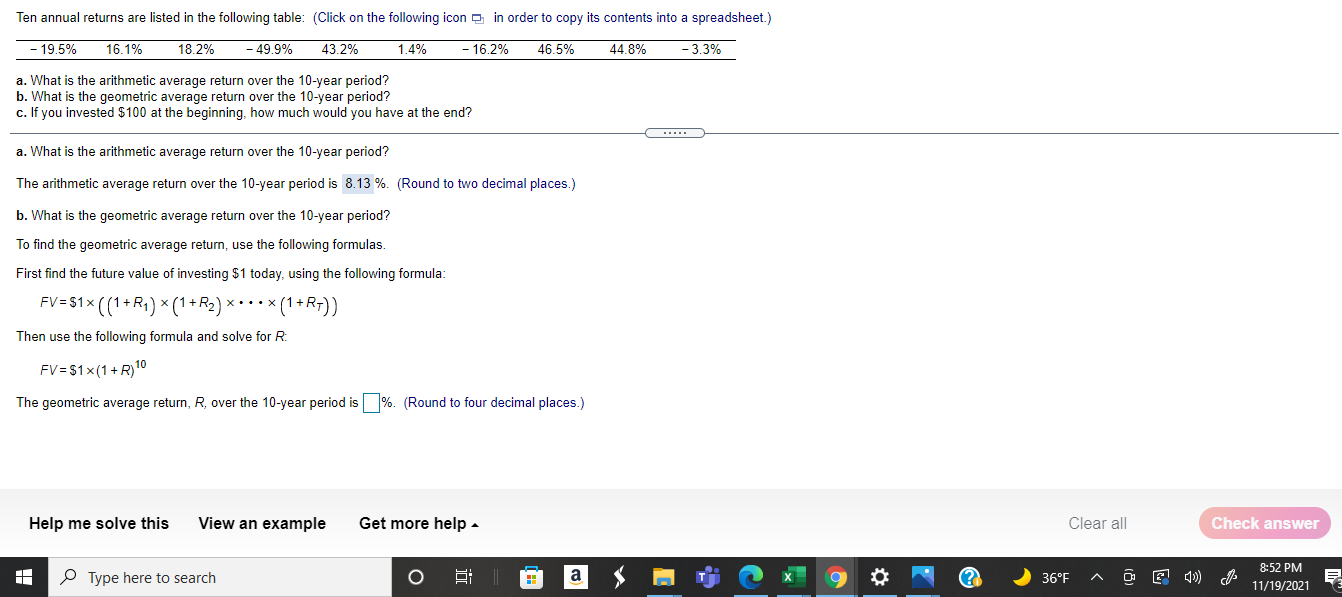
Ten annual returns are listed in the following table: (Click on the following icon e in order to copy its contents into a spreadsheet.) - 19.5% 16.1% 18.2% - 49.9% 43.2% 1.4% - 16.2% 46.5% 44.8% -3.3% a. What is the arithmetic average return over the 10-year period? b. What is the geometric average return over the 10-year period? c. If you invested $100 at the beginning, how much would you have at the end? a. What is the arithmetic average return over the 10-year period? The arithmetic average return over the 10-year period is 8.13 %. (Round to two decimal places.) b. What is the geometric average return over the 10-year period? To find the geometric average return, use the following formulas First find the future value of investing $1 today, using the following formula: FV=$1x ((1+R1) *(1+R2) ***(1 +RT)) Then use the following formula and solve for R: FV = $1*(1 + R) 10 X...X The geometric average return, R, over the 10-year period is %. (Round to four decimal places.) Help me solve this View an example Get more help Clear all Check answer Type here to search a 9 36F 8:52 PM 11/19/2021
Step by Step Solution
There are 3 Steps involved in it

Get step-by-step solutions from verified subject matter experts
 Study Help