







Question: What is the null hypothesis for this test? (Assume it's 2-sided) What is the alternative hypothesis for this test? What are the degrees of freedom
What is the null hypothesis for this test? (Assume it's 2-sided) What is the alternative hypothesis for this test? What are the degrees of freedom for the test?
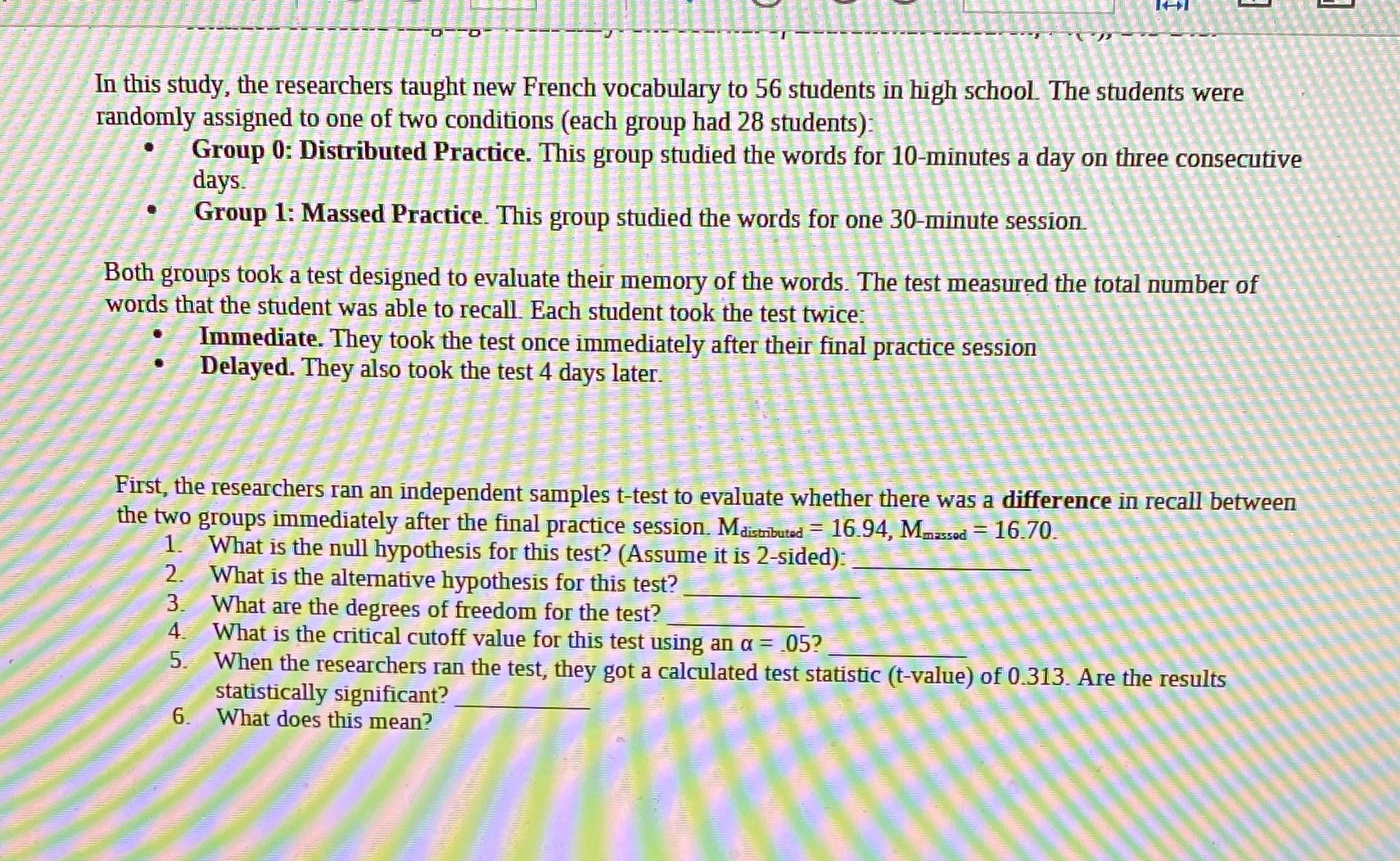
In this study, the researchers taught new French vocabulary to 56 students in high school. The students were randomly assigned to one of two conditions (each group had 28 students): Group 0: Distributed Practice. This group studied the words for 10-minutes a day on three consecutive days. Group 1: Massed Practice. This group studied the words for one 30-minute session. Both groups took a test designed to evaluate their memory of the words. The test measured the total number of words that the student was able to recall. Each student took the test twice: Immediate. They took the test once immediately after their final practice session Delayed. They also took the test 4 days later. First, the researchers ran an independent samples t-test to evaluate whether there was a difference in recall between the two groups immediately after the final practice session. Mdistributed = 16.94, Mmassed = 16.70. 1. What is the null hypothesis for this test? (Assume it is 2-sided): 2. What is the alternative hypothesis for this test? 3. What are the degrees of freedom for the test? 4. What is the critical cutoff value for this test using an a = .05? 5. When the researchers ran the test, they got a calculated test statistic (t-value) of 0.313. Are the results 6. statistically significant? What does this mean
Step by Step Solution
There are 3 Steps involved in it

Get step-by-step solutions from verified subject matter experts
 Study Help