



Question: What is the primary ethical dilemma in this case study? Name the primary stakeholders and describe their stake in the case. Address the primary ethical
What is the primary ethical dilemma in this case study? Name the primary stakeholders and describe their stake in the case. Address the primary ethical dilemma from a rights standpoint and suggest an ethical course of action. Address the primary ethical dilemma from a utilitarian standpoint and suggest an ethical course of action. Address the primary ethical dilemma from a justice standpoint and suggest an ethical course of action.
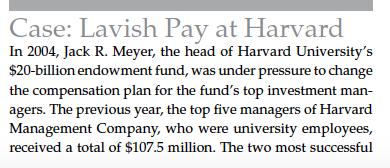
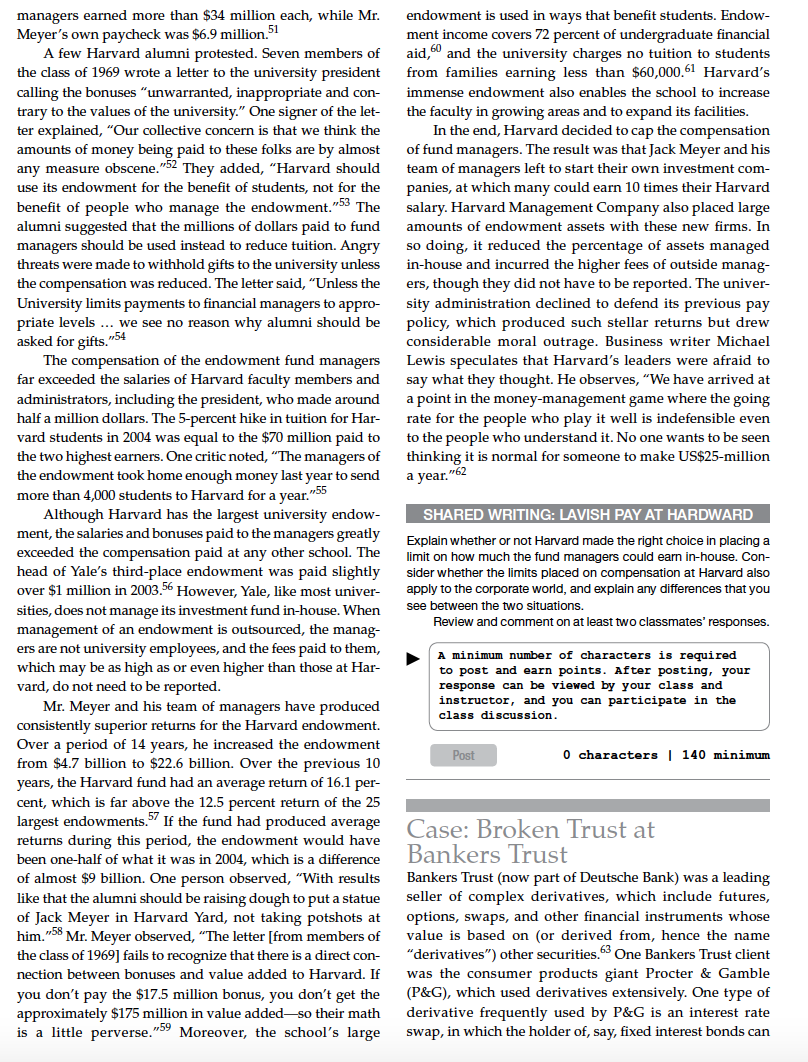
Case: Lavish Pay at Harvard In 2004, Jack R. Meyer, the head of Harvard University's $20-billion endowment fund, was under pressure to change the compensation plan for the fund's top investment man- agers. The previous year, the top five managers of Harvard Management Company, who were university employees, received a total of $107.5 million. The two most successful managers earned more than $34 million each, while Mr. Meyer's own paycheck was $6.9 million.51 A few Harvard alumni protested. Seven members of the class of 1969 wrote letter to the university president calling the bonuses "unwarranted, inappropriate and con- trary to the values of the university." One signer of the let- ter explained, "Our collective concern is that we think the amounts of money being paid to these folks are by almost any measure obscene."52 They added, "Harvard should use its endowment for the benefit of students, not for the benefit of people who manage the endowment."53 The alumni suggested that the millions of dollars paid to fund managers should be used instead to reduce tuition. Angry threats were made to withhold gifts to the university unless the compensation was reduced. The letter said, "Unless the University limits payments to financial managers to appro- priate levels... we see no reason why alumni should be asked for gifts. #54 The compensation of the endowment fund managers far exceeded the salaries of Harvard faculty members and administrators, including the president, who made around half a million dollars. The 5-percent hike in tuition for Har- vard students in 2004 was equal to the $70 million paid to the two highest earners. One critic noted, "The managers of the endowment took home enough money last year to send more than 4,000 students to Harvard for a year."55 Although Harvard has the largest university endow- ment, the salaries and bonuses paid to the managers greatly exceeded the compensation paid at any other school. The head of Yale's third-place endowment was paid slightly over $1 million in 2003.56 However, Yale, like most univer- sities, does not manage its investment fund in-house. When management of an endowment is outsourced, the manag- ers are not university employees, and the fees paid to them, which may be as high as or even higher than those at Har- vard, do not need to be reported. Mr. Meyer and his team of managers have produced consistently superior returns for the Harvard endowment. Over a period of 14 years, he increased the endowment from $4.7 billion to $22.6 billion. Over the previous 10 years, the Harvard fund had an average return of 16.1 per- cent, which is far above the 12.5 percent return of the 25 largest endowments.57 If the fund had produced average returns during this period, the endowment would have been one-half of what it was in 2004, which is a difference of almost $9 billion. One person observed, "With results like that the alumni should be raising dough to put a statue of Jack Meyer in Harvard Yard, not taking potshots at him."58 Mr. Meyer observed, "The letter [from members of the class of 1969] fails to recognize that there is a direct con- nection between bonuses and value added to Harvard. If you don't pay the $17.5 million bonus, you don't get the approximately $175 million in value added-so their math is a little perverse."59 Moreover, the school's large endowment is used in ways that benefit students. Endow- ment income covers 72 percent of undergraduate financial aid,60 and the university charges no tuition to students from families earning less than $60,000.61 Harvard's immense endowment also enables the school to increase the faculty in growing areas and to expand its facilities. In the end, Harvard decided to cap the compensation of fund managers. The result was that Jack Meyer and his team of managers left to start their own investment com- panies, at which many could earn 10 times their Harvard salary. Harvard Management Company also placed large amounts of endowment assets with these new firms. In so doing, it reduced the percentage of assets managed in-house and incurred the higher fees of outside manag- ers, though they did not have to be reported. The univer- sity administration declined to defend its previous pay policy, which produced such stellar returns but drew considerable moral outrage. Business writer Michael Lewis speculates that Harvard's leaders were afraid to say what they thought. He observes, "We have arrived at a point in the money-management game where the going rate for the people who play it well is indefensible even to the people who understand it. No one wants to be seen thinking it is normal for someone to make US$25-million a year."62 SHARED WRITING: LAVISH PAY AT HARDWARD Explain whether or not Harvard made the right choice in placing a limit on how much the fund managers could earn in-house. Con- sider whether the limits placed on compensation at Harvard also apply to the corporate world, and explain any differences that you see between the two situations. Review and comment on at least two classmates' responses. A minimum number of characters is required to post and earn points. After posting, your response can be viewed by your class and instructor, and you can participate in the class discussion. Post 0 characters | 140 minimum Case: Broken Trust at Bankers Trust Bankers Trust (now part of Deutsche Bank) was a leading seller of complex derivatives, which include futures, options, swaps, and other financial instruments whose value is based on (or derived from, hence the name "derivatives") other securities.63 One Bankers Trust client was the consumer products giant Procter & Gamble (P&G), which used derivatives extensively. One type of derivative frequently used by P&G is an interest rate swap, in which the holder of, say, fixed interest bonds canStep by Step Solution
There are 3 Steps involved in it
1 Expert Approved Answer
Step: 1 Unlock

Question Has Been Solved by an Expert!
Get step-by-step solutions from verified subject matter experts
Step: 2 Unlock
Step: 3 Unlock