


Question: What is the probability that a randomly selected individual is self-employed? What is the probability that a randomly selected self-employed individual filed an incomplete tax
What is the probability that a randomly selected
  1. What is the probability that a randomly selected individual is self-employed?

  2. What is the probability that a randomly selected self-employed individual filed an incomplete tax return?

  3. What is the probability that a randomly selected self-employed individual with a reported income under $50,000 filed an incomplete tax return?

  4. What is the probability that a randomly selected individual who was not self-employed and who reported an income over $50,000, filed an incomplete tax return?

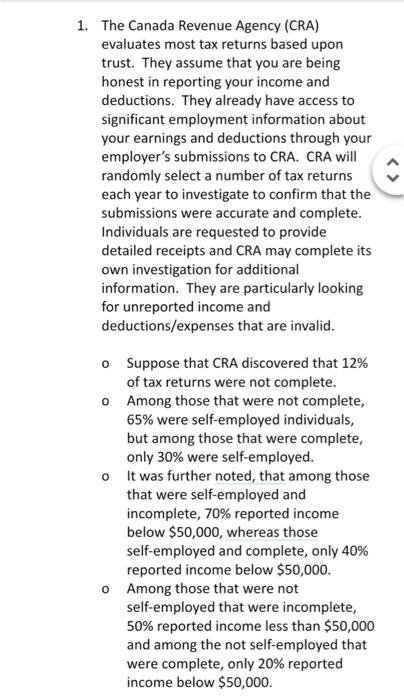
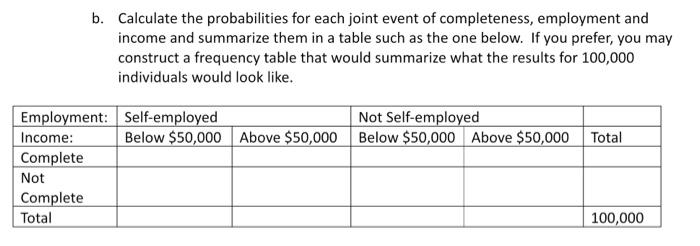
1. The Canada Revenue Agency (CRA) evaluates most tax returns based upon trust. They assume that you are being honest in reporting your income and deductions. They already have access to significant employment information about your earnings and deductions through your employer's submissions to CRA. CRA will randomly select a number of tax returns each year to investigate to confirm that the submissions were accurate and complete. Individuals are requested to provide detailed receipts and CRA may complete its own investigation for additional information. They are particularly looking for unreported income and deductions/expenses that are invalid. o Suppose that CRA discovered that 12% of tax returns were not complete. o Among those that were not complete, 65% were self-employed individuals, but among those that were complete, only 30% were self-employed. o It was further noted, that among those that were self-employed and incomplete, 70% reported income below $50,000, whereas those self-employed and complete, only 40% reported income below $50,000. o Among those that were not self-employed that were incomplete, 50% reported income less than $50,000 and among the not self-employed that were complete, only 20% reported income below $50,000. b. Calculate the probabilities for each joint event of completeness, employment and income and summarize them in a table such as the one below. If you prefer, you may construct a frequency table that would summarize what the results for 100,000 individuals would look like. Employment: Self-employed Not Self-employed Income: Below $50,000 Above $50,000 Below $50,000 Above $50,000 Total Complete Not Complete Total 100,000

Step by Step Solution

There are 3 Steps involved in it

1 Expert Approved Answer
Step: 1 Unlock blur-text-image

Question Has Been Solved by an Expert!

Get step-by-step solutions from verified subject matter experts

Step: 2 Unlock
Step: 3 Unlock

Students Have Also Explored These Related General Management Questions!