



Question: What is wrong with the following inductive argument intended to show that: every set of lines in the plane, no two of which are parallel,
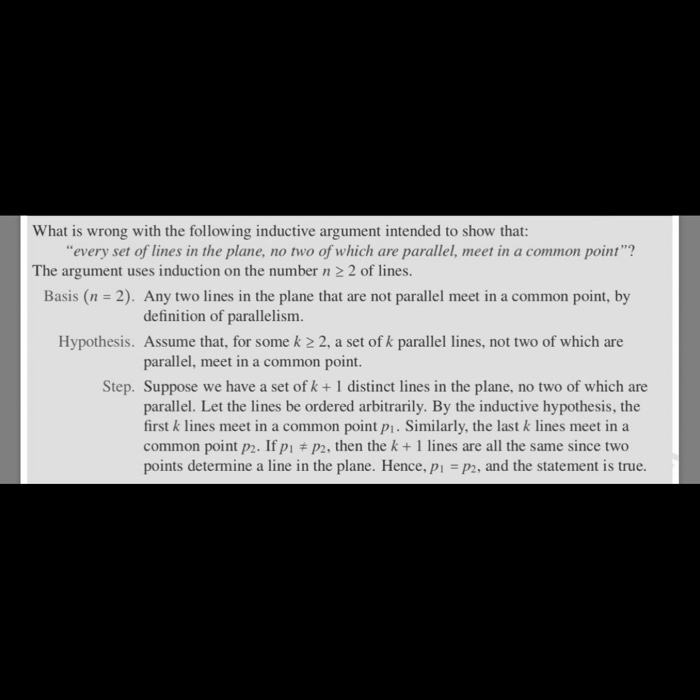
What is wrong with the following inductive argument intended to show that: every set of lines in the plane, no two of which are parallel, meet in a common point"? Basis (n 2). Any two lines in the plane that are not parallel meet in a common point, by Hypothesis. Assume that, for some k 2 2, a set of k parallel lines, not two of which are The argument uses induction on the number n 2 2 of lines. definition of parallelism parallel, meet in a common point. Step. Suppose we have a set of k+1 distinct lines in the plane, no two of which are parallel. Let the lines be ordered arbitrarily. By the inductive hypothesis, the first k lines meet in a common point pi. Similarly, the last k lines meet in a common point P2. Ifpi # P2, then the k + 1 lines are all the same since two points determine a line in the plane. Hence, pi p2, and the statement is true
Step by Step Solution
There are 3 Steps involved in it

Get step-by-step solutions from verified subject matter experts