







Question: What learning processes are most influenced by interactive multimedia? Which are influenced the least? LEARNING PROCESS Attention ET is generally seen as more interesting and
What learning processes are most influenced by interactive multimedia? Which are influenced the least?
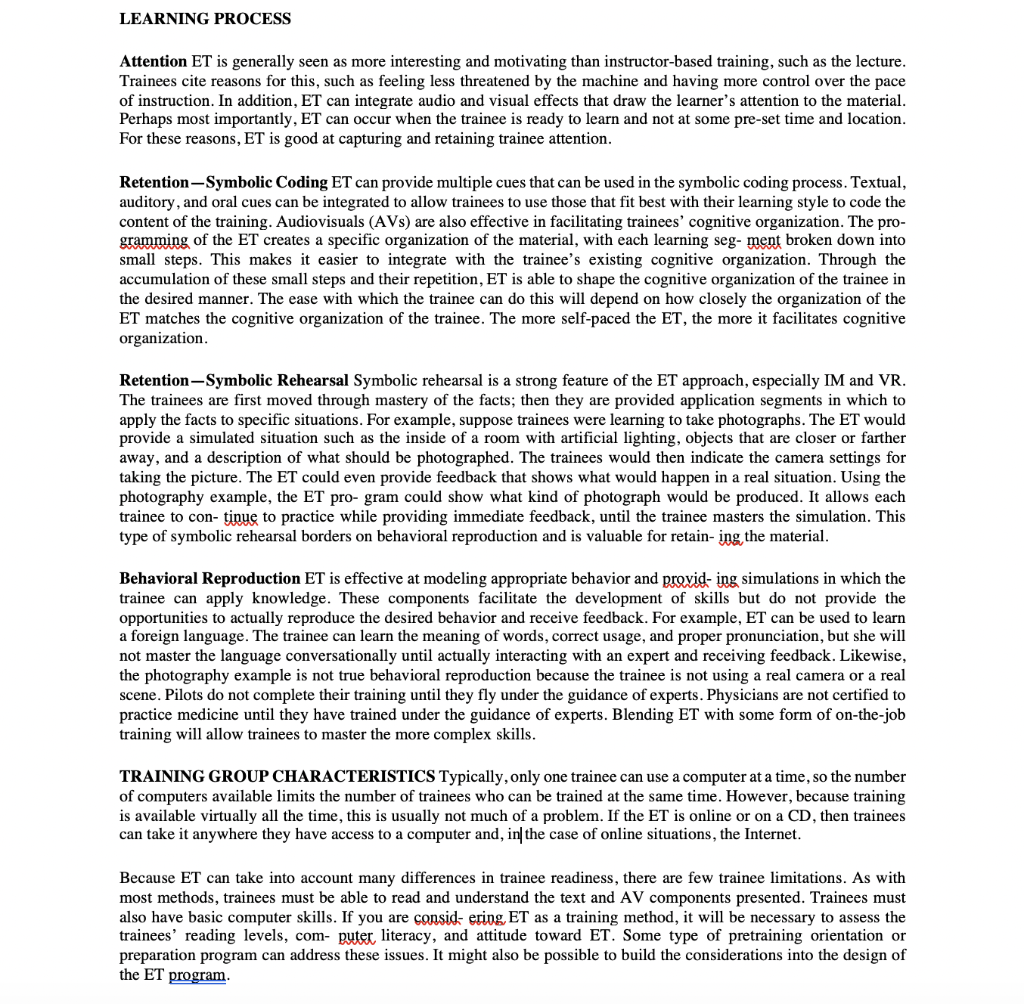
LEARNING PROCESS Attention ET is generally seen as more interesting and motivating than instructor-based training, such as the lecture. Trainees cite reasons for this, such as feeling less threatened by the machine and having more control over the pace of instruction. In addition, ET can integrate audio and visual effects that draw the learner's attention to the material. Perhaps most importantly, ET can occur when the trainee is ready to learn and not at some pre-set time and location. For these reasons, ET is good at capturing and retaining trainee attention. Retention-Symbolic Coding ET can provide multiple cues that can be used in the symbolic coding process. Textual, auditory, and oral cues can be integrated to allow trainees to use those that fit best with their learning style to code the content of the training. Audiovisuals (AVS) are also effective in facilitating trainees' cognitive organization. The pro- gramming of the ET creates a specific organization of the material, with each learning seg- ment broken down into small steps. This makes it easier to integrate with the trainee's existing cognitive organization. Through the accumulation of these small steps and their repetition, ET is able to shape the cognitive organization of the trainee in the desired manner. The ease with which the trainee can do this will depend on how closely the organization of the ET matches the cognitive organization of the trainee. The more self-paced the ET, the more it facilitates cognitive organization. Retention-Symbolic Rehearsal Symbolic rehearsal is a strong feature of the ET approach, especially IM and VR. The trainees are first moved through mastery of the facts; then they are provided application segments in which to apply the facts to specific situations. For example, suppose trainees were learning to take photographs. The ET would provide a simulated situation such as the inside of a room with artificial lighting, objects that are closer or farther away, and a description of what should be photographed. The trainees would then indicate the camera settings for taking the picture. The ET could even provide feedback that shows what would happen in a real situation. Using the photography example, the ET pro- gram could show what kind of photograph would be produced. It allows each trainee to con-tinue to practice while providing immediate feedback, until the trainee masters the simulation. This type of symbolic rehearsal borders on behavioral reproduction and is valuable for retaining the material. Behavioral Reproduction ET is effective at modeling appropriate behavior and providing simulations in which the trainee can apply knowledge. These components facilitate the development of skills but do not provide the opportunities to actually reproduce the desired behavior and receive feedback. For example, ET can be used to learn a foreign language. The trainee can learn the meaning of words, correct usage, and proper pronunciation, but she will not master the language conversationally until actually interacting with an expert and receiving feedback. Likewise, the photography example is not true behavioral reproduction because the trainee is not using a real camera or a real scene. Pilots do not complete their training until they fly under the guidance of experts. Physicians are not certified to practice medicine until they have trained under the guidance of experts. Blending ET with some form of on-the-job training will allow trainees to master the more complex skills. TRAINING GROUP CHARACTERISTICS Typically, only one trainee can use a computer at a time, so the number of computers available limits the number of trainees who can be trained at the same time. However, because training is available virtually all the time, this is usually not much of a problem. If the ET is online or on a CD, then trainees can take it anywhere they have access to a computer and, in the case of online situations, the Internet. Because ET can take into account many differences in trainee readiness, there are few trainee limitations. As with most methods, trainees must be able to read and understand the text and AV components presented. Trainees must also have basic computer skills. If you are considering ET as a training method, it will be necessary to assess the trainees' reading levels, com- puter literacy, and attitude toward ET. Some type of pretraining orientation or preparation program can address these issues. It might also be possible to build the considerations into the design of the ET programStep by Step Solution
There are 3 Steps involved in it
1 Expert Approved Answer
Step: 1 Unlock

Question Has Been Solved by an Expert!
Get step-by-step solutions from verified subject matter experts
Step: 2 Unlock
Step: 3 Unlock
 Study Help