







Question: What method should be adopted to explain the problem? How does it require us to understand this process? I was wondering where it was going
What method should be adopted to explain the problem? How does it require us to understand this process? I was wondering where it was going to simplify the formula.
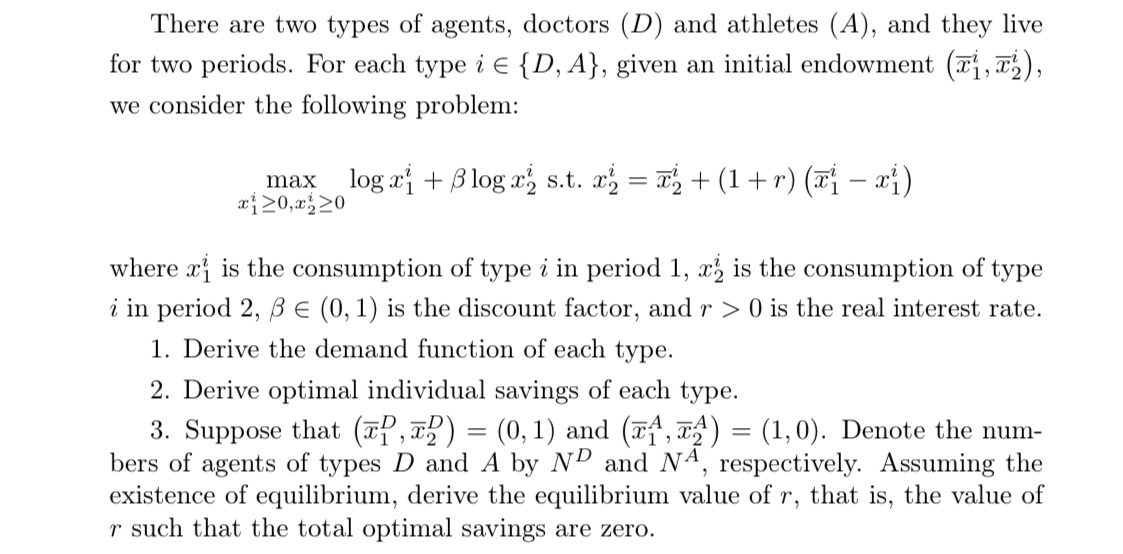
There are two types of agents, doctors (D) and athletes (A), and they live for two periods. For each type 2' E {D, A}, given an initial endowment (Whig), we consider the following problem: .max logmi + (310ng st 3:; = T; + (1 +1") (Eli 331) $330,320 where mil is the consumption of type 2' in period 1, 1:3 is the consumption of type 2' in period 2, ,6 6 (0,1) is the discount factor, and r > O is the real interest rate. 1. Derive the demand function of each type. 2. Derive optimal individual savings of each type. 3. Suppose that (5?,529) = (0,1) and ($14,554) = (1,0). Denote the num- bers of agents of types D and A by N D and N A, respectively. Assuming the existence of equilibrium, derive the equilibrium value of 1', that is, the value of r such that the total optimal savings are zero
Step by Step Solution
There are 3 Steps involved in it

Get step-by-step solutions from verified subject matter experts
 Study Help