



Question: what recommendation work best a perfect seed: developing a sustainable quinoa market for social impact For this article A Perfect Seed: Developing a Sustainable NACRA
what recommendation work best a perfect seed: developing a sustainable quinoa market for social impact
For this article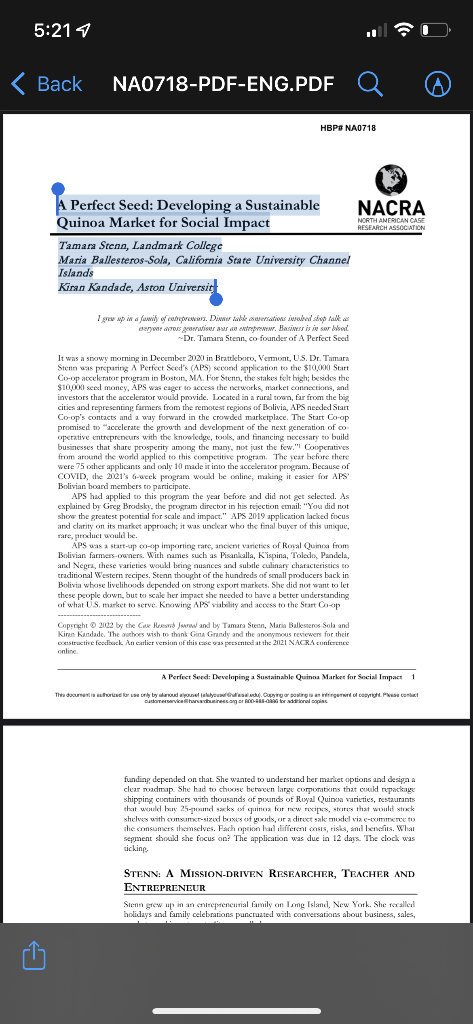
A Perfect Seed: Developing a Sustainable NACRA Quinoa Market for Social Impact WOFTH AMENICEN CASE Tamara Stenn, Landmark College Maria Ballesteros-Sola, Califomia State University Channel Islands Kiran Kandade, Aston Universit a*ryot aross gestnutisus aws an shrotbenw. Hociness is in sor bsol' Dr. Tarmara Stenn, co founder of A Perfect Seed It was a spowy morning in December 2020 in Bratteboro, Vemont, U.S. Dr. Tamara Stenn aas preparing A Perfect Sect's (APS) second application to the \$10,000 Start Co-op accelerator program in Hoston, MA. For Stenn, the stakes felt high; besides the \$10,000 seed money, APS was eaget to aceses the netuotks, matket connextions, sad investors that the accelerator would provide. Located in a rural town, far from the beg? cities and representing furmers from the remotest repions of Bolivia, APS necded Start Co-op's contacts and a way focward in the coowoded marketplace. The Start Co-op promised to "accelerare the prowth and development of the next generation of cooperative entrprencurs with the knovatedye, tools, and financing necessary to build businesses that share prosperity among the many, not just the few." Coopenatives from around the wotld applied to this coenpetitie program. The year before there were 75 other applicants and oaly 10 made it into the acoelerator program. Because of COVID, the 2021's 6-week peogram woukl le oaline, making it easies for APS' Bolivian board members to participate. APS had applied to this program the year before and did not pet selectod. As explained by Greg Brodsky, the program director in his rejection email: "You did not shor the greatest potential for scale and impoct." APS 2019 application lacked focus and clarity on its market approxeh; it was unclear who the final buyer of this unique, tare ptroluct would le. APS was a start-up co-op injporting rare, ancent varicties of Rosal Quinoa from Bolivian farmers-ouners. With names such as Pisankalla, Kispina, Toledo, Pandela, and Negrs, these varieties woukl bring suances and subtle culinary characteristics to emditional Western recipes. Stenn thougpt of the hundreds of small producers back in Bolivia whose livelihoods depended on strong export markets, She did not want to let these people down, but to scake her impact she needed to have a better understanding of what U. . market to serve. Krowing APS vabelity ind access to the Start Co-op Coprright 02022 by the Cak Auest faved and be Tamara Stenn, Maria Balleseros Sola and Kinen Kandade. The mochoes uish to thank Gina Grendy and the anceymous revieusers for their coststractire fosdlock An earlier venion of this cioe vas petsented at the 21121 NAC.R.A cunfertnce online. A Perfect Serd: Developing a Sustainahle Quinna Marloer for Sociall Tmpact 1 funding depended on that. She wanted to understand her marise options and desipg a clear roadmap. She had to chuose between large coporations that could repackage shipping containers with thousands of pounds of Royzl Quinos varieties, restaunants that uxuld bay 25-pround senks of quinns for now rexips, strores that would stokik shelver with consumet-sized boxes of guode, or a direct salk model via e-commered to whe comsumers themsetves. Fsch oprion hat differcnt onsts, risks, send lenefits. What sepment should she focus an? The applicabon was due in 12 dass. The elock was ticking? StenN: A Mission-Driven Researcher, TEACHER AND ENTREPRENEUR Sienn sow up in an snircyencuital family on Isme Islantl, New York. She foralled holidays and family celebrations punctuated wivh conversabions about basiness, sales
Step by Step Solution
There are 3 Steps involved in it

Get step-by-step solutions from verified subject matter experts