







Question: What value does Samsung create for its customers? What influences from the external environment over the next several years might affect the way Samsung competes?
- What value does Samsung create for its customers?
- What influences from the external environment over the next several years might affect the way Samsung competes?
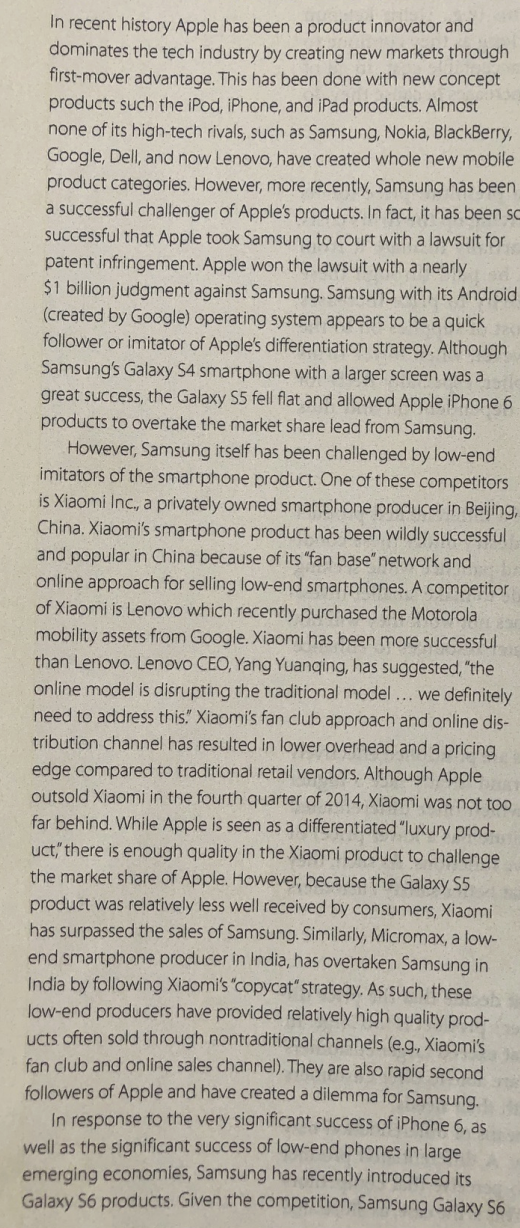
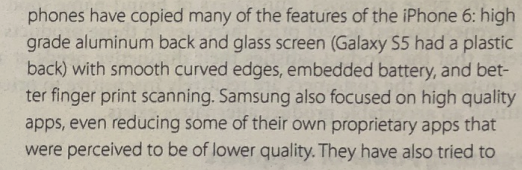
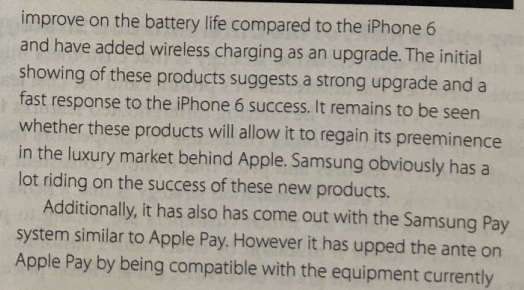
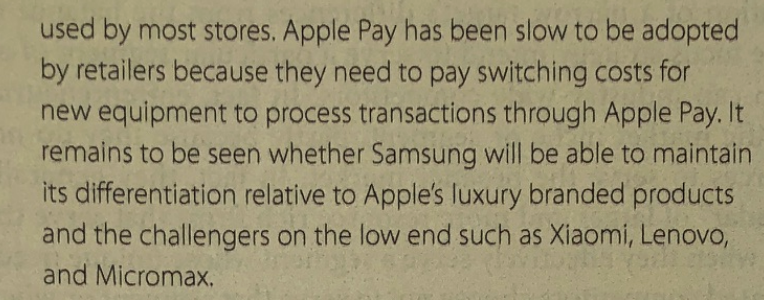
In recent history Apple has been a product innovator and dominates the tech industry by creating new markets through first-mover advantage. This has been done with new concept products such the iPod, iPhone, and iPad products. Almost none of its high-tech rivals, such as Samsung, Nokia, BlackBerry, Google, Dell, and now Lenovo, have created whole new mobile product categories. However, more recently, Samsung has been a successful challenger of Apple's products. In fact, it has been sc successful that Apple took Samsung to court with a lawsuit for patent infringement. Apple won the lawsuit with a nearly $1 billion judgment against Samsung. Samsung with its Android (created by Google) operating system appears to be a quick follower or imitator of Apple's differentiation strategy. Although Samsung's Galaxy S4 smartphone with a larger screen was a great success, the Galaxy S5 fell flat and allowed Apple iPhone 6 products to overtake the market share lead from Samsung. However, Samsung itself has been challenged by low-end imitators of the smartphone product. One of these competitors is Xiaomi Inc., a privately owned smartphone producer in Beijing, China. Xiaomi's smartphone product has been wildly successful and popular in China because of its "fan base" network and online approach for selling low-end smartphones. A competitor of Xiaomi is Lenovo which recently purchased the Motorola mobility assets from Google. Xiaomi has been more successful than Lenovo. Lenovo CEO, Yang Yuanqing, has suggested, "the online model is disrupting the traditional model ... we definitely need to address this." Xiaomi's fan club approach and online distribution channel has resulted in lower overhead and a pricing edge compared to traditional retail vendors. Although Apple outsold Xiaomi in the fourth quarter of 2014, Xiaomi was not too far behind. While Apple is seen as a differentiated "luxury product," there is enough quality in the Xiaomi product to challenge the market share of Apple. However, because the Galaxy $5 product was relatively less well received by consumers, Xiaomi has surpassed the sales of Samsung. Similarly, Micromax, a lowend smartphone producer in India, has overtaken Samsung in India by following Xiaomi's "copycat" strategy. As such, these low-end producers have provided relatively high quality products often sold through nontraditional channels (e.g., Xiaomi's fan club and online sales channel). They are also rapid second followers of Apple and have created a dilemma for Samsung. In response to the very significant success of iPhone 6 , as well as the significant success of low-end phones in large emerging economies, Samsung has recently introduced its Galaxy S6 products. Given the competition, Samsung Galaxy S6 phones have copied many of the features of the iPhone 6 : high grade aluminum back and glass screen (Galaxy S5 had a plastic back) with smooth curved edges, embedded battery, and better finger print scanning. Samsung also focused on high quality apps, even reducing some of their own proprietary apps that were perceived to be of lower quality. They have also tried to improve on the battery life compared to the iPhone 6 and have added wireless charging as an upgrade. The initial showing of these products suggests a strong upgrade and a fast response to the iPhone 6 success. It remains to be seen whether these products will allow it to regain its preeminence in the luxury market behind Apple. Samsung obviously has a lot riding on the success of these new products. Additionally, it has also has come out with the Samsung Pay system similar to Apple Pay. However it has upped the ante on Apple Pay by being compatible with the equipment currently used by most stores. Apple Pay has been slow to be adopted by retailers because they need to pay switching costs for new equipment to process transactions through Apple Pay. It remains to be seen whether Samsung will be able to maintain its differentiation relative to Apple's luxury branded products and the challengers on the low end such as Xiaomi, Lenovo, and Micromax
Step by Step Solution
There are 3 Steps involved in it

Get step-by-step solutions from verified subject matter experts
 Study Help