







Question: What were the key issues when H&R Block sold the franchise store to the local entrepreneurs (Chapters 8-9. e g. franchise contract on page 84)?
What were the key issues when H&R Block sold the franchise store to the local entrepreneurs (Chapters 8-9. e g. franchise contract on page 84)?
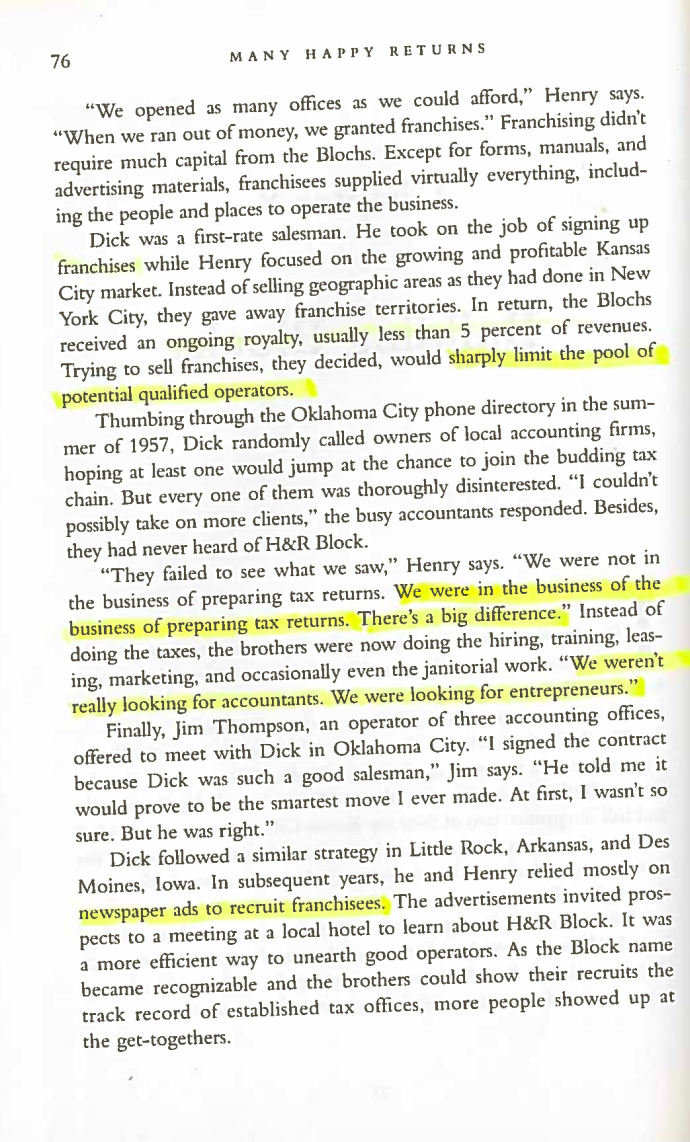
Why didn't Henry look for accountants as the franchisees (Chapter 8)?
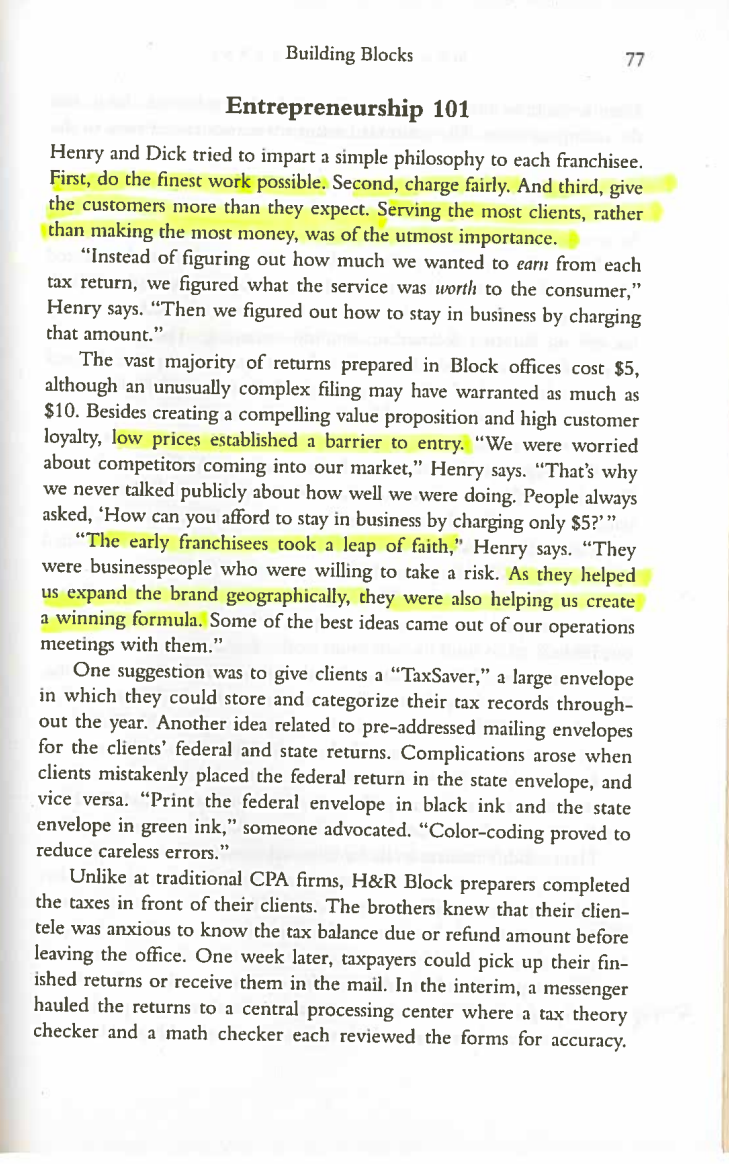
Why did these franchisees need to take a leap of faith? What kind of questions did Block ask the budding entrepreneurs (Chapter 9)?
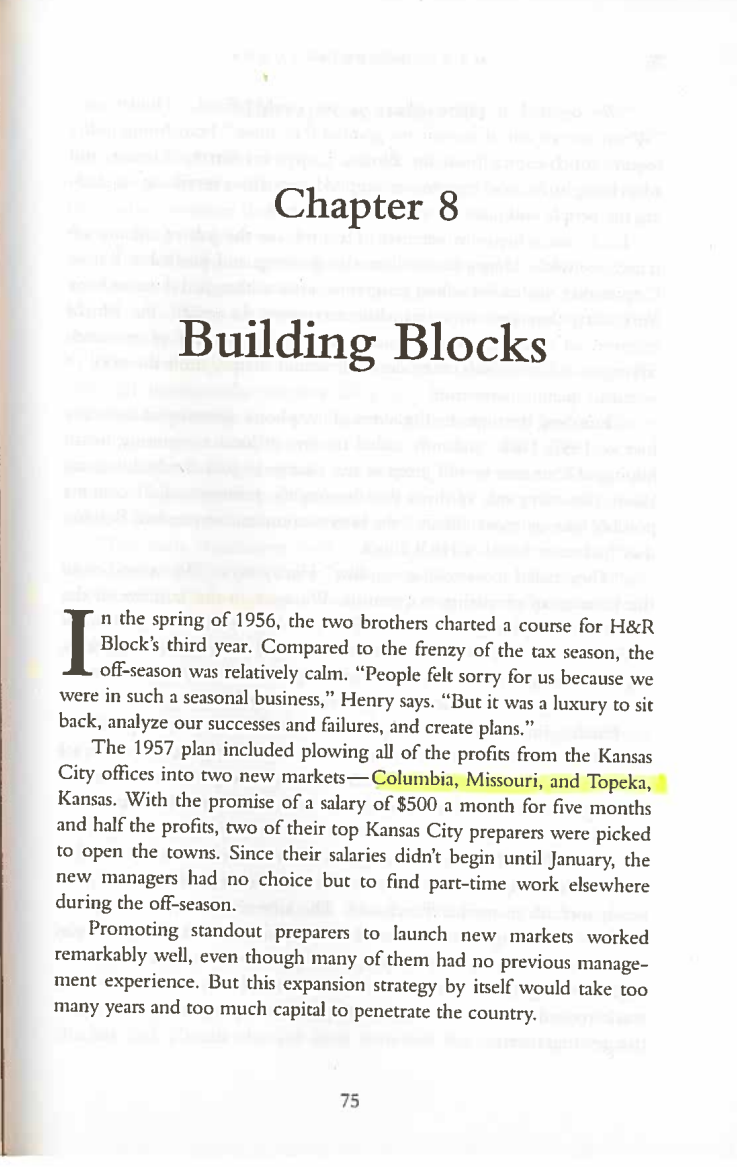
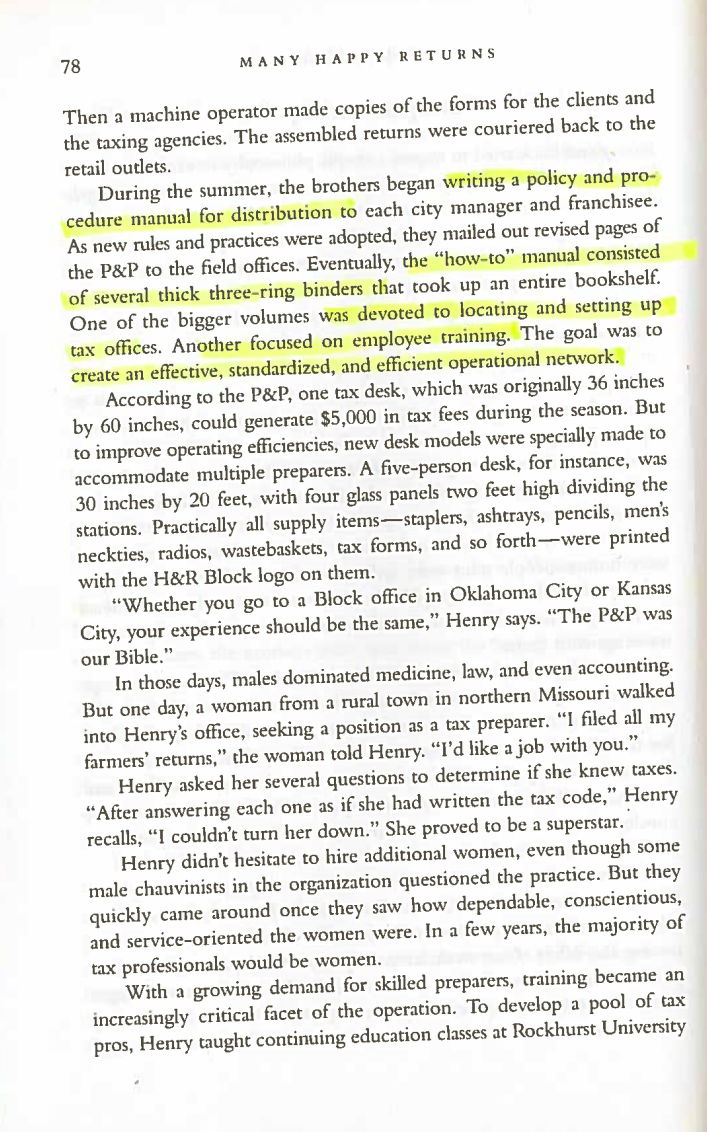
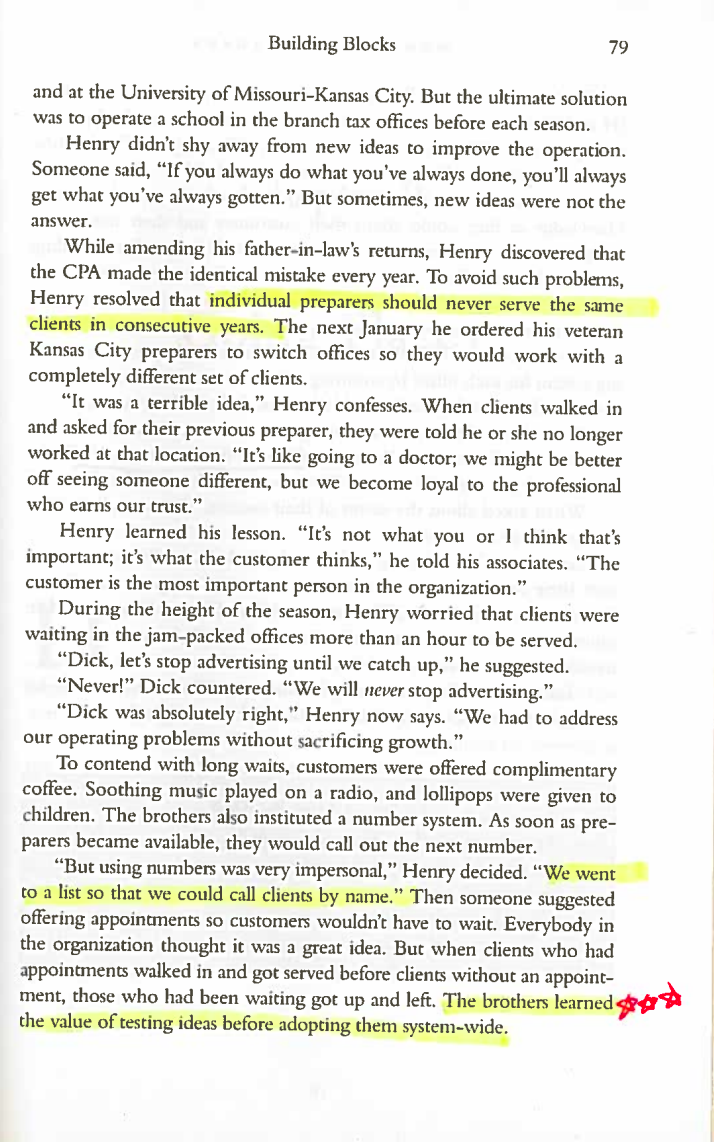
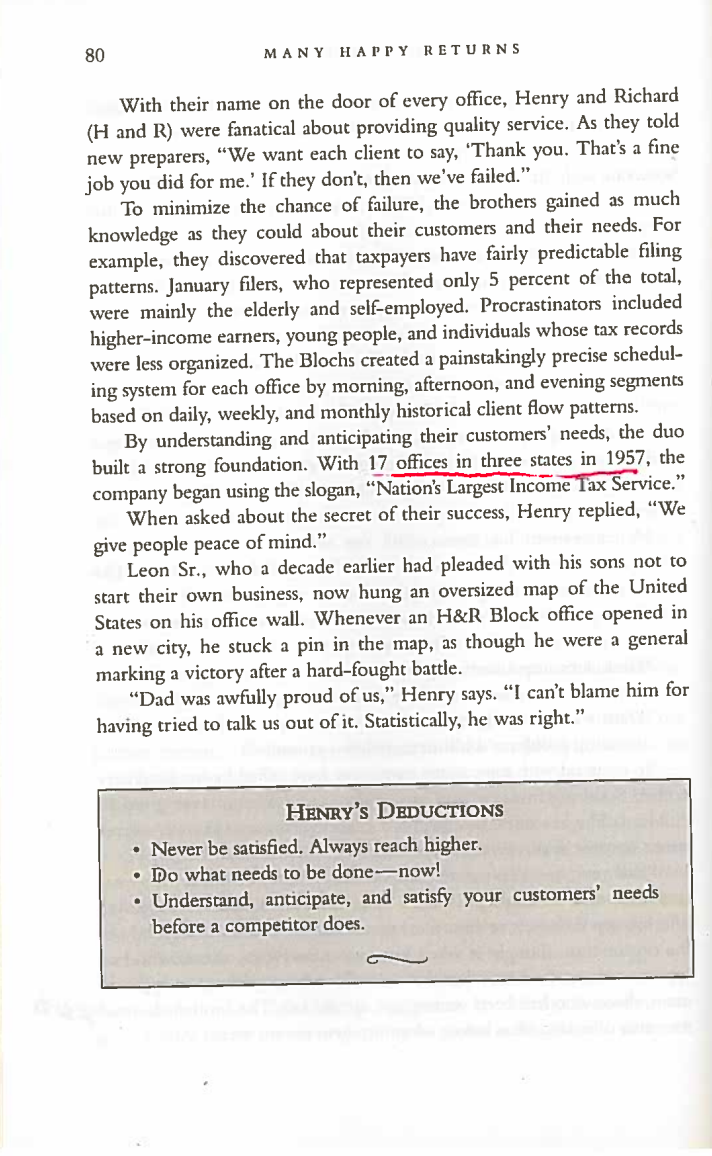
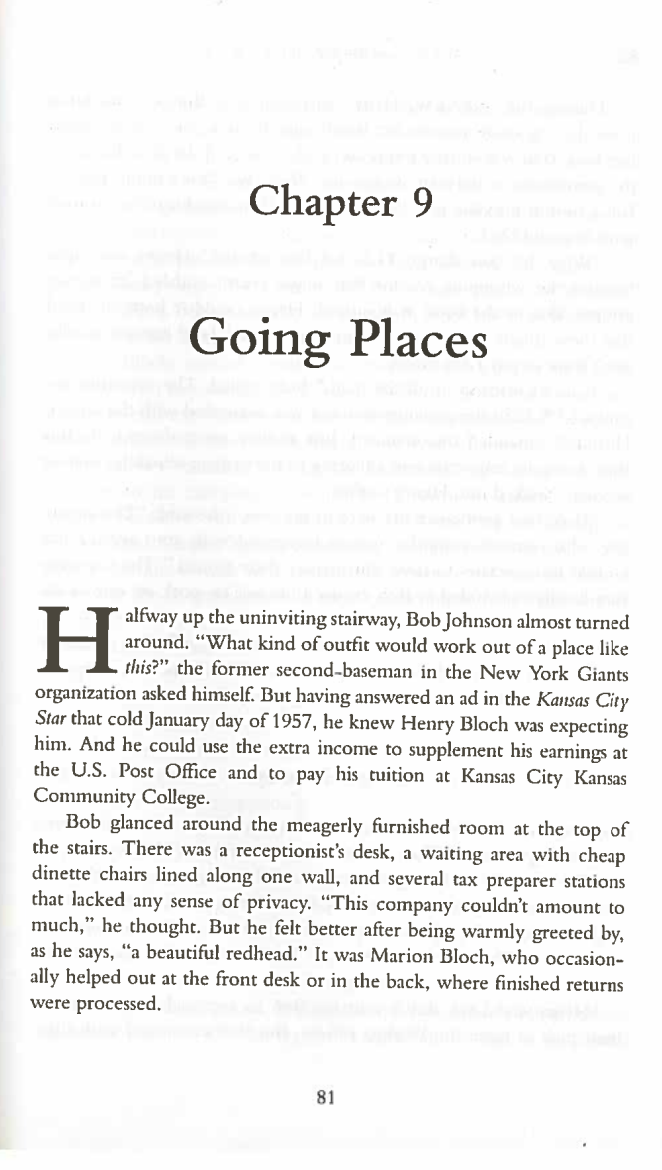
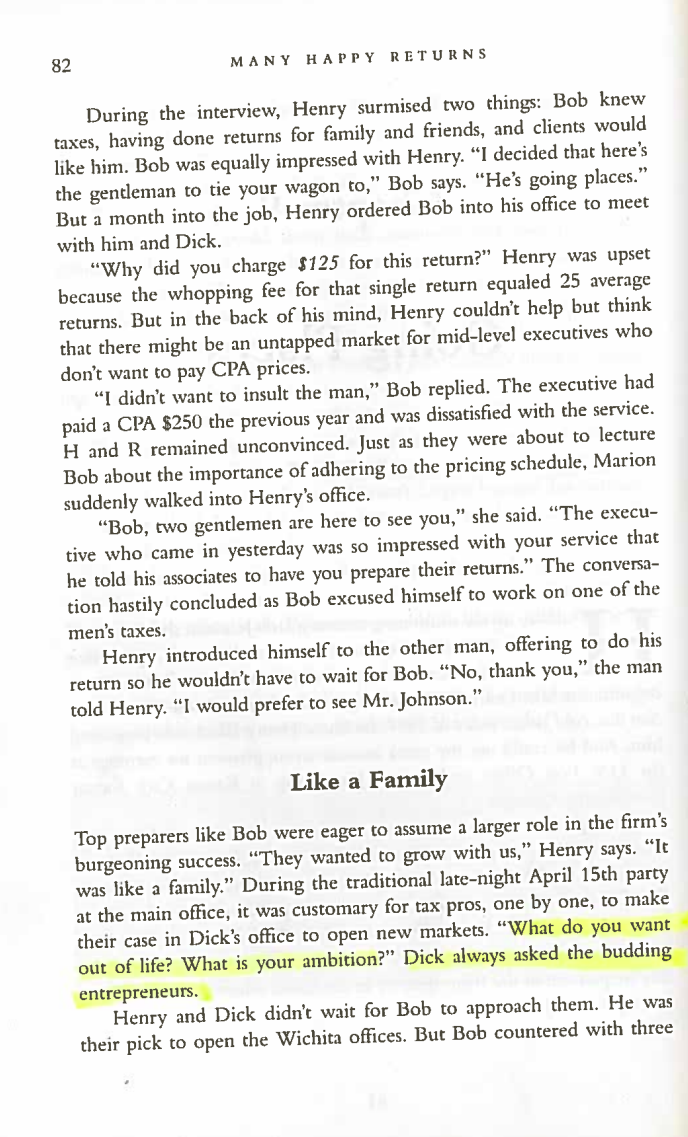
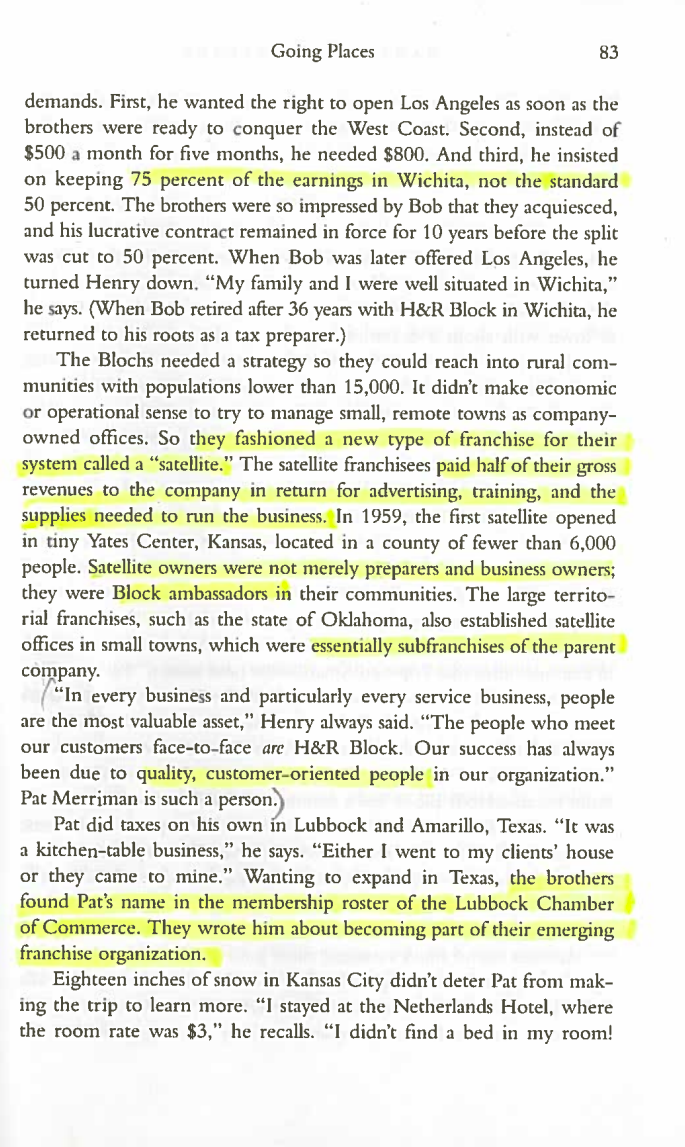
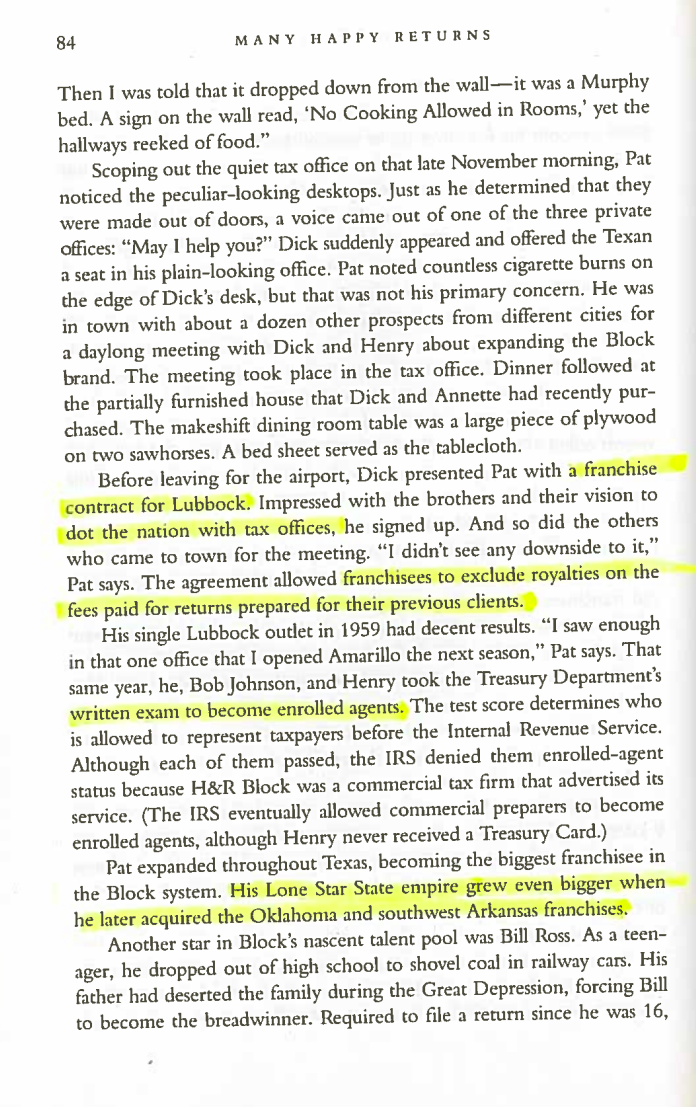
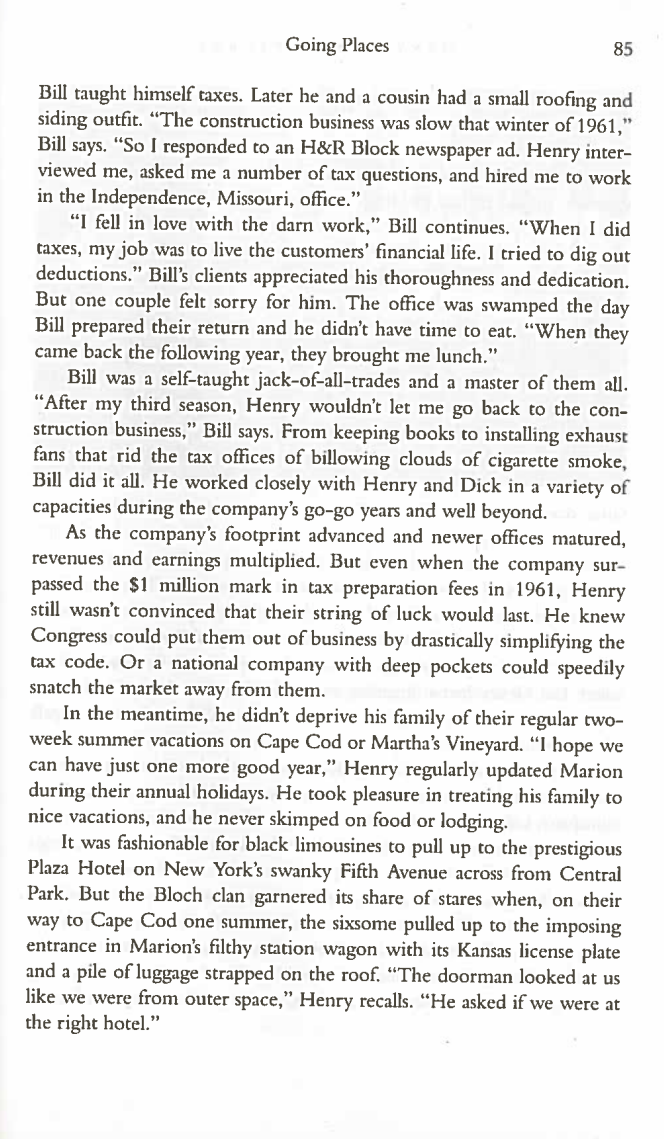
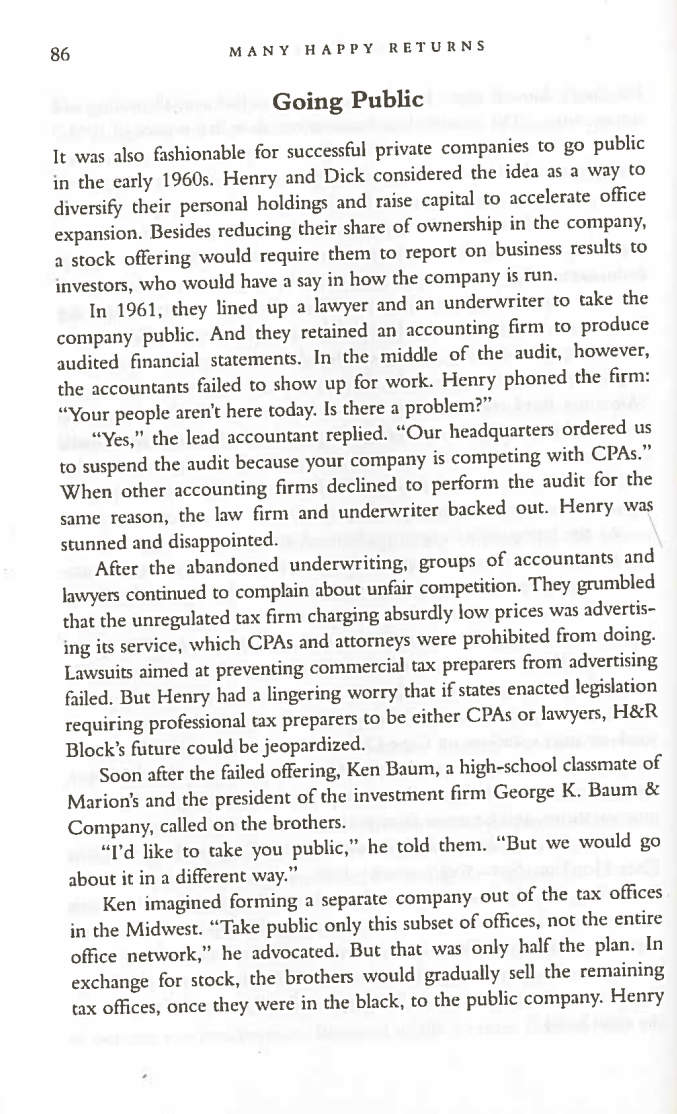
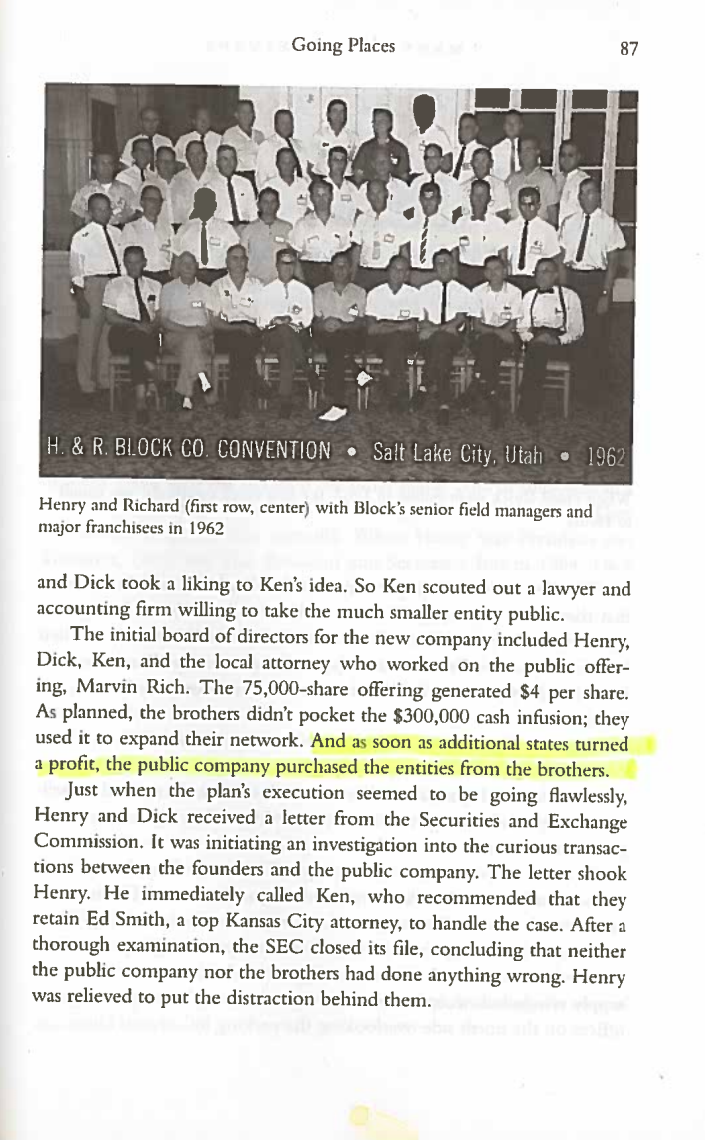
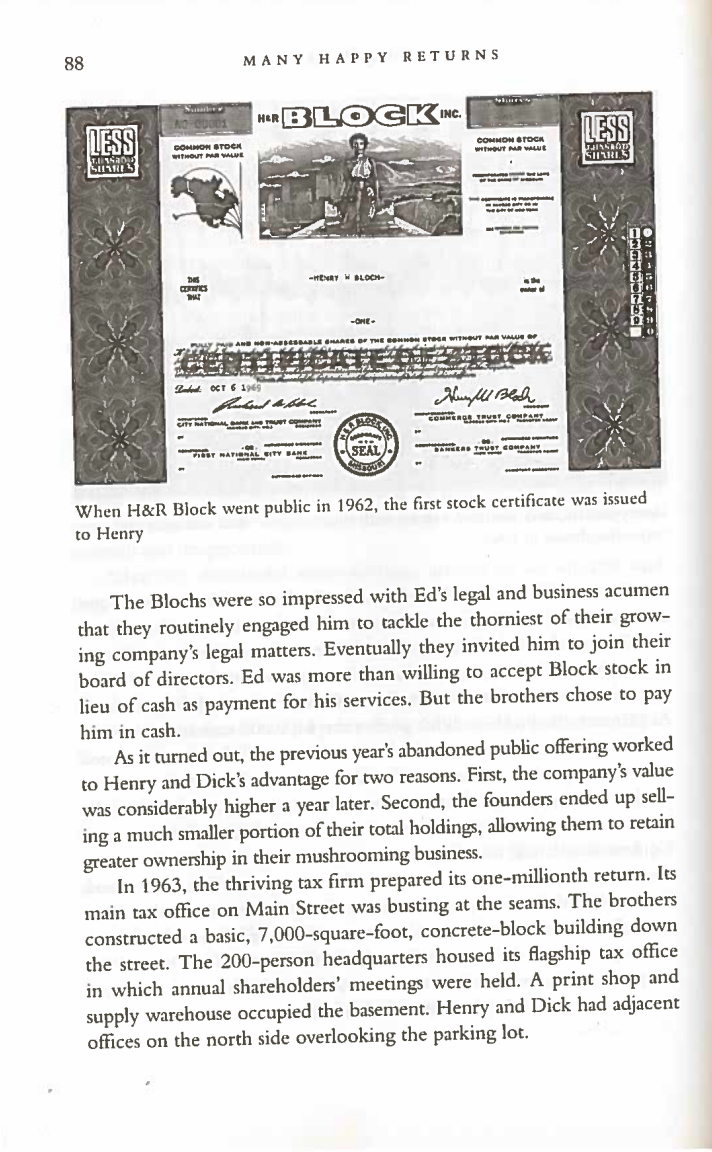
Chapter 8 Building Blocks in the spring of 1956, the two brothers charted a course for H&R Block's third year. Compared to the frenzy of the tax season, the were in such a seasonal business," Henry says. "But it was a luxury to sit back, analyze our successes and failures, and create plans." The 1957 plan included plowing all of the profits from the Kansas City offices into two new marketsColumbia, Missouri, and Topeka, Kansas. With the promise of a salary of $500 a month for five months and half the profits, two of their top Kansas City preparers were picked to open the towns. Since their salaries didn't begin until January, the new managers had no choice but to find part-time work elsewhere during the off-season. Promoting standout preparers to launch new markets worked remarkably well, even though many of them had no previous manage- ment experience. But this expansion strategy by itself would take too many years and too much capital to penetrate the country. 75 76 RETURNS MANY HAPPY We opened as many offices as we could afford, Henry says. When we ran out of money, we granted franchises. Franchising didn't require much capital from the Blochs. Except for forms, manuals, and advertising materials, franchisees supplied virtually everything, includ- ing the people and places to operate the business. Dick was a first-rate salesman. He took on the job of signing up franchises while Henry focused on the growing and profitable Kansas City market. Instead of selling geographic areas as they had done in New York City, they gave away franchise territories. In return, the Blochs received an ongoing royalty, usually less than 5 percent of revenues. Trying to sell franchises, they decided, would sharply limit the pool of potential qualified operators. Thumbing through the Oklahoma City phone directory in the sum- mer of 1957, Dick randomly called owners of local accounting firms, hoping at least one would jump at the chance to join the budding tax chain. But every one of them was thoroughly disinterested. I couldn't possibly take on more clients, the busy accountants responded. Besides, they had never heard of H&R Block. They failed to see what we saw," Henry says. We were not in the business of preparing tax returns. We were in the business of the business of preparing tax returns. There's a big difference. Instead of doing the taxes, the brothers were now doing the hiring, training, leas- ing, marketing, and occasionally even the janitorial work. We weren't really looking for accountants. We were looking for entrepreneurs." Finally, Jim Thompson, an operator of three accounting offices, offered to meet with Dick in Oklahoma City. I signed the contract because Dick was such a good salesman, Jim says. "He told me it would prove to be the smartest move I ever made. At first, I wasn't so sure. But he was right." Dick followed a similar strategy in Little Rock, Arkansas, and Des Moines, Iowa. In subsequent years, he and Henry relied mostly on newspaper ads to recruit franchisees. The advertisements invited pros- pects to a meeting at a local hotel to learn about H&R Block. It was a more efficient way to unearth good operators. As the Block name became recognizable and the brothers could show their recruits the track record of established tax offices, more people showed up at the get-togethers. Building Blocks 77 Entrepreneurship 101 Henry and Dick tried to impart a simple philosophy to each franchisee. First, do the finest work possible. Second, charge fairly. And third, give the customers more than they expect. Serving the most clients, rather than making the most money, was of the utmost importance. "Instead of figuring out how much we wanted to earn from each tax return, we figured what the service was worth to the consumer," Henry says. "Then we figured out how to stay in business by charging that amount." The vast majority of returns prepared in Block offices cost $5, although an unusually complex filing may have warranted as much as $10. Besides creating a compelling value proposition and high customer loyalty, low prices established a barrier to entry. "We were worried about competitors coming into our market," Henry says. "That's why we never talked publicly about how well we were doing. People always asked, 'How can you afford to stay in business by charging only $5?' "The early franchisees took a leap of faith," Henry says. They were businesspeople who were willing to take a risk. As they helped us expand the brand geographically, they were also helping us create a winning formula. Some of the best ideas came out of our operations meetings with them." One suggestion was to give clients a TaxSaver, a large envelope in which they could store and categorize their tax records through- out the year. Another idea related to pre-addressed mailing envelopes for the clients' federal and state returns. Complications arose when clients mistakenly placed the federal return in the state envelope, and vice versa. Print the federal envelope in black ink and the state envelope in green ink," someone advocated. Color-coding proved to reduce careless errors." Unlike at traditional CPA firms, H&R Block preparers completed the taxes in front of their clients. The brothers knew that their clien- tele was anxious to know the tax balance due or refund amount before leaving the office. One week later, taxpayers could pick up their fin- ished returns or receive them in the mail. In the interim, a messenger hauled the returns to a central processing center where a tax theory checker and a math checker each reviewed the forms for accuracy. 7) 78 MANY HAPPY RETURNS Then a machine operator made copies of the forms for the clients and the taxing agencies. The assembled returns were couriered back to the retail outlets. During the summer, the brothers began writing a policy and pro- cedure manual for distribution to each city manager and franchisee. As new rules and practices were adopted, they mailed out revised pages of the P&P to the field offices. Eventually, the "how-to manual consisted of several thick three-ring binders that took up an entire bookshelf. One of the bigger volumes was devoted to locating and setting up tax offices. Another focused on employee training. The goal was to create an effective, standardized, and efficient operational network. According to the P&P, one tax desk, which was originally 36 inches by 60 inches, could generate $5,000 in tax fees during the season. But to improve operating efficiencies, new desk models were specially made to accommodate multiple preparers. A five-person desk, for instance, was 30 inches by 20 feet, with four glass panels two feet high dividing the stations. Practically all supply items-staplers, ashtrays, pencils, men's neckties, radios, wastebaskets, tax forms, and so forth-were printed with the H&R Block logo on them. "Whether you go to a Block office in Oklahoma City or Kansas City, your experience should be the same," Henry says. "The P&P was our Bible." In those days, males dominated medicine, law, and even accounting. But one day, a woman from a rural town in northern Missouri walked into Henry's office, seeking a position as a tax preparer. I filed all my farmers' returns," the woman told Henry. "I'd like a job with you. Henry asked her several questions to determine if she knew taxes. After answering each one as if she had written the tax code, Henry recalls, I couldn't turn her down." She proved to be a superstar. Henry didn't hesitate to hire additional women, even though some male chauvinists in the organization questioned the practice. But they quickly came around once they saw how dependable, conscientious, and service-oriented the women were. In a few years, the majority of tax professionals would be women. With a growing demand for skilled preparers, training became an increasingly critical facet of the operation. To develop a pool of tax pros, Henry taught continuing education classes at Rockhurst University Building Blocks 79 and at the University of Missouri-Kansas City. But the ultimate solution was to operate a school in the branch tax offices before each season. Henry didn't shy away from new ideas to improve the operation. Someone said, If you always do what you've always done, you'll always get what you've always gotten." But sometimes, new ideas were not the answer. While amending his father-in-law's returns, Henry discovered that the CPA made the identical mistake every year. To avoid such problems, Henry resolved that individual preparers should never serve the same clients in consecutive years. The next January he ordered his veteran Kansas City preparers to switch offices so they would work with a completely different set of clients. "It was a terrible idea," Henry confesses. When clients walked in and asked for their previous preparer, they were told he or she no longer worked at that location. It's like going to a doctor; we might be better off seeing someone different, but we become loyal to the professional who earns our trust." Henry learned his lesson. "It's not what you or I think that's important; it's what the customer thinks," he told his associates. "The customer is the most important person in the organization." During the height of the season, Henry worried that clients were waiting in the jam-packed offices more than an hour to be served. Dick, let's stop advertising until we catch up," he suggested. Never!" Dick countered. We will never stop advertising.' "Dick was absolutely right," Henry now says. We had to address our operating problems without sacrificing growth. To contend with long waits, customers were offered complimentary coffee. Soothing music played on a radio, and lollipops were given to children. The brothers also instituted a number system. As soon as pre- parers became available, they would call out the next number. But using numbers was very impersonal," Henry decided. We went to a list so that we could call clients by name. Then someone suggested offering appointments so customers wouldn't have to wait. Everybody in the organization thought it was a great idea. But when clients who had appointments walked in and got served before clients without an appoint- ment, those who had been waiting got up and left. The brothers learned the value of testing ideas before adopting them system-wide. ost Chapter 9 Going Places H alfway up the uninviting stairway, Bob Johnson almost turned around. "What kind of outfit would work out of a place like this?" the former second-baseman in the New York Giants organization asked himself. But having answered an ad in the Kansas City Star that cold January day of 1957, he knew Henry Bloch was expecting him. And he could use the extra income to supplement his earnings at the U.S. Post Office and to pay his tuition at Kansas City Kansas Community College. Bob glanced around the meagerly furnished room at the top of the stairs. There was a receptionist's desk, a waiting area with cheap dinette chairs lined along one wall, and several tax preparer stations that lacked any sense of privacy. "This company couldn't amount to much," he thought. But he felt better after being warmly greeted by, as he says, "a beautiful redhead." It was Marion Bloch, who occasion- ally helped out at the front desk or in the back, where finished returns were processed. 81 82 MANY HAPPY RETURNS During the interview, Henry surmised two things: Bob knew taxes, having done returns for family and friends, and clients would like him. Bob was equally impressed with Henry. I decided that here's the gentleman to tie your wagon to, Bob says. "He's going places. But a month into the job, Henry ordered Bob into his office to meet with him and Dick. "Why did you charge $125 for this return?" Henry was upset because the whopping fee for that single return equaled 25 average returns. But in the back of his mind, Henry couldn't help but think that there might be an untapped market for mid-level executives who don't want to pay CPA prices. I didn't want to insult the man, Bob replied. The executive had paid a CPA $250 the previous year and was dissatisfied with the service. H and R remained unconvinced. Just as they were about to lecture Bob about the importance of adhering to the pricing schedule, Marion suddenly walked into Henry's office. Bob, two gentlemen are here to see you, she said. The execu- tive who came in yesterday was so impressed with your service that he told his associates to have you prepare their returns." The conversa- tion hastily concluded as Bob excused himself to work on one of the men's taxes. Henry introduced himself to the other man, offering to do his return so he wouldn't have to wait for Bob. No, thank you, the man told Henry. I would prefer to see Mr. Johnson." Like a Family Top preparers like Bob were eager to assume a larger role in the firm's burgeoning success. They wanted to grow with us, Henry says. It was like a family. During the traditional late-night April 15th party at the main office, it was customary for tax pros, one by one, to make their case in Dick's office to open new markets. What do you want out of life? What is your ambition?" Dick always asked the budding entrepreneurs. Henry and Dick didn't wait for Bob to approach them. He was their pick to open the Wichita offices. But Bob countered with three Going Places 83 demands. First, he wanted the right to open Los Angeles as soon as the brothers were ready to conquer the West Coast. Second, instead of $500 a month for five months, he needed $800. And third, he insisted on keeping 75 percent of the earnings in Wichita, not the standard 50 percent. The brothers were so impressed by Bob that they acquiesced, and his lucrative contract remained in force for 10 years before the split was cut to 50 percent. When Bob was later offered Los Angeles, he turned Henry down. My family and I were well situated in Wichita," he says. (When Bob retired after 36 years with H&R Block in Wichita, he returned to his roots as a tax preparer.) The Blochs needed a strategy so they could reach into rural com- munities with populations lower than 15,000. It didn't make economic or operational sense to try to manage small, remote towns as company- owned offices. So they fashioned a new type of franchise for their system called a "satellite." The satellite franchisees paid half of their gross revenues to the company in return for advertising, training, and the supplies needed to run the business. In 1959, the first satellite opened in tiny Yates Center, Kansas, located in a county of fewer than 6,000 people. Satellite owners were not merely preparers and business owners; they were Block ambassadors in their communities. The large territo- rial franchises, such as the state of Oklahoma, also established satellite offices in small towns, which were essentially subfranchises of the parent company. "In every business and particularly every service business, people are the most valuable asset," Henry always said. "The people who meet our customers face-to-face are H&R Block. Our success has always been due to quality, customer-oriented people in our organization." Pat Merriman is such a person. Pat did taxes on his own in Lubbock and Amarillo, Texas. "It was a kitchen-table business," he says. Either I went to my clients' house or they came to mine." Wanting to expand in Texas, the brothers found Pat's name in the membership roster of the Lubbock Chamber of Commerce. They wrote him about becoming part of their emerging franchise organization. Eighteen inches of snow in Kansas City didn't deter Pat from mak- ing the trip to learn more. I stayed at the Netherlands Hotel, where the room rate was $3," he recalls. I didn't find a bed in my room! 84 MANY HAPPY RETURNS Then I was told that it dropped down from the wall it was a Murphy bed. A sign on the wall read, 'No Cooking Allowed in Rooms,' yet the hallways reeked of food." Scoping out the quiet tax office on that late November morning, Pat noticed the peculiar-looking desktops. Just as he determined that they were made out of doors, a voice came out of one of the three private offices: May I help you?" Dick suddenly appeared and offered the Texan a seat in his plain-looking office. Pat noted countless cigarette burns on the edge of Dick's desk, but that was not his primary concern. He was in town with about a dozen other prospects from different cities for a daylong meeting with Dick and Henry about expanding the Block brand. The meeting took place in the tax office. Dinner followed at the partially furnished house that Dick and Annette had recently pur- chased. The makeshift dining room table was a large piece of plywood on two sawhorses. A bed sheet served as the tablecloth. Before leaving for the airport, Dick presented Pat with a franchise contract for Lubbock. Impressed with the brothers and their vision to dot the nation with tax offices, he signed up. And so did the others who came to town for the meeting. I didn't see any downside to it," Pat says. The agreement allowed franchisees to exclude royalties on the fees paid for returns prepared for their previous clients. His single Lubbock outlet in 1959 had decent results. I saw enough in that one office that I opened Amarillo the next season," Pat says. That same year, he, Bob Johnson, and Henry took the Treasury Department's written exam to become enrolled agents. The test score determines who is allowed to represent taxpayers before the Internal Revenue Service. Although each of them passed, the IRS denied them enrolled-agent status because H&R Block was a commercial tax firm that advertised its service. (The IRS eventually allowed commercial preparers to become enrolled agents, although Henry never received a Treasury Card.) Pat expanded throughout Texas, becoming the biggest franchisee in the Block system. His Lone Star State empire grew even bigger when he later acquired the Oklahoma and southwest Arkansas franchises. Another star in Block's nascent talent pool was Bill Ross. As a teen- ager, he dropped out of high school to shovel coal in railway cars. His father had deserted the family during the Great Depression, forcing Bill to become the breadwinner. Required to file a return since he was 16, Going Places 85 Bill taught himself taxes. Later he and a cousin had a small roofing and siding outfit. The construction business was slow that winter of 1961," Bill says. "So I responded to an H&R Block newspaper ad. Henry inter- viewed me, asked me a number of tax questions, and hired me to work in the Independence, Missouri, office." "I fell in love with the darn work," Bill continues. "When I did taxes, my job was to live the customers' financial life. I tried to dig out deductions." Bill's clients appreciated his thoroughness and dedication. But one couple felt sorry for him. The office was swamped the day Bill prepared their return and he didn't have time to eat. "When they came back the following year, they brought me lunch." Bill was a self-taught jack-of-all-trades and a master of them all. "After my third season, Henry wouldn't let me go back to the con- struction business, Bill says. From keeping books to installing exhaust fans that rid the tax offices of billowing clouds of cigarette smoke, Bill did it all. He worked closely with Henry and Dick in a variety of capacities during the company's go-go years and well beyond. As the company's footprint advanced and newer offices matured, revenues and earnings multiplied. But even when the company sur- passed the $1 million mark in tax preparation fees in 1961, Henry still wasn't convinced that their string of luck would last. He knew Congress could put them out of business by drastically simplifying the tax code. Or a national company with deep pockets could speedily snatch the market away from them. In the meantime, he didn't deprive his family of their regular two- week summer vacations on Cape Cod or Martha's Vineyard. I hope we can have just one more good year, Henry regularly updated Marion during their annual holidays. He took pleasure in treating his family to nice vacations, and he never skimped on food or lodging. It was fashionable for black limousines to pull up to the prestigious Plaza Hotel on New York's swanky Fifth Avenue across from Central Park. But the Bloch clan garnered its share of stares when, on their way to Cape Cod one summer, the sixsome pulled up to the imposing entrance in Marion's filthy station wagon with its Kansas license plate and a pile of luggage strapped on the roof. The doorman looked at us like we were from outer space, Henry recalls. He asked if we were at the right hotel. 86 MANY HAPPY RETURNS Going Public It was also fashionable for successful private companies to go public in the early 1960s. Henry and Dick considered the idea as a way to diversify their personal holdings and raise capital to accelerate office expansion. Besides reducing their share of ownership in the company, a stock offering would require them to report on business results to investors, who would have a say in how the company is run. In 1961, they lined up a lawyer and an underwriter to take the company public. And they retained an accounting firm to produce audited financial statements. In the middle of the audit, however, the accountants failed to show up for work. Henry phoned the firm: "Your people aren't here today. Is there a problem?" Yes," the lead accountant replied. Our headquarters ordered us to suspend the audit because your company is competing with CPAs. When other accounting firms declined to perform the audit for the same reason, the law firm and underwriter backed out. Henry was stunned and disappointed. After the abandoned underwriting, groups of accountants and lawyers continued to complain about unfair competition. They grumbled that the unregulated tax firm charging absurdly low prices was advertis- ing its service, which CPAs and attorneys were prohibited from doing. Lawsuits aimed at preventing commercial tax preparers from advertising failed. But Henry had a lingering worry that if states enacted legislation requiring professional tax preparers to be either CPAs or lawyers, H&R Block's future could be jeopardized. Soon after the failed offering, Ken Baum, a high-school classmate of Marion's and the president of the investment firm George K. Baum & Company, called on the brothers. I'd like to take you public, he told them. But we would go about it in a different way." Ken imagined forming a separate company out of the tax offices in the Midwest. Take public only this subset of offices, not the entire office network," he advocated. But that was only half the plan. In exchange for stock, the brothers would gradually sell the remaining tax offices, once they were in the black, to the public company. Henry Going Places 87 UNA H. & R. BLOCK CO. CONVENTION Salt Lake City, Utah 1962 Henry and Richard (first row, center) with Block's senior field managers and major franchisees in 1962 and Dick took a liking to Ken's idea. So Ken scouted out a lawyer and accounting firm willing to take the much smaller entity public. The initial board of directors for the new company included Henry, Dick, Ken, and the local attorney who worked on the public offer- ing, Marvin Rich. The 75,000-share offering generated $4 per share. As planned, the brothers didn't pocket the $300,000 cash infusion; they used it to expand their network. And as soon as additional states turned a profit, the public company purchased the entities from the brothers. Just when the plan's execution seemed to be going flawlessly, Henry and Dick received a letter from the Securities and Exchange Commission. It was initiating an investigation into the curious transac- tions between the founders and the public company. The letter shook Henry. He immediately called Ken, who recommended that they retain Ed Smith, a top Kansas City attorney, to handle the case. After a thorough examination, the SEC closed its file, concluding that neither the public company nor the brothers had done anything wrong. Henry was relieved to put the distraction behind them. 88 MANY HAPPY RETURNS HRBLOCKINC. LESS LESS COMMON STOCK WITHOUT A WALE COMMON STOCK wat MR WALUT INNOT SIIRIS KURIE -HENRY W BLOCH- res eru ABONES MAS OF THE WOTE WITHOUT MAA VALGF 74 SON 21 OCT 6 1965 Force 46 Kull Beach COMMERCE DELLA SEAL OT NATIONAL CITY WAS... When Taur COMPANY When H&R Block went public in 1962, the first stock certificate was issued to Henry The Blochs were so impressed with Ed's legal and business acumen that they routinely engaged him to tackle the thorniest of their grow- ing company's legal matters. Eventually they invited him to join their board of directors. Ed was more than willing to accept Block stock in lieu of cash as payment for his services. But the brothers chose to pay him in cash. As it turned out, the previous year's abandoned public offering worked to Henry and Dick's advantage for two reasons. First, the company's value was considerably higher a year later. Second, the founders ended up sell- ing a much smaller portion of their total holdings, allowing them to retain greater ownership in their mushrooming business. In 1963, the thriving tax firm prepared its one-millionth return. Its main tax office on Main Street was busting at the seams. The brothers constructed a basic, 7,000-square-foot, concrete-block building down the street. The 200-person headquarters housed its flagship tax office in which annual shareholders' meetings were held. A print shop and supply warehouse occupied the basement. Henry and Dick had adjacent offices on the north side overlooking the parking lot. Going Places Two "firsts" occurred the following year. One was the establish of a franchise in Calgary, representing the first Block office outside the United States. The company also sued its New York City franchise, charging unscrupulous practices relating to pricing and advertising. Two years later, Block agreed to settle the suit by paying more than $1 million for the franchise that it had originally sold for a mere $10,000. The Bloch brothers made a perfect team. While Henry focused on details and execution, Dick concentrated on the big picture and big ideas. Henry's management style could be described as deliber- ate, thoughtful, and considerate. Dick was swift, energetic, and tough. While Henry preferred documentation, Dick's files were mostly in his head. He would say, "My word is my bond." The two brothers led the company together. Henry finally told Dick, If we continue to jointly make every decision, we won't get anything done." They carved up the responsibilities, agreeing that each of them could veto any decision the other made. And in the event of a veto, they agreed to never hold hard feelings toward each other. They had always swapped titles annually. When Henry was President and Treasurer, Dick was Vice President and Secretary. But in 1964, Dick permanently took the post of Chairman of the Board, and Henry kept the title of President. The company benefited from the founders' distinct personas. They were down-to-earth businessmen, passionate about their work and their cigars. Dick preferred the fat ones and Henry the thin. Both were tight with a dollar, although Dick was the more frugal. Morton Sosland, who joined the company's board in 1963, says, Dick was as penurious a person as God has ever made. Once Dick phoned the Topeka office and got a recorded message. Do you realize how much it would cost if we put answering machines in every office?" he exclaimed. Defending their unyielding frugality, Henry says, We had to watch expenses closely because we didn't charge much for our service." The brothers also watched their salaries. For years, the two tax titans earned $32,000 apiece. The board tried repeatedly to give us a raise, but we turned them down," Henry says. "We figured that if the company reports higher earnings, all shareholders, including the two of us, would benefitStep by Step Solution
There are 3 Steps involved in it
1 Expert Approved Answer
Step: 1 Unlock

Question Has Been Solved by an Expert!
Get step-by-step solutions from verified subject matter experts
Step: 2 Unlock
Step: 3 Unlock
 Study Help