



Question: What's More .llictivityr 3.2.1: Solving Distance and Displacement Problems Direction: Use the data you obtained in Activity 3.1: Describing Motion to answer the following questions.
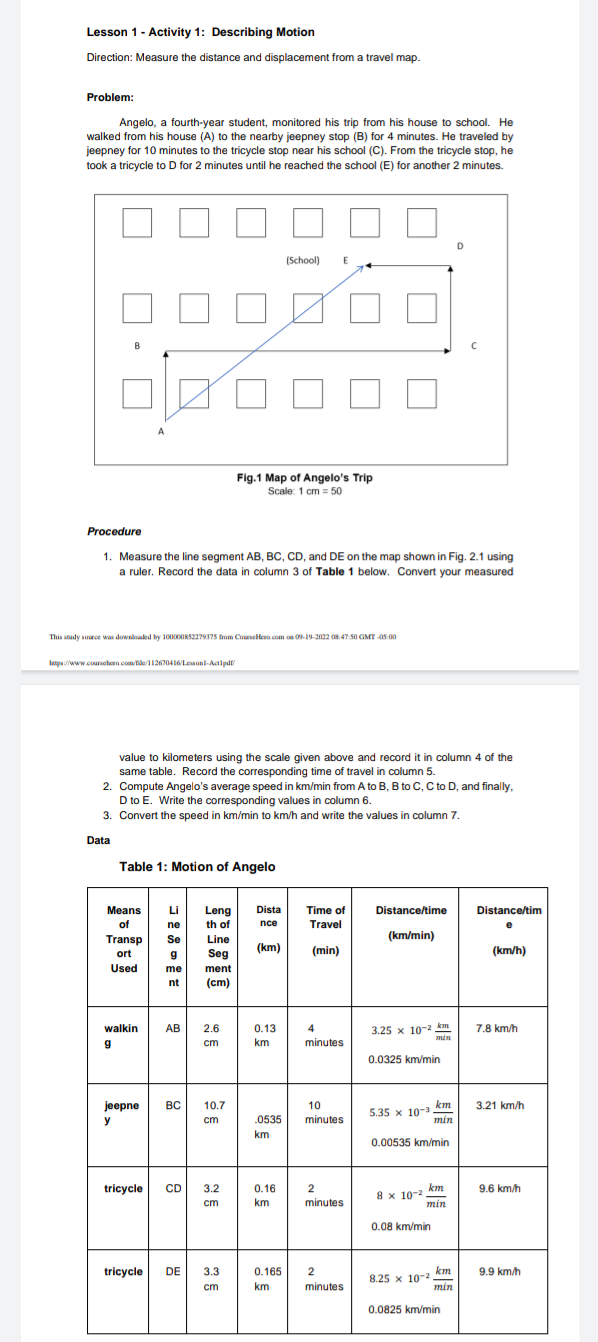
What's More .llictivityr 3.2.1: Solving Distance and Displacement Problems Direction: Use the data you obtained in Activity 3.1: Describing Motion to answer the following questions. Use separate sheet of paper. One point for each correct answer. 1. What was the total distance traveled by Angelo in km? 2. How long did it take him to reach the school\"? 3. What was his average speed in the first part of his trip? In the succeeding parts? 4. What is his average speed in the entire trip from his house to school? 5. What is his net displacement? (Hint: Draw a straight line from his house to school.) 6. Get the ratio of the distance that you measured in Q5 to the total time of travel. What does this ratio give you? Activity 3.2.2: Solving Speed and Velocity Problems Directions: Show your answers legibly. concisely and completely. Use separate sheet of paper. Five points for complete solution to each item. 1. A banca takes about 1.0 h to travel a distance of 15 km. A sailboat travels the same distance in [15 h. The same distance is travelled by a motorboat in 0.3 h. [a] Compute the average speed of each vessel. {b} Which vessel is the fastest? {c} Based on the data. how fast is the sailboat compared to the banca? 2. A car travels along a straight road for 100 meters, East in 4 seconds. then go the west for 5D meters in 1 second. Calculate the car's average speed and average velocity. Lesson 1 - Activity 1: Describing Motion Direction: Measure the distance and displacement from a travel map. Problem: Angelo, a fourth-year student, monitored his trip from his house to school. He walked from his house (A) to the nearby jeepney stop (B) for 4 minutes. He traveled by jeepney for 10 minutes to the tricycle stop near his school (C). From the tricycle stop, he took a tricycle to D for 2 minutes until he reached the school (E) for another 2 minutes. (School) B Fig.1 Map of Angelo's Trip Scale: 1 cm = 50 Procedure 1. Measure the line segment AB, BC, CD, and DE on the map shown in Fig. 2.1 using a ruler. Record the data in column 3 of Table 1 below. Convert your measured This study source was downloaded by 100000852279375 from CourseHero.com on 09-19-2022 09:47-50 CMT -05:00 hope:/www.couricher.com/file/1 12670416/Lessonl-Aclpat value to kilometers using the scale given above and record it in column 4 of the same table. Record the corresponding time of travel in column 5. 2. Compute Angelo's average speed in km/min from A to B, B to C, C to D, and finally, D to E. Write the corresponding values in column 6. 3. Convert the speed in km/min to km/h and write the values in column 7. Data Table 1: Motion of Angelo Means C Leng Dista Time of Distance/time Distance/tim of ne th of nce Travel Transp Se Line (km/min) (km) ort g Seg (min) (km/h) Used me ment nt (cm) walkin AB 2.6 0.13 3.25 x 10⁻² kit 7.8 km/h cm km minutes 0.0325 km/min jeepne BC 10.7 10 5.35 x 10⁻³ Am 3.21 km/h cm 0535 minutes min km 0.00535 km/min tricycle CD 3.2 0.16 2 8 x 10⁻² 4 9.6 km/h cm km minutes min 0.08 km/min tricycle DE 3.3 0.165 2 8.25 x 10⁻² km 9.9 km/h cm km minutes min 0.0825 km/min
Step by Step Solution
There are 3 Steps involved in it

Get step-by-step solutions from verified subject matter experts