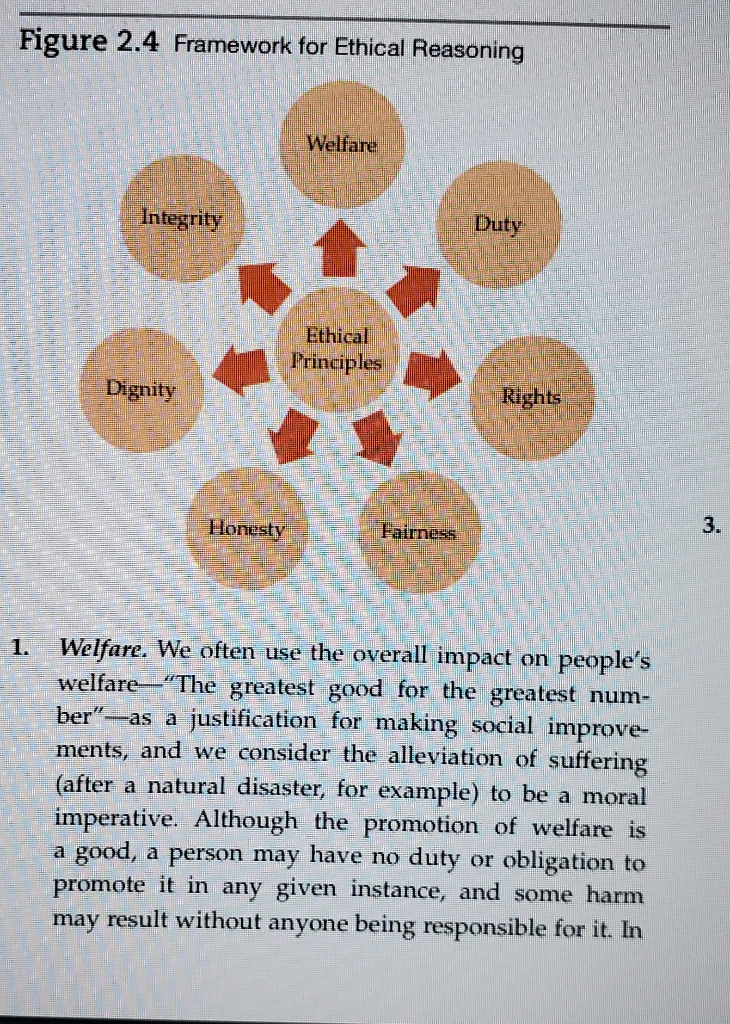
Question: what's the 7 Principle Framework and explain which principles are violated, and why? Provide appropriate reasoning (300 words paragraph) Figure 2.4 Framework for Ethical Reasoning
 what's the 7 Principle Framework and explain which principles are violated, and why? Provide appropriate reasoning (300 words paragraph)
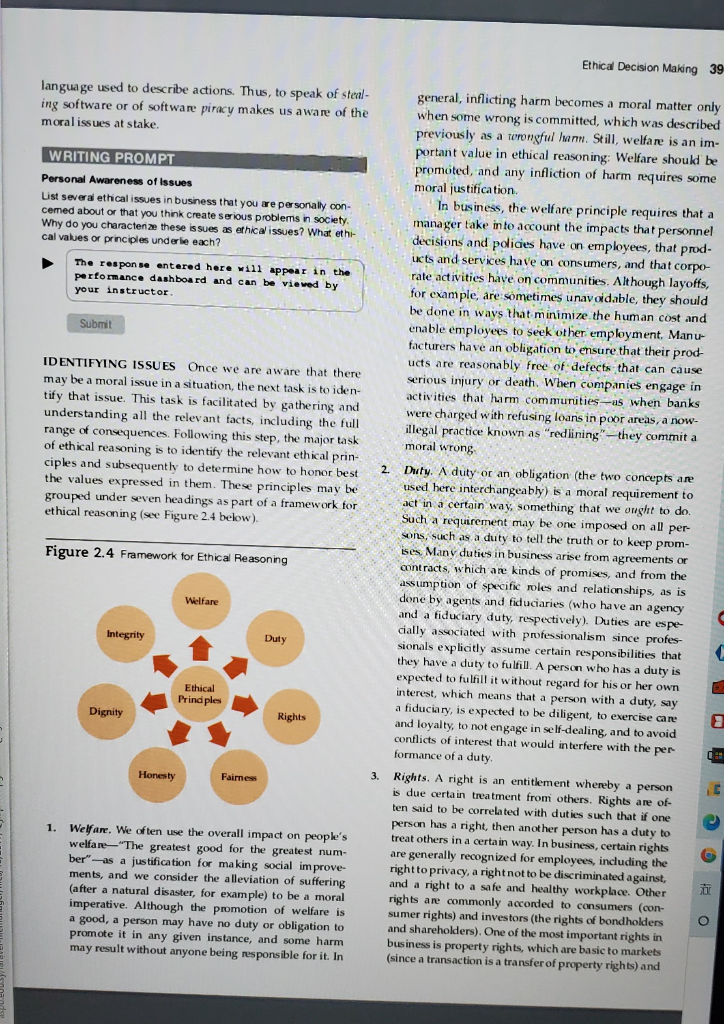
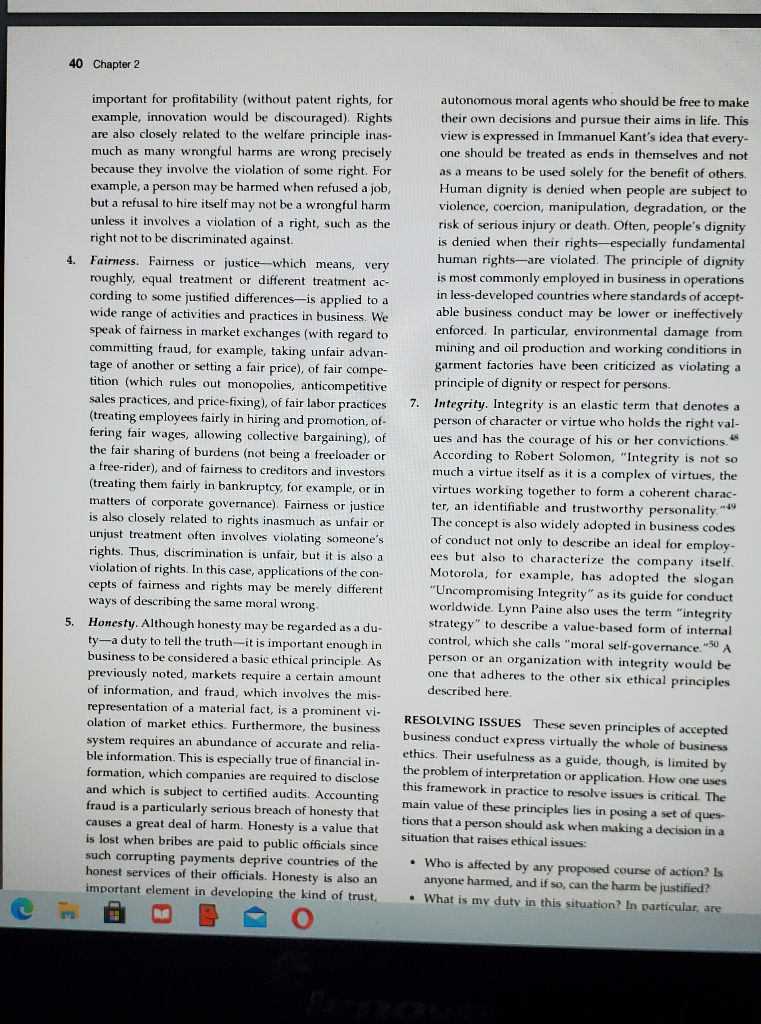
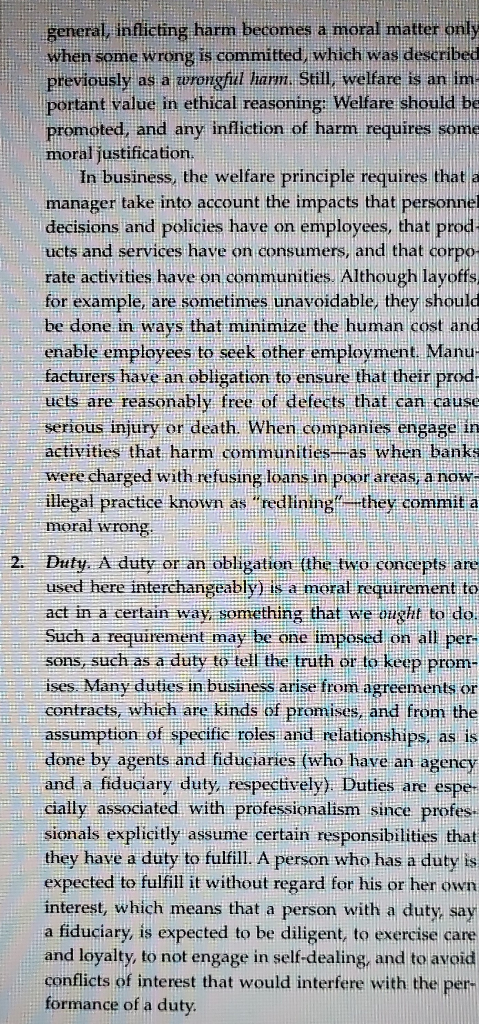
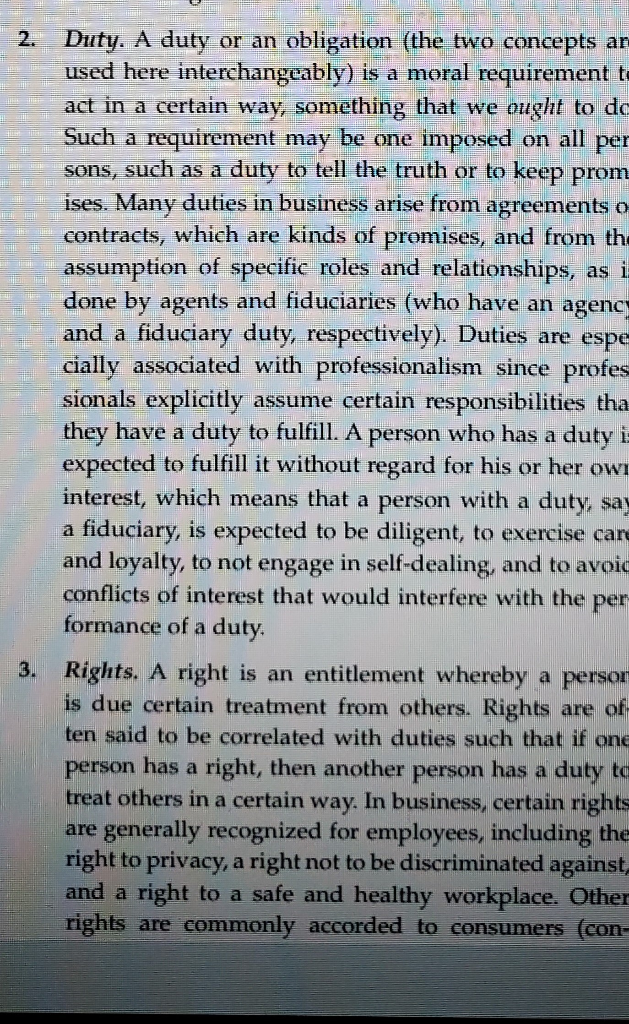
Figure 2.4 Framework for Ethical Reasoning Welfare Integrity Duty Ethical Principles Dignity Rights Honesty Fairness 3 . 1. Welfare. We often use the overall impact on people's welfare-"The greatest good for the greatest num- ber" "as a justification for making social improve ments, and we consider the alleviation of suffering (after a natural disaster, for example) to be a moral imperative. Although the promotion of welfare is a good, a person may have no duty or obligation to promote it in any given instance, and some harm may result without anyone being responsible for it. In general, inflicting harm becomes a moral matter only when some wrong is committed, which was described previously as a wrongful larm. Still, welfare is an im portant value in ethical reasoning: Welfare should be promoted, and any infliction of harm requires some moral justification In business, the welfare principle requires that a manager take into account the impacts that personnel decisions and policies have on employees, that prod ucts and services have on consumers, and that corpo rate activities have on communities. Although layoffs for example, are sometimes unavoidable, they should be done in ways that minimize the human cost and enable employees to seek other employment. Manu- facturers have an obligation to ensure that their prod- ucts are reasonably free of defects that can cause serious injury or death. When companies engage in activities that harm communities--as when bank: were charged with refusing loans in poor areas, a now- illegal practice known as "redlining" they commit a moral wrong 2. Duty. A duty or an obligation (the two concepts are used here interchangeably) is a moral requirement to act in a certain way, something that we ought to do. Such a requirement may be one imposed on all per- sons, such as a duty to tell the truth or lo keep prom- ises. Many duties in business arise from agreements or contracts, which are kinds of promises, and from the assumption of specific roles and relationships, as is done by agents and fiduciaries (who have an agency and a fiduciary duty, respectively). Duties are esper cially associated with professionalism since profes: sionals explicitly assume certain responsibilities that they have a duty to fulfill. A person who has a duty is expected to fulfill it without regard for his or her own interest, which means that a person with a duty, say a fiduciary, is expected to be diligent, to exercise care and loyalty, to not engage in self-dealing, and to avoid conflicts of interest that would interfere with the per- formance of a duty. 2. Duty. A duty or an obligation (the two concepts ar used here interchangeably) is a moral requirement to act in a certain way, something that we ought to de Such a requirement may be one imposed on all per sons, such as a duty to tell the truth or to keep prom ises. Many duties in business arise from agreements o contracts, which are kinds of promises, and from th assumption of specific roles and relationships, as is done by agents and fiduciaries (who have an agency and a fiduciary duty, respectively). Duties are espe cially associated with professionalism since profes sionals explicitly assume certain responsibilities tha they have a duty to fulfill. A person who has a duty is expected to fulfill it without regard for his or her own interest, which means that a person with a duty, say a fiduciary, is expected to be diligent, to exercise care and loyalty, to not engage in self-dealing, and to avoid conflicts of interest that would interfere with the per formance of a duty. 3. Rights. A right is an entitlement whereby a person is due certain treatment from others. Rights are of ten said to be correlated with duties such that if one person has a right, then another person has a duty to treat others in a certain way. In business, certain rights are generally recognized for employees, including the right to privacy, a right not to be discriminated against. and a right to a safe and healthy workplace. Other rights are commonly accorded to consumers (con- Ethical Decision Making 39 language used to describe actions. Thus, to speak of steval- ing software or of software piracy makes us aware of the moral issues at stake. WRITING PROMPT Personal Awareness of issues List several ethical issues in business that you are personally con- cemed about or that you think create serious problems in society Why do you characterize these issues as ethical issues? What eth- cal values or principles underle each? The response entered here will appear in the performance dashboard and can be viewed by your instructor Submit IDENTIFYING ISSUES Once we are aware that there may be a moral issue in a situation, the next task is to iden- tify that issue. This task is facilitated by gathering and understanding all the relevant facts, including the full range of consequences. Following this step, the major task of ethical reasoning is to identify the relevant ethical prin- ciples and subsequently to determine how to honor best the values expressed in them. These principles may be grouped under seven headings as part of a framework for ethical reasoning (see Figure 2.4 below). general, inflicting harm becomes a moral matter only when some wrong is committed, which was described previously as a wrongful lemn. Still, welfare is an im- portant value in ethical reasoning: Welfare should be promoted, and any infliction of harm requires some moral justification In business, the welfare principle requires that a manager take into account the impacts that personnel decisions and policies have on employees, that prod- ucts and services have on consumers, and that corpo- rate activities have on communities. Although layoffs, for example, are sometimes unavoidable, they should be done in ways that minimize the human cost and enable employees to seek other employment. Manu facturers have an obligation to ensure that their prod- ucts are reasonably free of defects that can cause serious injury or death. When companies engage in activities that harm communities-as when banks were charged with refusing loans in poor areas, a now- illegal practice known as "redlining"-they commit a moral wrong 2. Duty. A duty or an obligation (the two concepts are used here interchangeably) is a moral requirement to act in a certain way, something that we ought to do. Such a requirement may be one imposed on all per- sons, such as a duty to tell the truth or to keep prom- ises. Many duties in business arise from agreements or contracts, which are kinds of promises, and from the assumption of specific roles and relationships, as is done by agents and fiduciaries (who have an agency and a fiduciary duty, respectively). Duties are espe- sionals explicitly assume certain responsibilities that daly associated with professionalism since profes- they have a duty to fulfill A person who has a duty is expected to fulfill it without regard for his or her own which means that a person with a duty, say is expected to be diligent, to exercise care and loyalty, to not engage in self-dealing, and to avoid conflicts of interest that would interfere with the per formance of a duty 3. Rights. A right is an entitlement whereby a person is due certain treatment from others. Rights are of ten said to be correlated with duties such that if one person has a right, then another person has a duty to treat others in a certain way. In business, certain rights are generally recognized for employees, including the right to privacy, a right not to be discriminated against, and a right to a safe and healthy workplace. Other rights are commonly accorded to consumers (con- sumer rights) and investors (the rights of bondholders O and shareholders). One of the most important rights in business is property rights, which are basic to markets (since a transaction is a transfer of property rights) and Figure 2.4 Framework for Ethical Reasoning Welfare Integrity Duty Ethical Principles interest a fiduciary, is Dignity Rights Honesty Fairness 1 Welfare. We often use the overall impact on people's welfare-"The greatest good for the greatest num- ber"-as a justification for making social improve- ments, and we consider the alleviation of suffering (after a natural disaster, for example) to be a moral imperative. Although the promotion of welfare is a good, a person may have no duty or obligation to promote it in any given instance, and some harm may result without anyone being responsible for it. In 40 Chapter 2 important for profitability (without patent rights, for example, innovation would be discouraged). Rights are also closely related to the welfare principle inas- much as many wrongful harms are wrong precisely because they involve the violation of some right. For example, a person may be harmed when refused a job, but a refusal to hire itself may not be a wrongful harm unless it involves a violation of a right, such as the right not to be discriminated against. 4. Fairness. Fairness or justice-which means, very roughly, equal treatment or different treatment ac- cording to some justified differences-is applied to a wide range of activities and practices in business. We speak of fairness in market exchanges (with regard to committing fraud, for example, taking unfair advan- tage of another or setting a fair price), of fair compe- tition (which rules out monopolies, anticompetitive sales practices, and price-fixing), of fair labor practices (treating employees fairly in hiring and promotion, of fering fair wages, allowing collective bargaining), of the fair sharing of burdens (not being a freeloader or a free-rider), and of fairness to creditors and investors (treating them fairly in bankruptcy, for example, or in matters of corporate governance). Fairness or justice is also closely related to rights inasmuch as unfair or unjust treatment often involves violating someone's rights. Thus, discrimination is unfair, but it is also a violation of rights. In this case, applications of the con- cepts of fairness and rights may be merely different ways of describing the same moral wrong. 5. Honesty. Although honesty may be regarded as a du- ty-a duty to tell the truth-it is important enough in business to be considered a basic ethical principle. As previously noted, markets require a certain amount of information, and fraud, which involves the mis- representation of a material fact, is a prominent vi- olation of market ethics. Furthermore, the business requires an abundance of accurate and relia- ble information. This is especially true of financial in- formation, which companies are required to disclose and which is subject to certified audits. Accounting fraud is a particularly serious breach of honesty that causes a great deal of harm. Honesty is a value that is lost when bribes are paid to public officials since such corrupting payments deprive countries of the honest services their officials. Honesty is also an important element in developing the kind of trust. autonomous moral agents who should be free to make their own decisions and pursue their aims in life. This view is expressed in Immanuel Kant's idea that every- one should be treated as ends in themselves and not as a means to be used solely for the benefit of others. Human dignity is denied when people are subject to violence, coercion, manipulation, degradation, or the risk of serious injury or death. Often, people's dignity is denied when their rights-especially fundamental human rights-are violated. The principle of dignity is most commonly employed in business in operations in less-developed countries where standards of accept- able business conduct may be lower or ineffectively enforced. In particular, environmental damage from mining and oil production and working conditions in garment factories have been criticized as violating a principle of dignity or respect for persons. 7. Integrity. Integrity is an elastic term that denotes a person of character or virtue who holds the right val- ues and has the courage of his or her convictions According to Robert Solomon, "Integrity is not so much a virtue itself as it is a complex of virtues, the virtues working together to form a coherent charac- ter, an identifiable and trustworthy personality. 49 The concept is also widely adopted in business codes of conduct not only to describe an ideal for employ- ees but also to characterize the company itself. Motorola, for example, has adopted the slogan "Uncompromising Integrity" as its guide for conduct worldwide. Lynn Paine also uses the term "integrity strategy" to describe a value-based form of internal control, which she calls "moral self- If-governance A person or an organization with integrity would be one that adheres to the other six ethical principles described here system RESOLVING ISSUES These seven principles of accepted business conduct express virtually the whole of business ethics. Their usefulness as a guide, though, is limited by the problem of interpretation or application. How one uses this framework in practice to resolve issues is critical. The main value of these principles lies in posing a set of ques tions that a person should ask when making a decision in a situation that raises ethical issues Who is affected by any proposed course of action? Is anyone harmed, and if so, can the harm be justified? What is my duty in this situation? In particular, are









 Study Help