







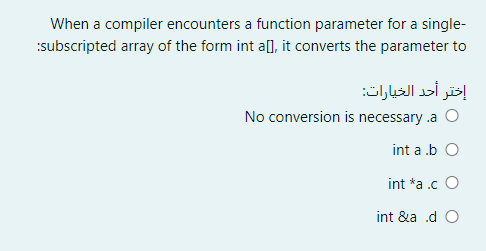
Question: When a compiler encounters a function parameter for a single- subscripted array of the form int a[], it converts the parameter to : No conversion
![array of the form int a[], it converts the parameter to :](https://dsd5zvtm8ll6.cloudfront.net/si.experts.images/questions/2024/09/66f5365f736c0_27166f5365f1b25d.jpg)
![in the ?; declaration int n[10] : n is a constant pointer](https://dsd5zvtm8ll6.cloudfront.net/si.experts.images/questions/2024/09/66f5366113fa6_27266f53660b6ffd.jpg)
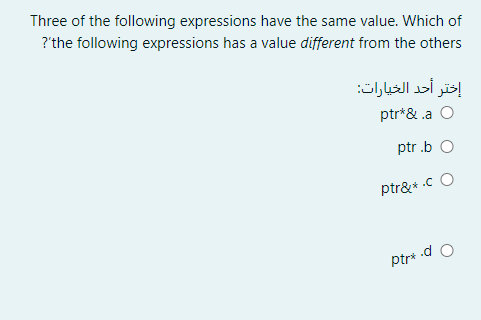
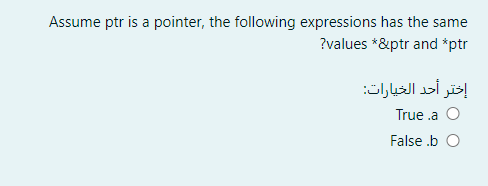
When a compiler encounters a function parameter for a single- subscripted array of the form int a[], it converts the parameter to : No conversion is necessary.a o int a .b O int *a.co int &a do Which of the following best describes the array name n in the ?; declaration int n[10] : n is a constant pointer to nonconstant data .a O n is a nonconstant pointer to nonconstant data.bo n is a nonconstant pointer to constant data.co n is a constant pointer to constant data.d O Three of the following expressions have the same value. Which of ? the following expressions has a value different from the others : ptr.bo ptr&*.co ptr*.do Assume ptr is a pointer, the following expressions has the same ?values * &ptr and *ptr ! True .a o False .bo .The is a relationship represents ! encapsulation .ao Composition .bo Aggregation.co inheritance.do
Step by Step Solution
There are 3 Steps involved in it

Get step-by-step solutions from verified subject matter experts
 Study Help