







Question: When a detection algorithm determines that a deadlock exists, the system must recover from the deadlock. The most common solution is to roll back one
When a detection algorithm determines that a deadlock exists, the system must recover from the deadlock. The most common solution is to roll back one or more transactions to break the deadlock. List the three actions that need to be taken using figure 16.19 to discuss.
link. https://my.uopeople.edu/pluginfile.php/388505/mod_book/chapter/178901/Database%20System%20Concepts%204th%20Edition%20By%20Silberschatz-Korth-Sudarshan.pdf
PLEASE LIST THE THREE ACTIONS THAT NEEDS TO BE TAKEN. DONT JUST EXPLAIN HOW TO BREAK THE DEADLOCK. THANKS!
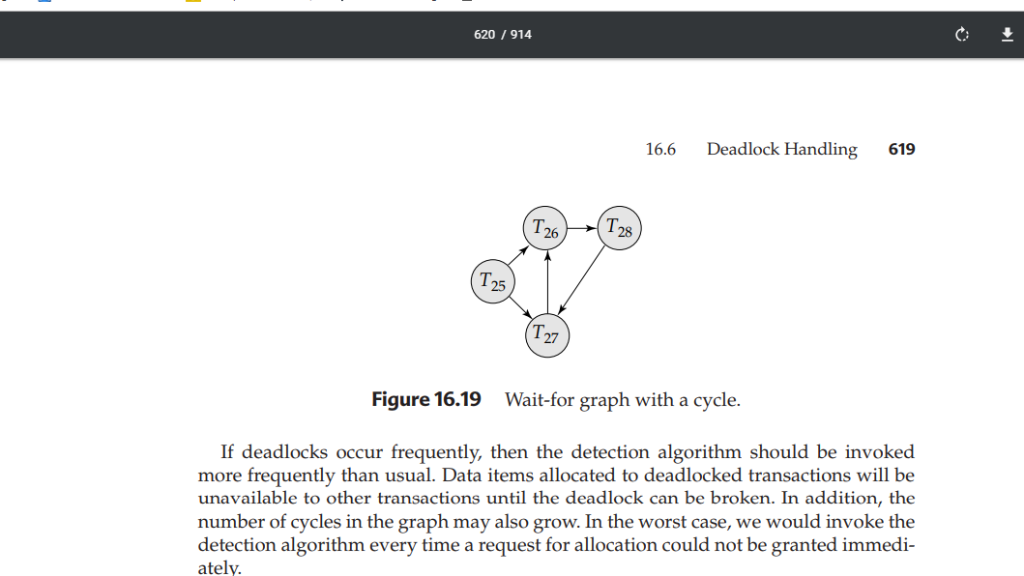
620/914 16.6 Deadlock Handling 619 26 28 25 27 Figure 16.19 Wait-for graph with a cycle. If deadlocks occur frequently, then the detection algorithm should be invoked more frequently than usual. Data items allocated to deadlocked transactions will be unavailable to other transactions until the deadlock can be broken. In addition, the number of cycles in the graph may also grow. In the worst case, we would invoke the detection algorithm every time a request for allocation could not be granted immedi- ately 620/914 16.6 Deadlock Handling 619 26 28 25 27 Figure 16.19 Wait-for graph with a cycle. If deadlocks occur frequently, then the detection algorithm should be invoked more frequently than usual. Data items allocated to deadlocked transactions will be unavailable to other transactions until the deadlock can be broken. In addition, the number of cycles in the graph may also grow. In the worst case, we would invoke the detection algorithm every time a request for allocation could not be granted immedi- ately
Step by Step Solution
There are 3 Steps involved in it

Get step-by-step solutions from verified subject matter experts
 Study Help