







Question: When a force F acts on an object at some distance r from a point P, called the pivot point, it can cause the
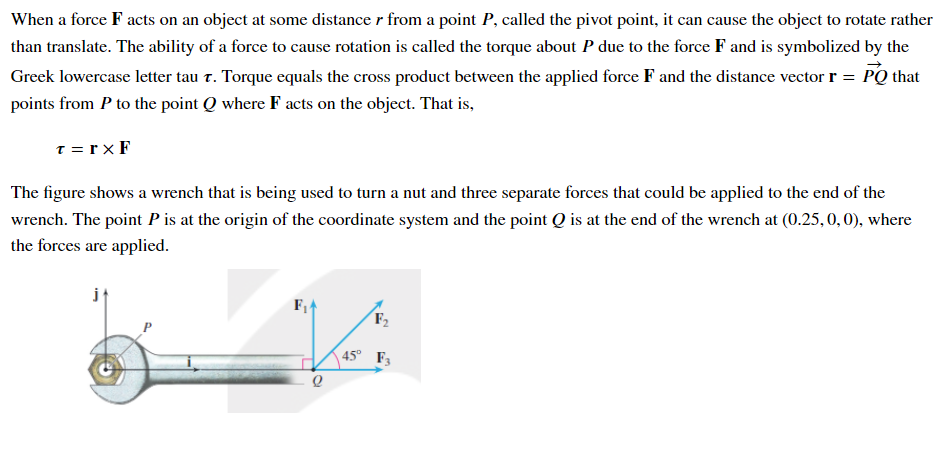
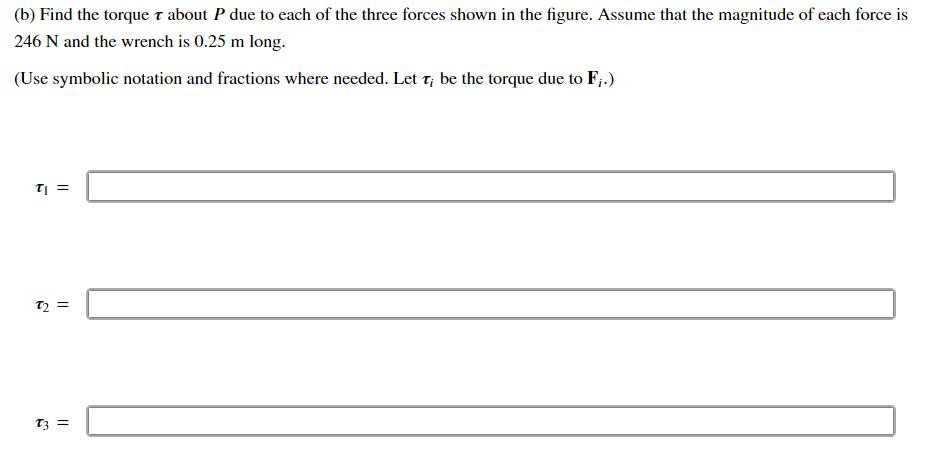
When a force F acts on an object at some distance r from a point P, called the pivot point, it can cause the object to rotate rather than translate. The ability of a force to cause rotation is called the torque about P due to the force F and is symbolized by the Greek lowercase letter tau 7. Torque equals the cross product between the applied force F and the distance vector r = PQ that points from P to the point Q where F acts on the object. That is, T = rx F The figure shows a wrench that is being used to turn a nut and three separate forces that could be applied to the end of the wrench. The point P is at the origin of the coordinate system and the point Q is at the end of the wrench at (0.25, 0, 0), where the forces are applied. F2 45 F3 (b) Find the torque r about P due to each of the three forces shown in the figure. Assume that the magnitude of each force is 246 N and the wrench is 0.25 m long. (Use symbolic notation and fractions where needed. Let t; be the torque due to F.) II T = T = T3 = Let P = (1,2,2), Q = (3,1,-3), R = (-2, -1,2). Find the area of the parallelogram with one vertex at P and sides PQ and PR. (Use symbolic notation and fractions where needed.) area: Find the sum of the cross products vxw and w x v, where v and w are two nonzero vectors. (Use symbolic notation and fractions where needed. Give your answer in the form a vector (*, *, *).) (V x W) + (w xv) =
Step by Step Solution
3.42 Rating (149 Votes )
There are 3 Steps involved in it
Torque Fdsin angle Where angle is between applied force and arm a F1 300 N d 14 m angle ... View full answer

Get step-by-step solutions from verified subject matter experts
 Study Help