







Question: When a foreign object lodged in the trachea forces a person to cough, the diaphragm thrusts upward, causing an increase in pressure in the lungs.
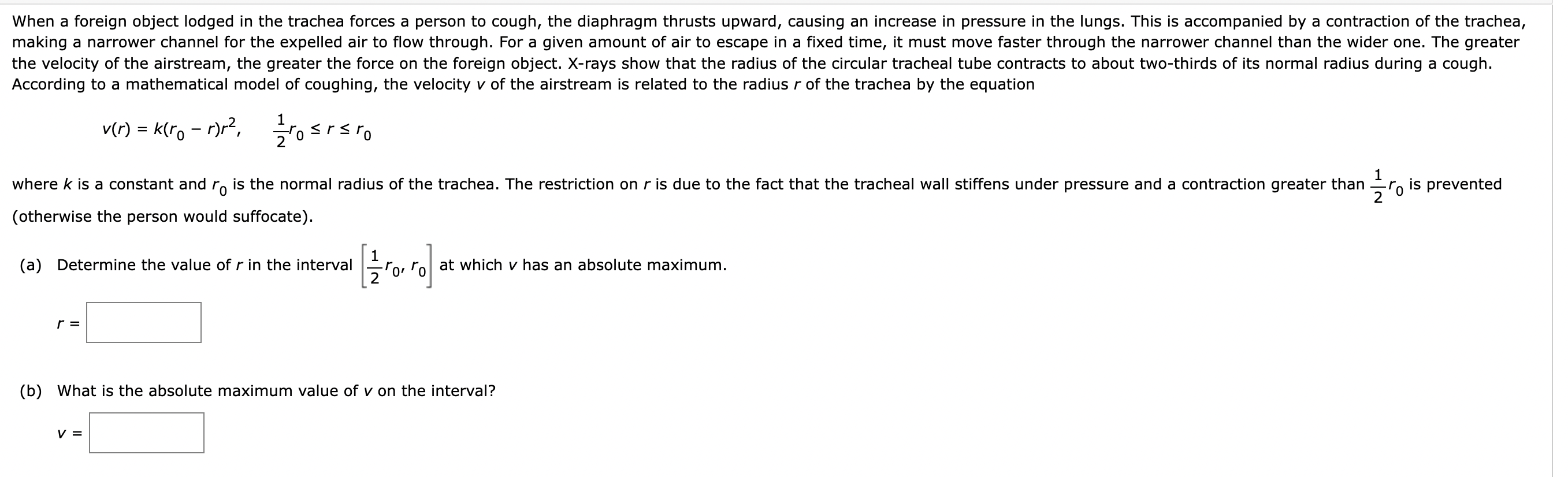
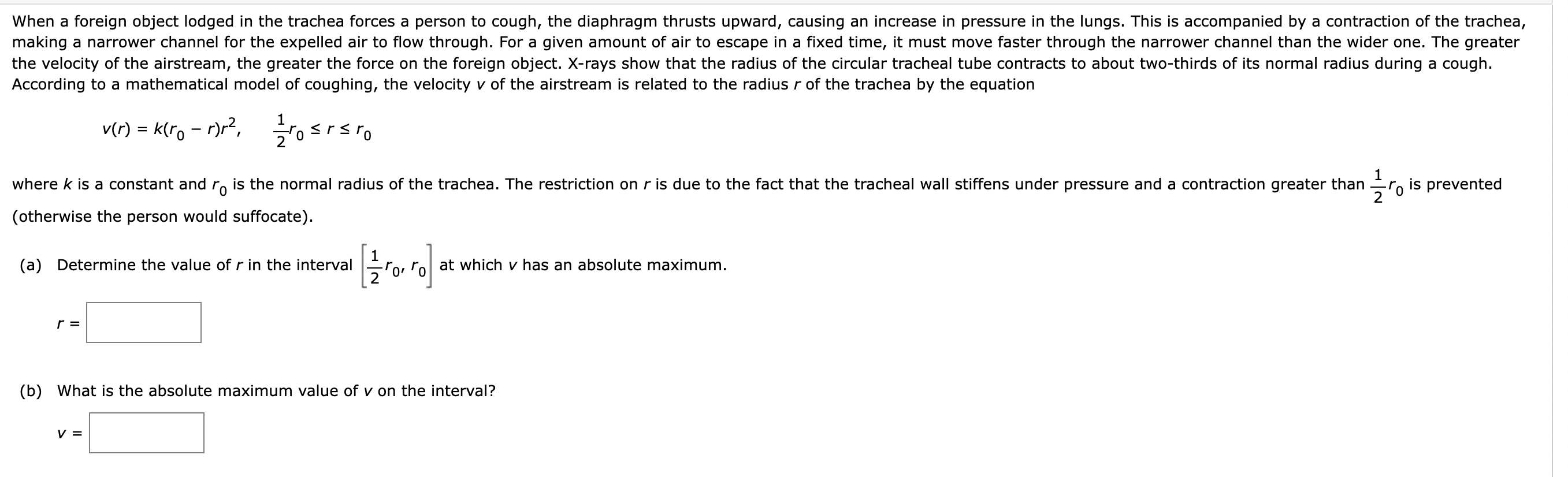
When a foreign object lodged in the trachea forces a person to cough, the diaphragm thrusts upward, causing an increase in pressure in the lungs. This is accompanied by a contraction of the trachea, making a narrower channel for the expelled air to ow through. For a given amount of air to escape in a xed time, it must move faster through the narrower channel than the wider one. The greater the velocity of the airstream, the greater the force on the foreign object. X-rays show that the radius of the circular tracheal tube contracts to about two-thirds of its normal radius during a cough. According to a mathematical model of coughing, the velocity v of the airstream is related to the radius rcf the trachea by the equation V(r) = k(ro r)r2, ro s r 5 r0 where k is a constant and r0 is the normal radius of the trachea. The restriction on r is due to the fact that the tracheal wall stiffens under pressure and a contraction greater than %"o is prevented (otherwise the person would suffocate). (a) Determine the value of r in the interval [%r0, r0] at which v has an absolute maximum. r: (b) What is the absolute maximum value of v on the interval? y=
Step by Step Solution
There are 3 Steps involved in it

Get step-by-step solutions from verified subject matter experts
 Study Help