



Question: When a non-current asset is sold the gain or loss on disposal is the difference between: Select one: a. Selling price and carrying amount
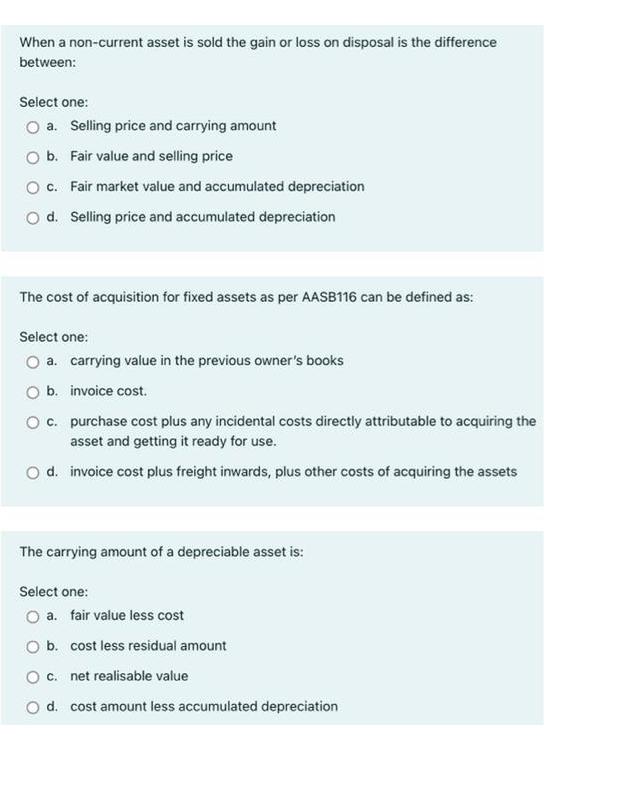
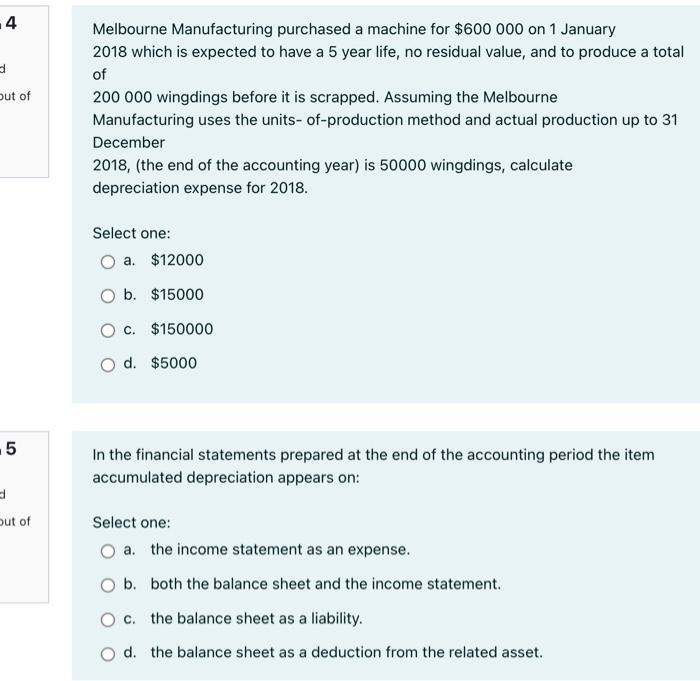
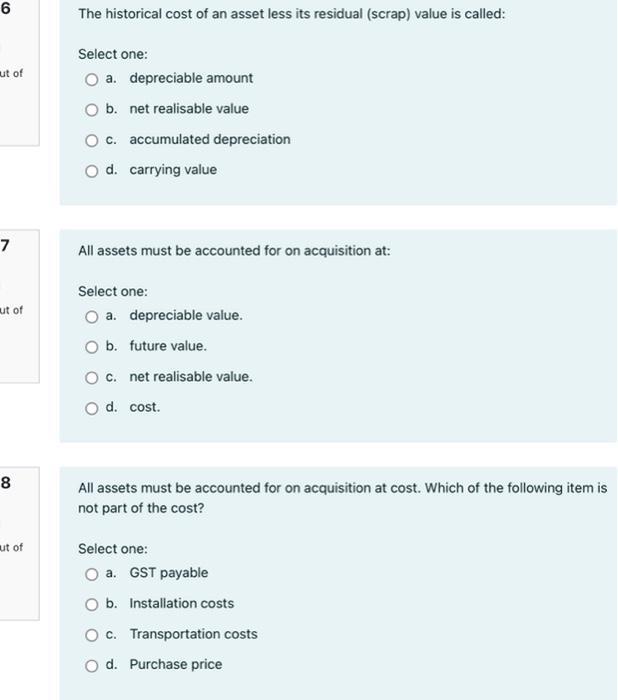
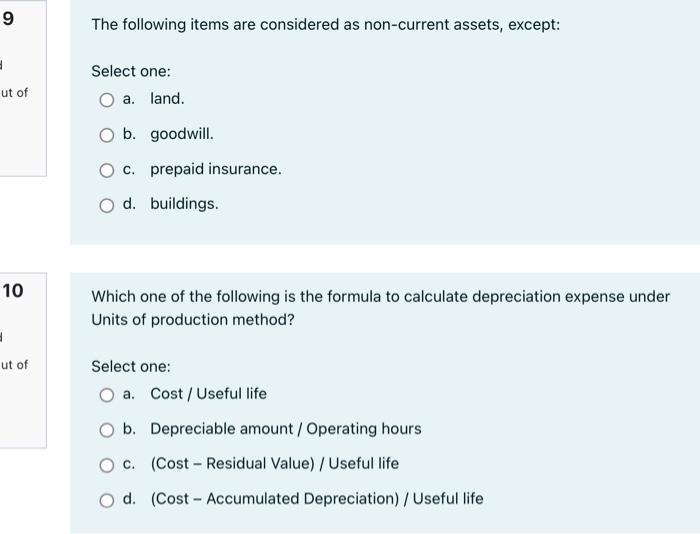
When a non-current asset is sold the gain or loss on disposal is the difference between: Select one: a. Selling price and carrying amount b. Fair value and selling price c. Fair market value and accumulated depreciation d. Selling price and accumulated depreciation The cost of acquisition for fixed assets as per AASB116 can be defined as: Select one: a. carrying value in the previous owner's books b. invoice cost. O c. purchase cost plus any incidental costs directly attributable to acquiring the asset and getting it ready for use. O d. invoice cost plus freight inwards, plus other costs of acquiring the assets The carrying amount of a depreciable asset is: Select one: a. fair value less cost b. cost less residual amount c. net realisable value d. cost amount less accumulated depreciation 4 d out of 5 d out of Melbourne Manufacturing purchased a machine for $600 000 on 1 January 2018 which is expected to have a 5 year life, no residual value, and to produce a total of 200 000 wingdings before it is scrapped. Assuming the Melbourne Manufacturing uses the units-of-production method and actual production up to 31 December 2018, (the end of the accounting year) is 50000 wingdings, calculate depreciation expense for 2018. Select one: a. $12000 O b. $15000 O c. $150000 O d. $5000 In the financial statements prepared at the end of the accounting period the item accumulated depreciation appears on: Select one: O a. the income statement as an expense. O b. both the balance sheet and the income statement. O c. the balance sheet as a liability. d. the balance sheet as a deduction from the related asset. 6 ut of 7 ut of 8 ut of The historical cost of an asset less its residual (scrap) value is called: Select one: O a. depreciable amount O b. net realisable value O c. accumulated depreciation O d. carrying value All assets must be accounted for on acquisition at: Select one: O a. depreciable value. O b. future value. O c. net realisable value. O d. cost. All assets must be accounted for on acquisition at cost. Which of the following item is not part of the cost? Select one: a. GST payable b. Installation costs O c. Transportation costs O d. Purchase price 9 3 ut of 10 3 ut of The following items are considered as non-current assets, except: Select one: a. land. O b. goodwill. O c. prepaid insurance. O d. buildings. Which one of the following is the formula to calculate depreciation expense under Units of production method? Select one: a. Cost/Useful life b. Depreciable amount / Operating hours O c. (Cost - Residual Value) /Useful life O d. (Cost Accumulated Depreciation) / Useful life -
Step by Step Solution
3.31 Rating (154 Votes )
There are 3 Steps involved in it
The detailed answer for the above question is provided below 1 When a noncurrent asset is sold the gain or loss on disposal is the difference between d Selling price and accumulated depreciation Expla... View full answer

Get step-by-step solutions from verified subject matter experts