







Question: When a star collapses it significantly shrinks in size and spins up. Consider a star with a mass of M = 2.2x1030 kg and
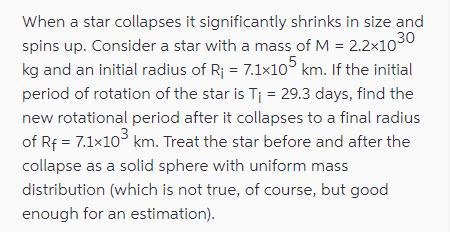
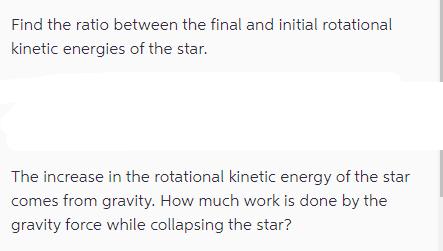
When a star collapses it significantly shrinks in size and spins up. Consider a star with a mass of M = 2.2x1030 kg and an initial radius of R = 7.1x10⁵ km. If the initial period of rotation of the star is T = 29.3 days, find the new rotational period after it collapses to a final radius of Rf = 7.1x10 km. Treat the star before and after the collapse as a solid sphere with uniform mass distribution (which is not true, of course, but good enough for an estimation). Find the ratio between the final and initial rotational kinetic energies of the star. The increase in the rotational kinetic energy of the star comes from gravity. How much work is done by the gravity force while collapsing the star?
Step by Step Solution
3.52 Rating (155 Votes )
There are 3 Steps involved in it
Solution To find the new rotational period of the star we can use the conservation of angular momentum which states that the product of the moment of ... View full answer

Get step-by-step solutions from verified subject matter experts
 Study Help