







Question: When a stream cipher is referred to a synchronous, what does this mean? How do the encryption and decryption operations differ in a binary additive
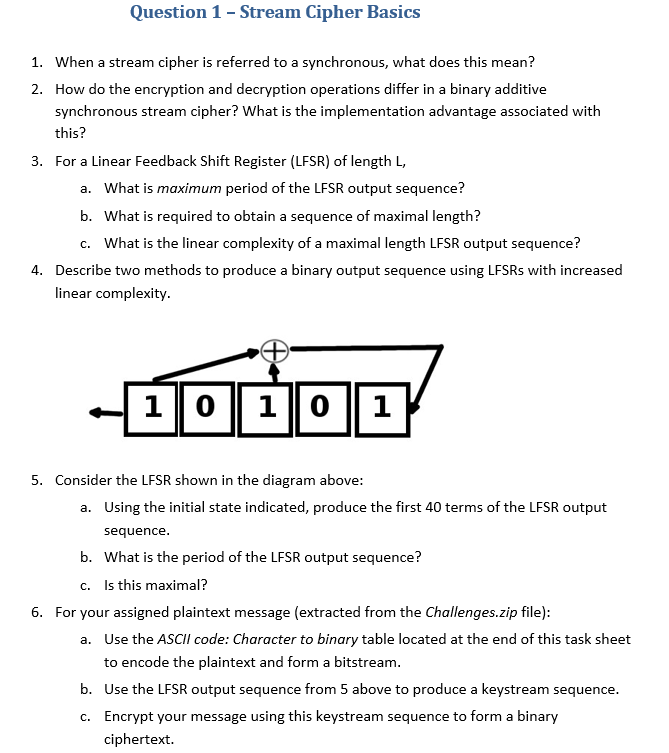
When a stream cipher is referred to a synchronous, what does this mean? How do the encryption and decryption operations differ in a binary additive synchronous stream cipher? What is the implementation advantage associated with this? For a Linear Feedback Shift Register (LFSR) of length L, a. What is maximum period of the LFSR output sequence? b. What is required to obtain a sequence of maximal length? c. What is the linear complexity of a maximal length LFSR output sequence? Describe two methods to produce a binary output sequence using LFSRs with increased linear complexity. Consider the LFSR shown in the diagram above: a. Using the initial state indicated, produce the first 40 terms of the LFSR output sequence. b. What is the period of the LFSR output sequence? c. Is this maximal? For your assigned plaintext message (extracted from the Challenges.zip file): a. Use the ASCII code: Character to binary table located at the end of this task sheet to encode the plaintext and form a bitstream. b. Use the LFSR output sequence from 5 above to produce a keystream sequence. c. Encrypt your message using this keystream sequence to form a binary ciphertext
Step by Step Solution
There are 3 Steps involved in it

Get step-by-step solutions from verified subject matter experts
 Study Help