



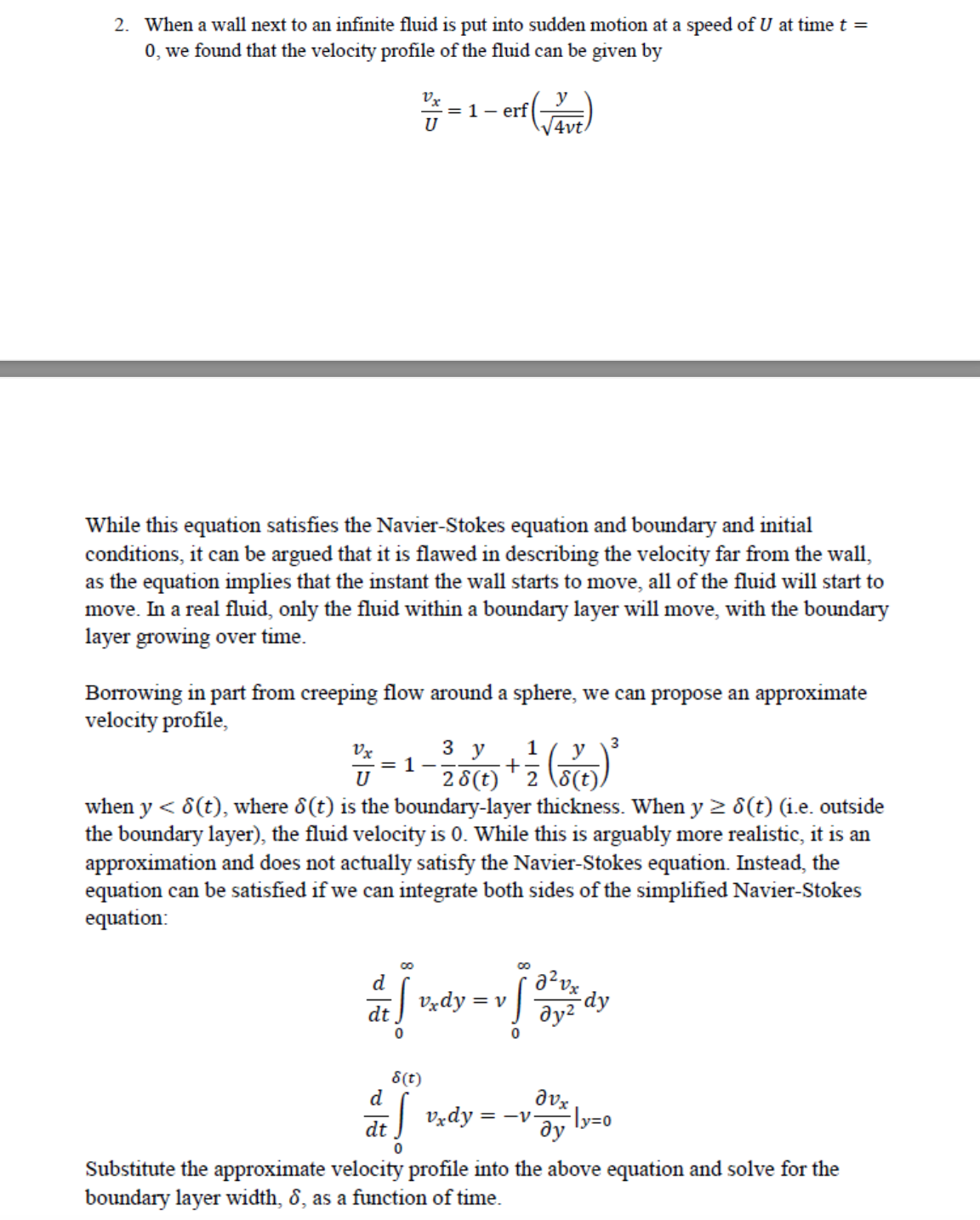
Question: When a wall next to an infinite fluid is put into sudden motion at a speed of U at time t = 0 , we
When a wall next to an infinite fluid is put into sudden motion at a speed of at time
we found that the velocity profile of the fluid can be given by
erf
While this equation satisfies the NavierStokes equation and boundary and initial
conditions, it can be argued that it is flawed in describing the velocity far from the wall,
as the equation implies that the instant the wall starts to move, all of the fluid will start to
move. In a real fluid, only the fluid within a boundary layer will move, with the boundary
layer growing over time.
Borrowing in part from creeping flow around a sphere, we can propose an approximate
velocity profile,
when where is the boundarylayer thickness. When ie outside
the boundary layer the fluid velocity is While this is arguably more realistic, it is an
approximation and does not actually satisfy the NavierStokes equation. Instead, the
equation can be satisfied if we can integrate both sides of the simplified NavierStokes
equation:
Substitute the approximate velocity profile into the above equation and solve for the
boundary layer width, as a function of time.
Step by Step Solution
There are 3 Steps involved in it
1 Expert Approved Answer
Step: 1 Unlock

Question Has Been Solved by an Expert!
Get step-by-step solutions from verified subject matter experts
Step: 2 Unlock
Step: 3 Unlock