Question: When Amancio Ortega, a former Spanish bathrobe maker, opened his first Zara clothing store, his business model was simple: sell high- fashion look-alikes to priceconscious
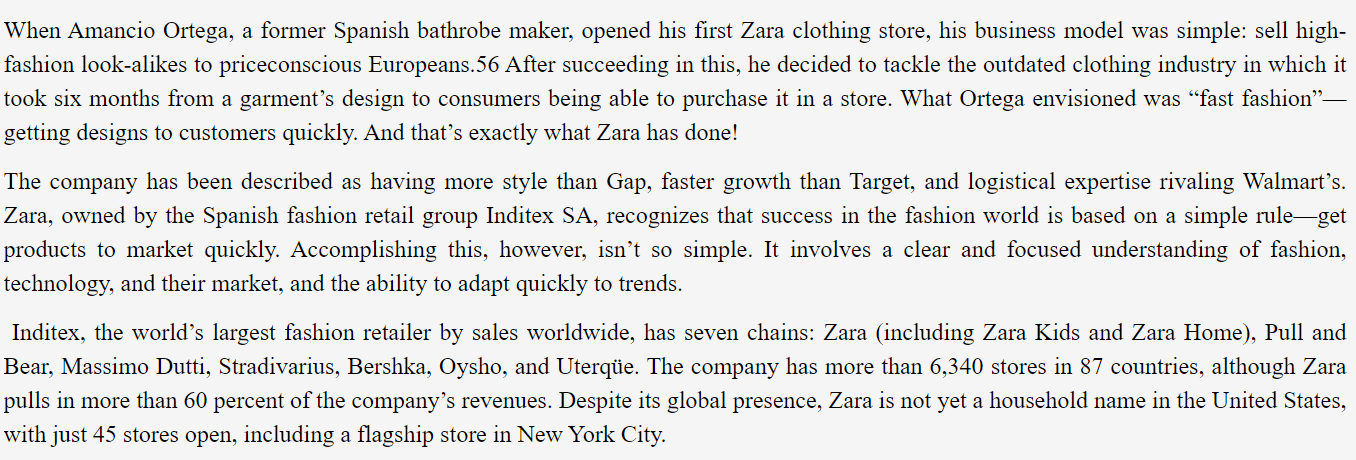
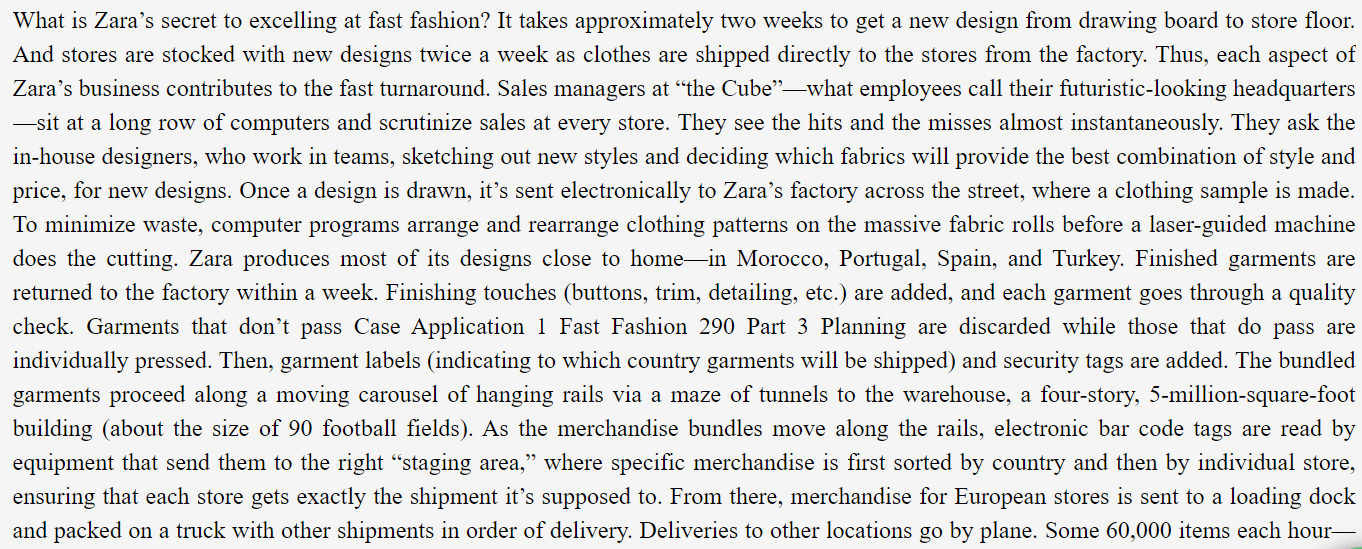
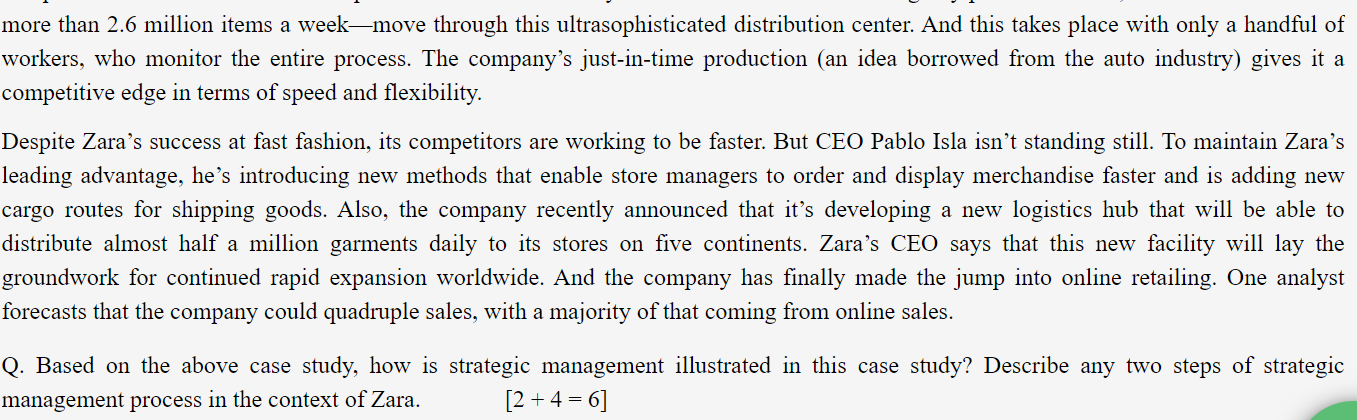
When Amancio Ortega, a former Spanish bathrobe maker, opened his first Zara clothing store, his business model was simple: sell high- fashion look-alikes to priceconscious Europeans.56 After succeeding in this, he decided to tackle the outdated clothing industry in which it took six months from a garment's design to consumers being able to purchase it in a store. What Ortega envisioned was fast fashion getting designs to customers quickly. And that's exactly what Zara has done! The company has been described as having more style than Gap, faster growth than Target, and logistical expertise rivaling Walmart's. Zara, owned by the Spanish fashion retail group Inditex SA, recognizes that success in the fashion world is based on a simple ruleget products to market quickly. Accomplishing this, however, isn't so simple. It involves a clear and focused understanding of fashion, technology, and their market, and the ability to adapt quickly to trends. Inditex, the world's largest fashion retailer by sales worldwide, has seven chains: Zara (including Zara Kids and Zara Home), Pull and Bear, Massimo Dutti, Stradivarius, Bershka, Oysho, and Uterqe. The company has more than 6,340 stores in 87 countries, although Zara pulls in more than 60 percent of the company's revenues. Despite its global presence, Zara is not yet a household name in the United States, with just 45 stores open, including a flagship store in New York City. What is Zara's secret to excelling at fast fashion? It takes approximately two weeks to get a new design from drawing board to store floor. And stores are stocked with new designs twice a week as clothes are shipped directly to the stores from the factory. Thus, each aspect of Zaras business contributes to the fast turnaround. Sales managers at the Cubewhat employees call their futuristic-looking headquarters sit at a long row of computers and scrutinize sales at every store. They see the hits and the misses almost instantaneously. They ask the in-house designers, who work in teams, sketching out new styles and deciding which fabrics will provide the best combination of style and price, for new designs. Once a design is drawn, it's sent electronically to Zara's factory across the street, where a clothing sample is made. To minimize waste, computer programs arrange and rearrange clothing patterns on the massive fabric rolls before a laser-guided machine does the cutting. Zara produces most of its designs close to homein Morocco, Portugal, Spain, and Turkey. Finished garments are returned to the factory within a week. Finishing touches (buttons, trim, detailing, etc.) are added, and each garment goes through a quality check. Garments that don't pass Case Application 1 Fast Fashion 290 Part 3 Planning are discarded while those that do pass are individually pressed. Then, garment labels (indicating to which country garments will be shipped) and security tags are added. The bundled garments proceed along a moving carousel of hanging rails via a maze of tunnels to the warehouse, a four-story, 5-million-square-foot building (about the size of 90 football fields). As the merchandise bundles move along the rails, electronic bar code tags are read by equipment that send them to the right staging area, where specific merchandise is first sorted by country and then by individual store, ensuring that each store gets exactly the shipment it's supposed to. From there, merchandise for European stores is sent to a loading dock and packed on a truck with other shipments in order of delivery. Deliveries to other locations go by plane. Some 60,000 items each hour- more than 2.6 million items a weekmove through this ultrasophisticated distribution center. And this takes place with only a handful of workers, who monitor the entire process. The company's just-in-time production (an idea borrowed from the auto industry) gives it a competitive edge in terms of speed and flexibility. Despite Zara's success at fast fashion, its competitors are working to be faster. But CEO Pablo Isla isn't standing still. To maintain Zara's leading advantage, hes introducing new methods that enable store managers to order and display merchandise faster and is adding new cargo routes for shipping goods. Also, the company recently announced that it's developing a new logistics hub that will be able to distribute almost half a million garments daily to its stores on five continents. Zara's CEO says that this new facility will lay the groundwork for continued rapid expansion worldwide. And the company has finally made the jump into online retailing. One analyst forecasts that the company could quadruple sales, with a majority of that coming from online sales. Q. Based on the above case study, how is strategic management illustrated in this case study? Describe any two steps of strategic management process in the context of Zara. [2 + 4 = 6]




