







Question: When analyzing a company's valuation using financial ratios, which statement accurately describes the use of P/E (Price-to-Earnings), P/B (Price-to-Book), and P/S (Price-to-Sales) ratios? The
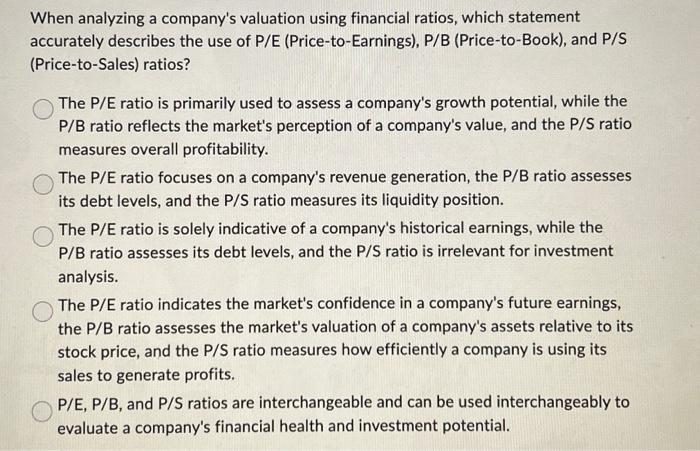
When analyzing a company's valuation using financial ratios, which statement accurately describes the use of P/E (Price-to-Earnings), P/B (Price-to-Book), and P/S (Price-to-Sales) ratios? The P/E ratio is primarily used to assess a company's growth potential, while the P/B ratio reflects the market's perception of a company's value, and the P/S ratio measures overall profitability. The P/E ratio focuses on a company's revenue generation, the P/B ratio assesses its debt levels, and the P/S ratio measures its liquidity position. The P/E ratio is solely indicative of a company's historical earnings, while the P/B ratio assesses its debt levels, and the P/S ratio is irrelevant for investment analysis. The P/E ratio indicates the market's confidence in a company's future earnings, the P/B ratio assesses the market's valuation of a company's assets relative to its stock price, and the P/S ratio measures how efficiently a company is using its sales to generate profits. P/E, P/B, and P/S ratios are interchangeable and can be used interchangeably to evaluate a company's financial health and investment potential.
Step by Step Solution
There are 3 Steps involved in it

Get step-by-step solutions from verified subject matter experts
 Study Help