







Question: When answering each question please provide which answer belongs to which letter. thank you! 4. Tablet Company is looking to set up a wholly owned
When answering each question please provide which answer belongs to which letter. thank you!
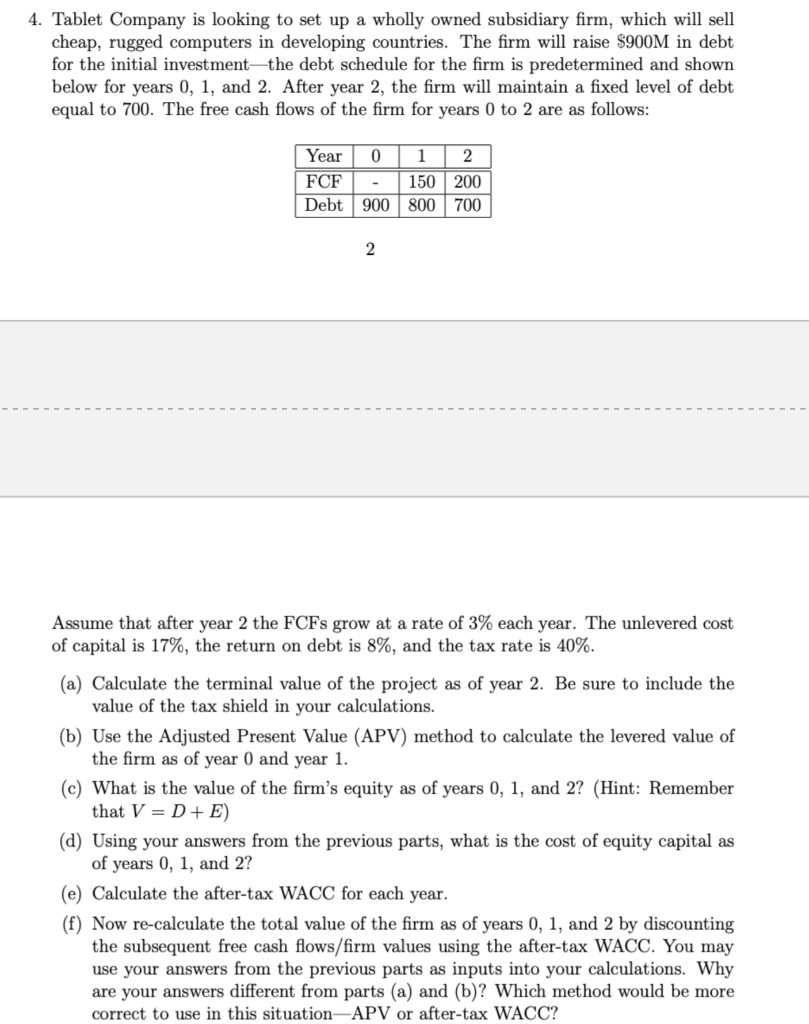
4. Tablet Company is looking to set up a wholly owned subsidiary firm, which will sell cheap, rugged computers in developing countries. The firm will raise $900M in debt for the initial investmentthe debt schedule for the firm is predetermined and shown below for years 0, 1, and 2. After year 2, the firm will maintain a fixed level of debt equal to 700. The free cash flows of the firm for years 0 to 2 are as follows: Year 0 1 2 FCF 150 200 Debt 900 800 700 2 Assume that after year 2 the FCFs grow at a rate of 3% each year. The unlevered cost of capital is 17%, the return on debt is 8%, and the tax rate is 40%. (a) Calculate the terminal value of the project as of year 2. Be sure to include the value of the tax shield in your calculations. (b) Use the Adjusted Present Value (APV) method to calculate the levered value of the firm as of year 0 and year 1. (c) What is the value of the firm's equity as of years 0, 1, and 2? (Hint: Remember that V = D+E) (d) Using your answers from the previous parts, what is the cost of equity capital as of years 0, 1, and 2? (e) Calculate the after-tax WACC for each year. (f) Now re-calculate the total value of the firm as of years 0, 1, and 2 by discounting the subsequent free cash flows/firm values using the after-tax WACC. You may use your answers from the previous parts as inputs into your calculations. Why are your answers different from parts (a) and (b)? Which method would be more correct to use in this situation-APV or after-tax WACC? 4. Tablet Company is looking to set up a wholly owned subsidiary firm, which will sell cheap, rugged computers in developing countries. The firm will raise $900M in debt for the initial investmentthe debt schedule for the firm is predetermined and shown below for years 0, 1, and 2. After year 2, the firm will maintain a fixed level of debt equal to 700. The free cash flows of the firm for years 0 to 2 are as follows: Year 0 1 2 FCF 150 200 Debt 900 800 700 2 Assume that after year 2 the FCFs grow at a rate of 3% each year. The unlevered cost of capital is 17%, the return on debt is 8%, and the tax rate is 40%. (a) Calculate the terminal value of the project as of year 2. Be sure to include the value of the tax shield in your calculations. (b) Use the Adjusted Present Value (APV) method to calculate the levered value of the firm as of year 0 and year 1. (c) What is the value of the firm's equity as of years 0, 1, and 2? (Hint: Remember that V = D+E) (d) Using your answers from the previous parts, what is the cost of equity capital as of years 0, 1, and 2? (e) Calculate the after-tax WACC for each year. (f) Now re-calculate the total value of the firm as of years 0, 1, and 2 by discounting the subsequent free cash flows/firm values using the after-tax WACC. You may use your answers from the previous parts as inputs into your calculations. Why are your answers different from parts (a) and (b)? Which method would be more correct to use in this situation-APV or after-tax WACC
Step by Step Solution
There are 3 Steps involved in it

Get step-by-step solutions from verified subject matter experts
 Study Help